CHAPTER
Env-A 1200 VOLATILE ORGANIC COMPOUNDS
(VOCs) REASONABLY AVAILABLE CONTROL TECHNOLOGY (RACT)
Statutory
Authority: RSA 125-C:4, RSA 125-C:6, II,
XIV, RSA 125-C:11, I, RSA 125-C:12, IV
REVISION NOTE:
Document #9933, effective 6-1-11,
readopted with amendments and renumbered rules in the former Part Env-A 1204
entitled “Stationary Sources of Volatile Organic Compounds (VOCs)” as rules in
Chapter Env-A 1200, entitled “Volatile Organic Compounds (VOCs) Reasonably
Available Control Technology (RACT)”.
Chapter Env-A 1200 had formerly been entitled “Prevention, Abatement,
and Control of Stationary Source Air Pollution.” Document #9933 also adopted various new rules
in the new Chapter Env-A 1200.
Document #9933 supersedes all prior
filings for rules in the former Env-A 1204.
The filings prior to Document #9933 affecting rules in the former Env-A
1204 and its predecessor rules include the following documents:
#1376, eff 7-1-79 #5309,
eff 1-17-92
#1717, eff 2-19-81 #5505,
eff 11-15-92
#1734, eff 3-25-81 #6016,
INTERIM, eff 4-14-95, EXPIRED: 8-12-95
#2332, eff 4-29-83 #6087,
eff 8-31-95
#2381, eff 6-17-83 #6838,
eff 8-27-98
#2459, eff 8-31-83 #7060,
eff 7-22-99
#2938, eff 12-27-84 #7812,
eff 12-31-02
#4703, eff 11-16-89 #8293,
eff 2-16-05
#5033, eff 12-27-90 #9838,
INTERIM, eff 12-31-10
Prior
to Document #9933, some parts in the former Chapter Env-A 1200 had been
readopted with amendments and renumbered, and other parts had expired, as
follows:
Former
Rule Existing Rule
and Original Document
Env-A
1201 Env-A 1900, #6483-B, eff 4-1-97
Env-A
1202 Env-A 2000, #6505-B, eff 5-1-97
Env-A
1203 Env-A 2100, #6428-B, eff 1-18-97
Env-A
1205 Env-Wm 1404, #8141, eff 8-21-04
Env-A
1208 Env-A 2600, #6724-B, eff 3-28-98
Env-A
1211 Env-A 1300, #9803, eff 10-31-10
Former
Rule Final Document
and Expiration Date
Env-A 1206 #5033, eff 12-27-90 as Env-A 1205, renumbered as
Env-A 1206 by #5446, and EXPIRED 12-27-96
Env-A 1207 #5033, eff 12-27-90 as Env-A 1206, renumbered as
Env-A 1207 by #5446, and EXPIRED 12-27-96
Env-A 1209 #5033, eff 12-27-90 as Env-A 1207, renumbered as
Env-A 1208 by #5264, and Env-A 1209 by #5446, and EXPIRED 12-27-96
Env-A 1210 #5033, eff 12-27-90 as Env-A 1208, renumbered as
Env-A 1209 by #5264 and as Env-A 1210 by #5446, and EXPIRED 12-27-96
Env-A 1202, as filed in Document
#5033, eff 12-27-90, and readopted as an interim rule in Document #6425, eff
1-1-97, had been allowed to expire 5-9-97 after being replaced by Env-A 2000,
adopted in Document #6505-B, effective 5-1-97.
Env-A 1205, as filed in Document
#5033, had been renumbered, but not readopted, as Env-A 1206 by Document #5446, which had
adopted a new rule Env-A 1205, effective 8-17-92. This new Env-A 1205 was subsequently
readopted with amendments and renumbered as Env-Wm 1404 by Document #8141,
effective 8-21-04.
Env-A 1207 was adopted as a new rule
in Document #5264, effective 10-31-91, which also repealed Env-A 1206.03 as
filed in Document #5033. Env-A 1207 was
subsequently renumbered, but not readopted, as Env-A 1208 by Document #5446,
and readopted as an interim rule by Document #6618, effective 10-31-97, which
expired 2-28-98. Env-A 1208 was
subsequently readopted with amendments and renumbered as Env-A 2600, effective
3-28-98.
PART
Env-A 1201 PURPOSE AND APPLICABILITY
Env-A 1201.01 Purpose. The purpose of this chapter is to establish
requirements for the implementation of reasonably available control
technology (RACT) on certain stationary sources located in New Hampshire which
emit volatile organic compounds (VOCs), as required to comply with sections
172(c)(1) and 182(b)(2) of the Clean Air Act.
Source. (See Revision Note at chapter heading for
Env-A 1200) #9933, eff 6-1-11; ss by #12899, eff 10-17-19
Env-A 1201.02 Effect on Prior Rules. The requirements in Env-A 1200, as effective
on June 1, 2011, shall not relieve any source that was subject to any previous
version of Env-A 1204 from its obligation to have been
in compliance with applicable rules as then in effect.
Source. (See Revision Note at chapter heading for
Env-A 1200) #9933, eff 6-1-11; ss by #12899, eff 10-17-19
Env-A 1201.03 Applicability.
(a)
This chapter shall apply to processes and devices in the following
stationary source categories which emit or have the potential to emit the threshold amounts
of VOCs specified
in the cited part:
(1)
Metal can
coating, Env-A 1206;
(2)
Paper, fabric, film, and foil substrates coating, Env-A 1207;
(3)
Vinyl or urethane substrate coating, Env-A 1208;
(4)
Metal furniture coating, Env-A 1209;
(5)
Magnetic wire insulation coating, Env-A 1210;
(6)
Metal coils coating, Env-A 1211;
(7)
Miscellaneous metal parts and products
coating, Env-A 1212;
(8)
Miscellaneous plastic
parts and products coating, Env-A 1212;
(9)
Wood furniture, burial caskets, and gunstock coating, Env-A 1213;
(10)
Flat wood paneling coating, Env-A 1214;
(11)
Rotogravure and flexographic printing, Env-A 1215;
(12)
Offset lithographic and letterpress printing, Env-A 1216;
(13)
Fixed-roof VOL storage tanks, Env-A 1217.01 and Env-A 1217.02;
(14)
External floating roof tanks, Env-A 1217.03 and Env-A 1217.04;
(15)
Bulk gasoline loading terminals, Env-A 1217.05 through Env-A 1217.07;
(16)
Bulk gasoline plants, Env-A 1217.08 and Env-A 1217.09;
(17)
Cutback and emulsified asphalt, Env-A 1218;
(18)
Fiberglass boat manufacturing, Env-A 1219;
(19)
Miscellaneous industrial adhesives, Env-A 1220;
(20)
Industrial cleaning solvents, Env-A 1221.05 through Env-A 1221.07;
(21) Solvent metal cleaning, Env-A 1221.01 through
Env-A 1221.04;
(22)
Miscellaneous stationary VOC sources, Env-A 1222; and
(23)
Multicategory stationary VOC sources, Env-A 1222.
(b)
Any stationary source that first becomes subject to the requirements of
a source category listed in (a), above, after June 1, 2011, whether through new
source construction or modification of an existing source, shall meet those
requirements upon startup of the new or modified source.
(c)
Once a stationary source becomes subject to the requirements of a source
category listed in (a), above, the source shall remain subject to those requirements
even if its emissions later fall below the relevant RACT applicability
threshold.
(d)
This chapter shall apply to any person who sells or offers for sale any
solvent for use in a cold cleaning machine.
Source. (See Revision Note at chapter heading for
Env-A 1200) #9933, eff 6-1-11; ss by #12899, eff 10-17-19
Env-A 1201.04 Exemptions; Conditions.
(a) Any source with coating, printing, or
miscellaneous devices or processes that meets or exceeds the relevant RACT
applicability criteria in Env-A 1206.01, Env-A 1208.01, Env-A 1210.01, Env-A
1211.01, Env-A 1213.01, Env-A 1215.01, or Env-A 1222.01, or that are
unclassifiable, shall be exempt from the applicable compliance requirements in
this chapter only if all of the following conditions are met:
(1)
The source accepts
an enforceable permit containing restrictions that limit the combined actual
VOC emissions during any consecutive 12-month period from all process
operations associated with a specific classifiable process or device to below
the relevant applicability threshold for that classifiable process or device;
(2)
The source has been and remains in full compliance with the conditions
of the permit since the date of issuance or the terms of any consent decree entered into by the division or by EPA, or pursuant to any
court order;
(3)
The actual VOC emissions of the source, or from all operations
associated with the applicable VOC category, have not exceeded the relevant
RACT applicability threshold in any calendar year since May 31, 1995;
(4)
The enforceable permit contains testing provisions as necessary to
demonstrate compliance with permit restrictions, pursuant to Env-A 800; and
(5)
The enforceable permit contains recordkeeping and reporting provisions
as necessary to demonstrate compliance with the permit restrictions, pursuant
to Env-A 903, Env-A 904, and Env-A 908, respectively.
(b)
If a classifiable process or device that was not subject to this chapter
prior to June 1, 2011 meets or exceeds the applicability threshold for its VOC
category as specified in Env-A 1207.01, Env-A 1209.01, Env-A 1212.01, Env-A
1214.01, Env-A 1215.06, Env-A 1216.01, Env-A 1219.01, Env-A 1220.01, or Env-A
1221.06 on June 1, 2011, the classifiable process or device shall be exempt
from the applicable compliance provisions only if all of the following
conditions are met:
(1)
The owner or operator accepts an enforceable permit containing
restrictions that limit the combined actual VOC emissions during any
consecutive 12-month period from all process operations associated with a specific
classifiable process or device below the relevant applicability threshold for
that process or device;
(2)
The source has been and remains in full compliance with the conditions
of the permit since the date of issuance or the terms of any consent decree entered into by the division or by EPA, or pursuant to any
court order;
(3)
The actual VOC emissions of the source, or from all operations
associated with the applicable VOC category, have not exceeded the relevant
RACT applicability threshold in any calendar year since June 1, 2011;
(4)
The enforceable permit contains testing provisions as necessary to
demonstrate compliance with permit restrictions, pursuant to Env-A 800; and
(5)
The enforceable permit contains recordkeeping and reporting provisions
as necessary to demonstrate compliance with the permit restrictions, pursuant
to Env-A 903, Env-A 904, and Env-A 908.
(c)
One or more minor core activities of VOCs at a stationary source having total
aggregate actual emissions of less than 5 tons per year combined for all
classifiable and unclassifiable processes or devices,
shall be exempt from the provisions of this chapter.
(d)
Testing and research activities performed at coating, printing, or
miscellaneous sources shall be exempt from the provisions of this chapter
provided that the combined VOC emissions from such activities do not exceed 5
tons per consecutive
12-month period.
(e)
For purposes of demonstrating that a source is not subject to this
chapter, the owner or operator of such source shall maintain, for 5 years and
for each process chemical used, monthly purchase records and safety data sheets
(SDS), as used to comply with the Occupational Safety and Health
Administration’s hazard communication standard at 29 CFR 1910.1200, sufficient
to show that VOC emissions are below the applicability threshold for that
source’s category.
Source. (See Revision Note at chapter heading for
Env-A 1200) #9933, eff 6-1-11; amd by #10145, eff
6-19-12; ss by #12899, eff 10-17-19
PART
Env-A 1202 DEFINITIONS: A THROUGH F
Env-A 1202.01 “Acrylonitrile-butadiene-styrene welding (ABS
welding)” means any process to weld acrylonitrile-butadiene-styrene pipe.
Source. (See Revision Note at chapter heading for
Env-A 1200) #9933, eff 6-1-11; ss by #12899, eff 10-17-19
Env-A 1202.02
"Actual VOC emissions" means the total VOCs actually
emitted by a source, process, or device in a specified time period.
Source. (See Revision Note at chapter heading for
Env-A 1200) #9933, eff 6-1-11; ss by #12899, eff 10-17-19
Env-A
1202.03 "Actual VOC emission
rate" means the mass of VOCs actually emitted by a source, process, or device
per unit throughput, where the throughput is stated in terms of either solvent
usage or other quantifiable production variable.
Source. (See Revision Note at chapter heading for
Env-A 1200) #9933, eff 6-1-11; ss by #12899, eff 10-17-19
Env-A 1202.04 "Add-on controls" means equipment
or techniques, such as incineration, which are used to collect, remove, or
destroy organic vapors from a gas stream before the vapors are released into
the ambient air.
Source. (See Revision Note at chapter heading for
Env-A 1200) #9933, eff 6-1-11; ss by #12899, eff 10-17-19
Env-A 1202.05 "Adhesion promoter" means a coating
applied to a plastic substrate to facilitate the adhesion of subsequent
coatings.
Source. (See Revision Note at chapter heading for
Env-A 1200) #9933, eff 6-1-11; ss by #12899, eff 10-17-19
Env-A 1202.06 “Adhesive” means any chemical substance that
is applied for the purpose of bonding 2 surfaces together other than by
mechanical means.
Source. (See Revision Note at chapter heading for
Env-A 1200) #9933, eff 6-1-11; ss by #12899, eff 10-17-19
Env-A 1202.07 “Adhesive primer” means any product intended
by the manufacturer for application to a substrate, prior to the application of
an adhesive, to provide a bonding surface.
Source. (See Revision Note at chapter heading for
Env-A 1200) #9933, eff 6-1-11; ss by #12899, eff 10-17-19
Env-A 1202.08 “Aerosol adhesive” means an adhesive packaged
as an aerosol product in which the spray mechanism is permanently housed in a
non-refillable can designed for handheld application without the need for ancillary
hoses or spray equipment.
Source. (See Revision Note at chapter heading for
Env-A 1200) #9933, eff 6-1-11; ss by #12899, eff 10-17-19
Env-A 1202.09 "Air dried coating" means coatings
which are dried by the use of air or forced warm air at temperatures up to 90C,
equivalent to 194F.
Source. (See Revision Note at chapter heading for
Env-A 1200) #9933, eff 6-1-11; ss by #12899, eff 10-17-19
Env-A 1202.10 "Alcohol substitute" means any
non-alcohol additive that contains VOCs and is used in a fountain solution.
Source. (See Revision Note at chapter heading for
Env-A 1200) #9933, eff 6-1-11; ss by #12899, eff 10-17-19
Env-A 1202.11 “Antifouling sealer/tie coat” means a coating applied
over biocidal antifouling coating for the purpose of preventing release of
biocides into the environment or to promote adhesion between an antifouling and
a primer or other antifoulings.
Source. (See Revision Note at chapter heading for
Env-A 1200) #9933, eff 6-1-11; ss by #12899, eff 10-17-19
Env-A 1202.12 "Application area" means the area
within a facility where the coating is applied by spraying, dipping, or flowcoating techniques.
Source. (See Revision Note at chapter heading for
Env-A 1200) #9933, eff 6-1-11; ss by #12899, eff 10-17-19
Env-A 1202.13 “Architectural” means, when used to describe
a coating, a coating intended by the manufacturer to be applied to stationary
structures or the components thereof.
Source. (See Revision Note at chapter heading for
Env-A 1200) #9933, eff 6-1-11; ss by #12899, eff 10-17-19
Env-A 1202.14 "As applied" means the VOC and
solids content, including any diluent solvents, of the material that is actually used for coating the substrate.
Source. (See Revision Note at chapter heading for
Env-A 1200) #9933, eff 6-1-11; ss by #12899, eff 10-17-19
Env-A 1202.15 "Asphalt" means a dark-brown to
black cementitious solid, semisolid, or liquid, which is predominately
comprised of various mixtures of hydrocarbons, including bitumens,
crude petroleum, or tars, which occur naturally or which are obtained as
residues from refining petroleum.
Source. (See Revision Note at chapter heading for
Env-A 1200) #9933, eff 6-1-11; ss by #12899, eff 10-17-19
Env-A 1202.16 "Asphalt cement" means asphalt that
is refined to meet specifications for paving and industrial purposes.
Source. (See Revision Note at chapter heading for
Env-A 1200) #9933, eff 6-1-11; ss by #12899, eff 10-17-19
Env-A 1202.17 "Automotive" means pertaining to
roadway vehicles with enclosed driver/passenger compartments, including
automobiles, trucks, buses, vans, and limousines.
Source. (See Revision Note at chapter heading for
Env-A 1200) #9933, eff 6-1-11; ss by #12899, eff 10-17-19
Env-A 1202.18
“Automotive/transportation coating” means the surface coating of
interior and exterior plastic components of automobiles, trucks, tractors,
lawnmowers, and other mobile equipment.
Source. (See Revision Note at chapter heading for
Env-A 1200) #9933, eff 6-1-11; ss by #12899, eff 10-17-19
Env-A 1202.19 “Baked coating” means a coating that is cured
at a temperature that is at or above 90°C, equivalent to 194°F.
Source. (See Revision Note at chapter heading for
Env-A 1200) #9933, eff 6-1-11; ss by #12899, eff 10-17-19
Env-A 1202.20 "Basecoat" means a coat of colored
material, usually opaque, that is applied before graining inks, glazing coats,
or other opaque finishing materials, and which is usually topcoated
for protection.
Source. (See Revision Note at chapter heading for
Env-A 1200) #9933, eff 6-1-11; ss by #12899, eff 10-17-19
Env-A 1202.21 "Bubble" means a technique of
aggregating certain emissions so as to impose controls
that are more stringent than RACT-level on certain emissions units at a
particular source, while simultaneously imposing controls that are less
stringent than RACT-level on other emissions units, including the option of no
controls on such units.
Source. (See Revision Note at chapter heading for
Env-A 1200) #9933, eff 6-1-11; ss by #12899, eff 10-17-19
Env-A 1202.22 "Bulk gasoline loading terminal"
means a gasoline storage facility which:
(a)
Receives gasoline from refineries primarily by pipeline, ship, or barge;
(b)
Delivers gasoline to commercial or retail bulk gasoline plants within or
outside New Hampshire, primarily by tank truck; and
(c)
Has a daily throughput of at least 76,000 liters, equivalent to 20,000 gallons, of gasoline in any consecutive 30-day
period during the ozone season.
Source. (See Revision Note at chapter heading for
Env-A 1200) #9933, eff 6-1-11; ss by #12899, eff 10-17-19
Env-A 1202.23 "Bulk gasoline plant" means a
gasoline storage and distribution facility with a daily throughput of less than
76,000 liters, equivalent to 20,000 gallons, which receives gasoline from bulk
terminals by trailer transport, which gasoline is stored in tanks and
subsequently delivered by trucks to local end users and retailers.
Source. (See Revision Note at chapter heading for
Env-A 1200) #9933, eff 6-1-11; ss by #12899, eff 10-17-19
Env-A 1202.24 "Business machine" means
"business machine" as defined in 40 CFR 60.721(a), as reprinted in
Appendix C.
Source. (See Revision Note at chapter heading for
Env-A 1200) #9933, eff 6-1-11; ss by #12899, eff 10-17-19
Env-A 1202.25 “Business machine coating” means the surface
coating of plastic housings for electronic business machines and for medical
and musical equipment.
Source. (See Revision Note at chapter heading for
Env-A 1200) #9933, eff 6-1-11; ss by #12899, eff 10-17-19
Env-A 1202.26 “Camouflage coating” means a coating used
principally by the military to conceal equipment from detection.
Source. (See Revision Note at chapter heading for
Env-A 1200) #9933, eff 6-1-11; ss by #12899, eff 10-17-19
Env-A 1202.27 "Capture and control system" means
a system to capture and convey VOC emissions released from VOC-emitting devices
to add-on control equipment that destroys, recovers, or otherwise removes VOC,
to permanently reduce the emission of VOC to the air.
Source. (See Revision Note at chapter heading for
Env-A 1200) #9933, eff 6-1-11; ss by #12899, eff 10-17-19
Env-A 1202.28 "Classifiable process or device"
means any process or device covered under one of the VOC categories listed in
Env-A 1201.03(a).
Source. (See Revision Note at chapter heading for
Env-A 1200) #9933, eff 6-1-11; ss by #12899, eff 10-17-19
Env-A 1202.29 “Cleaning materials” means a VOC-containing
material used to remove a loosely-held cured adhesive or sealant from a
substrate, or to clean equipment used in applying a material.
Source. (See Revision Note at chapter heading for
Env-A 1200) #9933, eff 6-1-11; ss by #12899, eff 10-17-19
Env-A 1202.30 "Cleaning solution" means any
liquid used to remove ink and debris from the surfaces of a printing press and
its parts.
Source. (See Revision Note at chapter heading for
Env-A 1200) #9933, eff 6-1-11; ss by #12899, eff 10-17-19
Env-A 1202.31 "Clear coat" means a colorless
coating
which contains binder, but no pigment, and is formulated
to form a transparent
film.
Source. (See Revision Note at chapter heading for
Env-A 1200) #9933, eff 6-1-11; ss by #12899, eff 10-17-19
Env-A
1202.32 “Closed molding” means a
fiberglass boat manufacturing process by which pressure is used to distribute a
resin through reinforcing fabric placed between 2 mold surfaces to either
saturate the fabric or fill the mold cavity.
The term includes, but is not limited to, compression molding with sheet
molding compound, infusion molding, resin injection molding, vacuum-assisted
resin transfer molding, resin transfer molding, and vacuum-assisted compression
molding. The term does not include any
processes in which a closed mold is used only to compact saturated fabric or
remove air or excess resin from the fabric, such as in vacuum bagging.
Source. (See Revision Note at chapter heading for
Env-A 1200) #9933, eff 6-1-11; ss by #12899, eff 10-17-19
Env-A 1202.33 "Coating" means a protective,
decorative, or functional film applied in a thin layer to a surface or
impregnated into a substrate. This term
includes but is not limited to paints, varnishes, sealants, adhesives, inks,
maskants, and temporary protective coatings such as lacquers or enamels and
films applied to paper, plastics, or foil.
Source. (See Revision Note at chapter heading for
Env-A 1200) #9933, eff 6-1-11; ss by #12899, eff 10-17-19
Env-A 1202.34 "Coating line" means a series of
operations wherein a surface coating is applied and dried or cured.
Source. (See Revision Note at chapter heading for
Env-A 1200) #9933, eff 6-1-11; ss by #12899, eff 10-17-19
Env-A 1202.35 "Cold cleaning" means the batch
process of degreasing metal surfaces using a cold VOC solvent, whether by
spraying, brushing, flushing, or immersion.
The term does not include wipe cleaning.
Source. (See Revision Note at chapter heading for
Env-A 1200) #9933, eff 6-1-11; ss by #12899, eff 10-17-19
Env-A 1202.36 "Cold VOL solvent" means a VOL
solvent maintained below its boiling point during use in solvent metal
cleaning.
Source. (See Revision Note at chapter heading for
Env-A 1200) #9933, eff 6-1-11; ss by #12899, eff 10-17-19
Env-A 1202.37 "Color coat" means a coating that
is pigmented to impart a desired color to a product.
Source. (See Revision Note at chapter heading for
Env-A 1200) #9933, eff 6-1-11; ss by #12899, eff 10-17-19
Env-A 1202.38 "Compliant coating" means a coating
material that meets the applicable VOC RACT emission rate standard in this
chapter.
Source. (See Revision Note at chapter heading for
Env-A 1200) #9933, eff 6-1-11; ss by #12899, eff 10-17-19
Env-A 1202.39 "Condensate" means any VOL,
separated from the gas or vapor phase, that condenses due to changes in
temperature or pressure, or both, and remains liquid at standard conditions.
Source. (See Revision Note at chapter heading for
Env-A 1200) #9933, eff 6-1-11; ss by #12899, eff 10-17-19
Env-A 1202.40 “Contact bond adhesive” means an adhesive
that is designed for application to both surfaces to be bonded together, is
allowed to dry before the two surfaces are placed in contact with each other,
forms an immediate bond that is impossible, or difficult, to reposition after
both adhesive-coated surfaces are placed in contact with each other, and does
not need sustained pressure or clamping of surfaces after the adhesive-coated
surfaces have been brought together using sufficient momentary pressure to
establish full contact between both surfaces.
The term does not include rubber cements that are primarily intended for
use on paper substrates or vulcanized fluids that are designed and labeled for
tire repair only.
Source. (See Revision Note at chapter heading for
Env-A 1200) #9933, eff 6-1-11; ss by #12899, eff 10-17-19
Env-A 1202.41 "Continuous coater" means a
finishing system that continuously applies finishing materials onto furniture
or burial casket parts moving along a conveyor system, wherein finishing
materials that are not transferred to the parts are recycled to the finishing
reservoir.
Source. (See Revision Note at chapter heading for
Env-A 1200) #9933, eff 6-1-11; ss by #12899, eff 10-17-19
Env-A 1202.42 "Conventional air spray" means a
spray coating method in which the coating is atomized by mixing it with
compressed air at an air pressure greater than 10 pounds per square inch gauge
(psig) at the point of atomization.
Source. (See Revision Note at chapter heading for
Env-A 1200) #9933, eff 6-1-11; ss by #12899, eff 10-17-19
Env-A 1202.43 "Conversion varnish" means a
special water-resistant varnish used primarily for wood cabinets and trim
installed in kitchens, bathrooms, and other environments where water resistance
is important.
Source. (See Revision Note at chapter heading for
Env-A 1200) #9933, eff 6-1-11; ss by #12899, eff 10-17-19
Env-A 1202.44 "Conveyorized degreasing" means the
continuous process of cleaning and removing soils or grease from metal surfaces
by operating a conveyor system with either cold or vaporized VOL solvents.
Source. (See Revision Note at chapter heading for
Env-A 1200) #9933, eff 6-1-11; ss by #12899, eff 10-17-19
Env-A 1202.45 "Core activities" means operations
that are central to the manufacturing or business of the source. The term excludes all non-core activities as
defined in Env-A 1203.53.
Source. (See Revision Note at chapter heading for
Env-A 1200) #9933, eff 6-1-11; ss by #12899, eff 10-17-19
Env-A 1202.46 “Cove base” means a flooring trim unit,
generally made of vinyl or rubber, having a concave radius on one edge and a
convex radius on the opposite edge, that is used in forming a junction between
the bottom wall course and the floor or to form an inside corner.
Source. (See Revision Note at chapter heading for
Env-A 1200) #9933, eff 6-1-11; ss by #12899, eff 10-17-19
Env-A 1202.47 "Cutback asphalt" means asphalt
cement which has been liquefied by blending with petroleum solvents, which
solvents evaporate upon exposure to atmospheric conditions leaving the asphalt
cement to perform its function.
Source. (See Revision Note at chapter heading for
Env-A 1200) #9933, eff 6-1-11; ss by #12899, eff 10-17-19
Env-A 1202.48 “Cyanoacrylate adhesive” means any adhesive
with a cyanoacrylate content of at least 95 percent by weight.
Source. (See Revision Note at chapter heading for
Env-A 1200) #9933, eff 6-1-11; ss by #12899, eff 10-17-19
Env-A 1202.49 "Dampening system" means equipment
used to deliver fountain solution to a lithographic
plate.
Source. (See Revision Note at chapter heading for
Env-A 1200) #9933, eff 6-1-11; ss by #12899, eff 10-17-19
Env-A 1202.50 "Determination of insufficiency"
means a written determination by the department that the documentation
submitted by an applicant, pursuant to Env-A 1205.03(a) and (b), is inadequate
for the department to issue a VOC RACT order.
Source. (See Revision Note at chapter heading for
Env-A 1200) #9933, eff 6-1-11; ss by #12899, eff 10-17-19
Env-A 1202.51 "Determination of sufficiency"
means a written determination by the department that the documentation
submitted by an applicant pursuant to Env-A 1205.03(a) and (b), is adequate for
the department to issue a VOC RACT order.
Source. (See Revision Note at chapter heading for
Env-A 1200) #9933, eff 6-1-11; ss by #12899, eff 10-17-19
Env-A 1202.52 “Digital printing” means a method of printing
in which an electronic output device transfers variable data, in the form of an
image, from a computer to a substrate.
The term includes inkjet printers.
Source. (See Revision Note at chapter heading for
Env-A 1200) #9933, eff 6-1-11; ss by #12899, eff 10-17-19
Env-A 1202.53 "Electric-dissipating coating"
means a coating that rapidly dissipates a high-voltage electric charge.
Source. (See Revision Note at chapter heading for
Env-A 1200) #9933, eff 6-1-11; ss by #12899, eff 10-17-19
Env-A 1202.54 “Electric-insulating varnish” means a
non-convertible-type coating applied to electric motors, components of electric
motors, or power transformers, to provide electrical, mechanical, and
environmental protection or resistance.
Source. (See Revision Note at chapter heading for
Env-A 1200) #9933, eff 6-1-11; ss by #12899, eff 10-17-19
Env-A 1202.55 “Electrical and electronic components” means
components and assemblies of cabinets, components, wires, windings, stators,
rotors, magnets, contacts, relays, printed circuit boards, printed wire assemblies,
wiring boards, integrated circuits, resistors, capacitors, and transistors that
house, generate, convert, transmit, or modify electrical energy.
Source. (See Revision Note at chapter heading for
Env-A 1200) #9933, eff 6-1-11; ss by #12899, eff 10-17-19
Env-A 1202.56 "Electrostatic prep coating" means
a coating that is applied to a plastic part solely to provide conductivity for
the subsequent application of a prime coating, a topcoat, or other coating by a
spray that uses electrically charged particles, and which is clearly identified
as an electrostatic prep coat on its accompanying material safety data sheet.
Source. (See Revision Note at chapter heading for
Env-A 1200) #9933, eff 6-1-11; ss by #12899, eff 10-17-19
Env-A 1202.57 “EMI/RFI shielding” means a coating used on
electrical or electronic equipment to provide shielding against electromagnetic
interference (EMI), radio frequency interference (RFI), or static discharge.
Source. (See Revision Note at chapter heading for
Env-A 1200) #9933, eff 6-1-11; ss by #12899, eff 10-17-19
Env-A 1202.58 "Emulsified asphalt" means an
emulsion of asphalt cement and water that contains a small amount of an
emulsifying agent, forming a heterogeneous, or normally immiscible, system in
which the water forms the continuous phase of the emulsion, and minute globules of asphalt form the discontinuous phase.
Source. (See Revision Note at chapter heading for
Env-A 1200) #9933, eff 6-1-11; ss by #12899, eff 10-17-19
Env-A 1202.59 "End sealing compound" means a
synthetic rubber compound that is coated onto metal can ends and which
functions as a gasket when the end is assembled on the can.
Source. (See Revision Note at chapter heading for
Env-A 1200) #9933, eff 6-1-11; ss by #12899, eff 10-17-19
Env-A 1202.60 “EPDM roof membrane” means a prefabricated
single sheet of elastomeric material composed of ethylene propylenediene
monomer (EPDM) that is field-applied to the roof of a building using one layer
of membrane material.
Source. (See Revision Note at chapter heading for
Env-A 1200) #9933, eff 6-1-11; ss by #12899, eff 10-17-19
Source. (See Revision Note at chapter heading for
Env-A 1200) #9933, eff 6-1-11; ss by #12899, eff 10-17-19
Env-A 1202.62 “Etching filler” means a coating that
contains less than 23 percent solids by weight and at least 0.5-percent acid by
weight, which is used instead of applying a pretreatment coating followed by a
primer.
Source. (See Revision Note at chapter heading for
Env-A 1200) #9933, eff 6-1-11; ss by #12899, eff 10-17-19
Env-A 1202.63 "Exterior base-coating" means a
coating applied to the exterior of the body of a 2-piece can
to provide exterior protection to the metal or to provide background for
the lithographic or printing operation.
Source. (See Revision Note at chapter heading for
Env-A 1200) #9933, eff 6-1-11; ss by #12899, eff 10-17-19
Env-A 1202.64 "External floating roof" means the
cover of an open-top storage tank, which consists of a double deck or pontoon
single deck that rests upon and is supported by the VOL being contained, and that
is equipped with a closure seal to close the space between the roof edge and
tank shell.
Source. (See Revision Note at chapter heading for
Env-A 1200) #9933, eff 6-1-11; ss by #12899, eff 10-17-19
Env-A 1202.65 “Extreme high-gloss coating” means a coating
which, when tested by ASTM standard
D523-08, shows a reflectance of 90 or more on a 60° meter.
Source. (See Revision Note at chapter heading for
Env-A 1200) #9933, eff 6-1-11; ss by #12899, eff 10-17-19
Env-A 1202.66 "Extreme performance coating" means
a coating used on a metal or plastic surface where the coated surface is, in
its intended use, exposed to extreme environmetal
conditions such as those listed below.
The term includes, but is not limited to, coatings applied to
locomotives, railroad cars, farm machinery, and heavy duty
trucks.
Extreme environmental conditions include, but are not limited to, any of
the following:
(a)
Chronic exposure to corrosive, caustic, or acidic agents, chemicals,
chemical fumes, chemical mixtures, or solutions;
(b)
Repeated exposure to temperatures in excess of
121oC,
equivalent to 250oF; or
(c)
Repeated heavy abrasion, including mechanical wear and repeated
scrubbing with industrial grade solvents, cleansers, or scouring agents.
Source. (See Revision Note at chapter heading for
Env-A 1200) #9933, eff 6-1-11; ss by #12899, eff 10-17-19
Env-A
1202.67 "Fabric coating" means
the coating of a textile substrate including, but not limited to, application
by impregnation or saturation by the use of a knife,
roll, or rotogravure coater to impart properties that are not initially
present, such as strength, stability, water or acid repellency, or
appearance. The term does not include
fabric printing.
Source. (See Revision Note at chapter heading for
Env-A 1200) #9933, eff 6-1-11; ss by #12899, eff 10-17-19
Env-A 1202.68 "Federally-enforceable document"
means:
(a)
A federally-approved department rule as defined in 40 CFR 51;
(b)
A permit, license, or order issued by the department pursuant to a
federally-approved rule;
(c)
A permit or order issued by the EPA; or
(d)
A regulation promulgated by EPA and codified under 40 CFR 60, 40 CFR 61,
or 40 CFR 63.
Source. (See Revision Note at chapter heading for
Env-A 1200) #9933, eff 6-1-11; ss by #12899, eff 10-17-19
Env-A 1202.69 “Fiberglass” means a material consisting of
extremely fine glass fibers.
Source. (See Revision Note at chapter heading for
Env-A 1200) #9933, eff 6-1-11; ss by #12899, eff 10-17-19
Env-A 1202.70 “Fiberglass boat manufacturing facility”
means any facility that manufactures hulls, decks, or boats from fiberglass, or
builds molds to make fiberglass boat hulls or decks.
Source. (See Revision Note at chapter heading for
Env-A 1200) #9933, eff 6-1-11; ss by #12899, eff 10-17-19
Env-A 1202.71 “Filled resin” means a resin to which fillers
have been added to achieve certain physical properties, particularly for
building fiberglass boat molds.
Source. (See Revision Note at chapter heading for
Env-A 1200) #9933, eff 6-1-11; ss by #12899, eff 10-17-19
Env-A 1202.72 "Finishing application station"
means the part of a finishing operation where the finishing material is
applied, such as a spray booth.
Source. (See Revision Note at chapter heading for
Env-A 1200) #9933, eff 6-1-11; ss by #12899, eff 10-17-19
Env-A 1202.73 "Finishing material" means a
coating other than an adhesive. For the
wood furniture and burial casket manufacturing industry, such materials
include, but are not limited to, basecoats, stains, washcoats,
sealers, topcoats, and enamels.
Source. (See Revision Note at chapter heading for
Env-A 1200) #9933, eff 6-1-11; ss by #12899, eff 10-17-19
Env-A 1202.74 "Finishing operation" means those
activities in which a finishing material is applied to a substrate and is
subsequently air-dried, cured in an oven, or cured by radiation.
Source. (See Revision Note at chapter heading for
Env-A 1200) #9933, eff 6-1-11; ss by #12899, eff 10-17-19
Env-A 1202.75 "Flash-off area" means the space
between a coating application area and an oven.
Source. (See Revision Note at chapter heading for
Env-A 1200) #9933, eff 6-1-11; ss by #12899, eff 10-17-19
Env-A 1202.76 “Flat wood paneling” means any rectangular
interior, exterior, or tileboard piece of construction material made from trees
to which a protective, decorative, or functional material or layer has been applied.
Source. (See Revision Note at chapter heading for
Env-A 1200) #9933, eff 6-1-11; ss by #12899, eff 10-17-19
Env-A 1202.77 "Flexible coating" means any
coating that is required to comply with
engineering specifications for impact resistance, mandrel bend, or elongation,
as defined by the original equipment manufacturer.
Source. (See Revision Note at chapter heading for
Env-A 1200) #9933, eff 6-1-11; ss by #12899, eff 10-17-19
Env-A 1202.78 “Flexible packaging” means any container, or
part of a container, that can be readily changed, such as bags, pouches,
liners, or wraps, made from paper, plastic, film, aluminum foil, or metalized
or coated paper or film. The term does
not include folding cartons, gift wraps, wall coverings, vinyl products,
decorative laminates, floor covering, tissue products, self-adhesive labels, or
miscellaneous specialty products.
Source. (See Revision Note at chapter heading for
Env-A 1200) #9933, eff 6-1-11; ss by #12899, eff 10-17-19
Env-A 1202.79 “Flexible vinyl” means non-rigid polyvinyl
chloride plastic with 5 percent by weight plasticizer content.
Source. (See Revision Note at chapter heading for
Env-A 1200) #9933, eff 6-1-11; ss by #12899, eff 10-17-19
Env-A 1202.80 "Flexographic printing" means the
application of ink in the form of characters, designs, pictures, or any
combination thereof to a substrate by means of a roll printing technique in
which the pattern to be applied is raised above the printing roll and the image
carrier is made of rubber or other elastomeric materials.
Source. (See Revision Note at chapter heading for
Env-A 1200) #9933, eff 6-1-11; ss by #12899, eff 10-17-19
Env-A 1202.81 "Fountain
solution" means a mixture of water, volatile and non-volatile printing
chemicals, and additives, which maintains the quality of the printing plate and
reduces the surface tension of the water so that it spreads easily across the
printing surfaces.
Source. (See Revision Note at chapter heading for
Env-A 1200) #9933, eff 6-1-11; ss by #12899, eff 10-17-19
Env-A 1202.82 "Freeboard height" means:
(a)
For a cold cleaner, the distance from the liquid solvent level in a
degreaser tank to the lip of the tank;
(b)
For an open top vapor degreaser tank, the distance from the solvent
vapor level in the tank during idling to the lip of the tank;
(c)
For a conveyorized cold degreaser, the distance from the liquid solvent
level to the bottom of the entrance or exit opening, whichever is lower; or
(d)
For a conveyorized vapor degreaser, the distance from the vapor level to
the bottom of the entrance or exit opening, whichever is lower.
Source. (See Revision Note at chapter heading for
Env-A 1200) #9933, eff 6-1-11; ss by #12899, eff 10-17-19
Env-A 1202.83 "Freeboard ratio" means the ratio
of the freeboard height to the smallest interior dimension, such as length or
width, of a degreaser tank.
Source. (See Revision Note at chapter heading for
Env-A 1200) #9933, eff 6-1-11; ss by #12899, eff 10-17-19
PART
Env-A 1203 DEFINITIONS: G
THROUGH P
Env-A 1203.01 "Gasoline" means any petroleum
distillate or blend of petroleum distillate and alcohol that has a Reid vapor
pressure of 27.6 kilopascals (kPa), equivalent to 4 pounds per square inch
(psi), or greater, that is used as a fuel for internal combustion engines.
Source. (See Revision Note at chapter heading for
Env-A 1200) #9933, eff 6-1-11; ss by #12899, eff 10-17-19
Env-A 1203.02 “Gel coat” means a clear or pigmented
polyester resin that, when mixed with a hardening catalyst, is applied so that
it becomes the outer surface of the finished part or mold.
Source. (See Revision Note at chapter heading for
Env-A 1200) #9933, eff 6-1-11; ss by #12899, eff 10-17-19
Env-A 1203.03 "Gloss reducer" means a coating that
is applied at a thickness of 0.5 mils or less solely
to reduce the shine of a plastic part.
Source. (See Revision Note at chapter heading for
Env-A 1200) #9933, eff 6-1-11; ss by #12899, eff 10-17-19
Env-A 1203.04 "Gunstock coating" means the
surface coating of wooden components of firearms, which components are exposed
to the environment and subject to functional handling by the end user.
Source. (See Revision Note at chapter heading for
Env-A 1200) #9933, eff 6-1-11; ss by #12899, eff 10-17-19
Env-A 1203.05 “Heat-resistant coating” means a coating
intended to withstand a temperature of at least 204oC,
equivalent to 400
oF,
during normal use.
Source. (See Revision Note at chapter heading for
Env-A 1200) #9933, eff 6-1-11; ss by #12899, eff 10-17-19
Env-A 1203.06 "Heatset"
means any operation where heat is required to set printing ink.
Source. (See Revision Note at chapter heading for
Env-A 1200) #9933, eff 6-1-11; ss by #12899, eff 10-17-19
Env-A 1203.07 "Heatset
dryer" means any device used in heatset web
offset lithographic printing to heat the printed substrate and to promote the
evaporation of ink oils.
Source. (See Revision Note at chapter heading for
Env-A 1200) #9933, eff 6-1-11; ss by #12899, eff 10-17-19
Env-A 1203.08 “Heavier
vehicles” means “other motor vehicles” as defined in the National Emission
Standards for Surface Coating of Automobile and Light-Duty Trucks at 40 CFR
63.3176, namely “a self-propelled vehicle designed
for transporting persons or property on a street or highway that has a gross
vehicle weight rating over 8,500 pounds.”
Source. (See Revision Note at chapter heading for
Env-A 1200) #9933, eff 6-1-11; ss by #12899, eff 10-17-19
Env-A 1203.09 "High bake coating" means a coating
designed to cure at temperatures above 90°C,
equivalent to 194°F.
Source. (See Revision Note at chapter heading for
Env-A 1200) #9933, eff 6-1-11; ss by #12899, eff 10-17-19
Env-A
1203.10 “High-performance architectural
coating” means a coating used to protect architectural subsections, which meets
the requirements of the American Architectural Manufacturers Association's publication number
AAMA 2604-05, Voluntary Specification, Performance Requirements and Test
Procedures for High Performance Organic Coatings on Aluminum Extrusions and
Panels, or 2605-05, Voluntary Specification, Performance Requirements and Test
Procedures for Superior Performing Organic Coatings on Aluminum Extrusions and
Panels.
Source. (See Revision Note at chapter heading for
Env-A 1200) #9933, eff 6-1-11; ss by #12899, eff 10-17-19
Env-A 1203.11 “High-precision optic”
means an optical element used in an electro-optical device which is designed to
sense, detect, or transmit light energy, including specific wavelengths of
light energy and changes in light energy levels.
Source. (See Revision Note at chapter heading for
Env-A 1200) #9933, eff 6-1-11; ss by #12899, eff 10-17-19
Env-A 1203.12 “High-temperature coating” means a coating
that is certified by its manufacturer to withstand a temperature of 538°C,
equivalent to 1,000°F,
for 24 hours.
Source. (See Revision Note at chapter heading for
Env-A 1200) #9933, eff 6-1-11; ss by #12899, eff 10-17-19
Env-A 1203.13 "Hot VOL solvent" means a VOL
solvent maintained above its boiling point during use in solvent metal
cleaning.
Source. (See Revision Note at chapter heading for
Env-A 1200) #9933, eff 6-1-11; ss by #12899, eff 10-17-19
Env-A 1203.14 “Indoor floor covering installation adhesive”
means any adhesive intended by the manufacturer for use in the installation of
wood flooring, carpet, resilient tile, vinyl tile, vinyl-backed carpet, resilient
sheet and roll vinyl, or artificial grass.
The term does not include adhesives used to install ceramic tile or perimeter bonded sheet flooring with vinyl backing
onto a non-porous substrate such as flexible vinyl.
Source. (See Revision Note at chapter heading for
Env-A 1200) #9933, eff 6-1-11; ss by #12899, eff 10-17-19
Env-A 1203.15 "Interior
base-coating" means a coating applied by roller coater
or spray to metal sheets used to make 3-piece cans to provide a protective
lining between the can metal and product.
Source. (See Revision Note at chapter heading for
Env-A 1200) #9933, eff 6-1-11; ss by #12899, eff 10-17-19
Env-A 1203.16 "Interior body spray" means a
coating sprayed on the interior of a metal can body to provide a protective
film between the product and the can.
Source. (See Revision Note at chapter heading for
Env-A 1200) #9933, eff 6-1-11; ss by #12899, eff 10-17-19
Env-A 1203.17 "Internal floating roof" means the
cover or roof of a fixed-roof tank, which rests upon or is floated upon the
petroleum liquid contained in the tank, and that is equipped with a closure
seal or seals to close the space between the roof edge and tank shell.
Source. (See Revision Note at chapter heading for
Env-A 1200) #9933, eff 6-1-11; ss by #12899, eff 10-17-19
Env-A
1203.18 "Knife coating" means
the application of a
coating
material to a substrate by means of drawing the substrate beneath a knife or
other type of blade, to spread the coating evenly over the entire width of the
substrate.
Source. (See Revision Note at chapter heading for
Env-A 1200) #9933, eff 6-1-11; ss by #12899, eff 10-17-19
Env-A 1203.19 “Laminate” means a product made by bonding
together 2 or more layers of material.
Source. (See Revision Note at chapter heading for
Env-A 1200) #9933, eff 6-1-11; ss by #12899, eff 10-17-19
Env-A 1203.20 "Lease custody transfer" means the
transfer of produced crude oil or condensate, after processing or treating in
the producing operations, from storage tanks
or automatic transfer facilities to pipelines or any other forms of
transportation.
Source. (See Revision Note at chapter heading for
Env-A 1200) #9933, eff 6-1-11; ss by #12899, eff 10-17-19
Env-A
1203.21 “Letterpress printing” means a
printing process in which the image area is raised relative to the non-image
area and the paste ink is transferred to the substrate directly from the image
surface.
Source. (See Revision Note at chapter heading for
Env-A 1200) #9933, eff 6-1-11; ss by #12899, eff 10-17-19
Source. (See Revision Note at chapter heading for
Env-A 1200) #9933, eff 6-1-11; ss by #12899, eff 10-17-19
Source. (See Revision Note at chapter heading for
Env-A 1200) #9933, eff 6-1-11; ss by #12899, eff 10-17-19
Env-A 1203.24 "Lithography" means a planar
printing process where the image and non-image areas are chemically
differentiated, such that the image area is oil receptive and the non-image
area is typically water receptive.
Source. (See Revision Note at chapter heading for
Env-A 1200) #9933, eff 6-1-11; ss by #12899, eff 10-17-19
Env-A 1203.25 "Low bake coating" means a coating
designed to cure at temperatures no higher than 90°C,
equivalent to 194°F.
Source. (See Revision Note at chapter heading for
Env-A 1200) #9933, eff 6-1-11; ss by #12899, eff 10-17-19
Env-A 1203.26 "Low solvent coating" means a
coating that contains a smaller percentage, by weight or volume, of organic
solvent than conventional coatings used by an industry and which can be used by
that industry in lieu of the conventional coatings. The term includes water-borne, higher
solids-content, electro deposition, and powder coatings.
Source. (See Revision Note at chapter heading for
Env-A 1200) #9933, eff 6-1-11; ss by #12899, eff 10-17-19
Env-A 1203.27 "Low-VOC emitting process" means a
process that has a VOC emission rate equivalent to a VOC RACT-level add-on
control system.
Source. (See Revision Note at chapter heading for
Env-A 1200) #9933, eff 6-1-11; ss by #12899, eff 10-17-19
Env-A 1203.28 "Magnetic wire insulation coating"
means a coating in which an electrically-insulated varnish or enamel is applied
onto the surface of wire for use in electrical machinery.
Source. (See Revision Note at chapter heading for
Env-A 1200) #9933, eff 6-1-11; ss by #12899, eff 10-17-19
Env-A 1203.29 “Mask coating” means a thin film coating
applied through a template, or mask, to coat only a portion of a substrate.
Source. (See Revision Note at chapter heading for
Env-A 1200) #9933, eff 6-1-11; ss by #12899, eff 10-17-19
Env-A 1203.30 “Medical equipment manufacturing” means the
manufacture of medical devices including, but not limited to, catheters, heart
valves, blood cardioplegia machines, tracheostomy tubes, blood oxygenators, and
cardiatory reservoirs.
Source. (See Revision Note at chapter heading for
Env-A 1200) #9933, eff 6-1-11; ss by #12899, eff 10-17-19
Env-A 1203.31 "Medium curing cutback asphalt"
means a material which meets the specifications of ASTM Standard
D2027/D2027M-10.
Source. (See Revision Note at chapter heading for
Env-A 1200) #9933, eff 6-1-11; ss by #12899, eff 10-17-19
Env-A 1203.32 "Metal coil coating" means the
surface coating of any continuous metal strip with thickness of not less than
0.15 millimeter (mm), equivalent to 0.006 in., that is packaged in a roll or in
helical form.
Source. (See Revision Note at chapter heading for
Env-A 1200) #9933, eff 6-1-11; ss by #12899, eff 10-17-19
Env-A 1203.33 "Metal degreasing" means the
removal of grease, grease-bearing soils, or both from metal surfaces using
liquid or vapor means.
Source. (See Revision Note at chapter heading for
Env-A 1200) #9933, eff 6-1-11; ss by #12899, eff 10-17-19
Env-A 1203.34 "Metal furniture coating" means the
surface coating of:
(a)
Any furniture made of metal; or
(b)
Any metal part that will be assembled with other metal, wood, fabric,
plastic, or glass parts to form a furniture piece.
Source. (See Revision Note at chapter heading for
Env-A 1200) #9933, eff 6-1-11; ss by #12899, eff 10-17-19
Env-A 1203.35 “Metal to
urethane/rubber molding or casting adhesive” means any adhesive intended by the
manufacturer to bond metal to high density or elastomeric urethane or molded
rubber materials, in heater molding or casting processes, to fabricate products
such as rollers for computer printers or other paper handling equipment.
Source. (See Revision Note at chapter heading for
Env-A 1200) #9933, eff 6-1-11; ss by #12899, eff 10-17-19
Env-A 1203.36 “Metallic coating” means a coating that
contains more than 5 grams total of pure
elemental metal or a combination of elemental metals per liter of coating as
applied.
Source. (See Revision Note at chapter heading for
Env-A 1200) #9933, eff 6-1-11; ss by #12899, eff 10-17-19
Env-A
1203.37
“Military specification coating” means a coating that has a formulation
approved by a
Source. (See Revision Note at chapter heading for
Env-A 1200) #9933, eff 6-1-11; ss by #12899, eff 10-17-19
(a)
The relevant RACT applicability emissions threshold; and
(b)
A total of 5 actual tons per consecutive 12-month period.
Source. (See Revision Note at chapter heading for
Env-A 1200) #9933, eff 6-1-11; ss by #10145, eff 6-19-12; ss by #12899, eff
10-17-19
Env-A 1203.39 "Miscellaneous metal and plastic parts
and products" means metal and plastic components other than those parts
and products for which the coating is specifically regulated under this
chapter, whether or not pre-assembled, of any kind of industrial or commercial
machinery, equipment, or vehicles and any kind of indoor or outdoor machinery,
equipment, vehicles, or other products for use by the general population,
including but not limited to:
(a)
Fabricated metal products;
(b)
Molded plastic parts;
(c)
Farm machinery;
(d)
Commercial and industrial machinery and equipment;
(e)
Automotive or transportation equipment;
(f) Interior or exterior automotive parts;
(g)
Construction equipment;
(h)
Motor vehicle accessories;
(i) Bicycles and sporting goods;
(j)
Toys;
(k)
Recreational vehicles;
(l) Watercraft;
(m)
Extruded aluminum structural components;
(n)
Railroad cars;
(o)
Heavier vehicles;
(p)
Lawn and garden equipment;
(q)
Business machines;
(r)
Laboratory and medical equipment;
(s)
Electronic equipment;
(t)
Steel drums; and
(u)
Metal pipes.
Source. (See Revision Note at chapter heading for
Env-A 1200) #9933, eff 6-1-11; ss by #12899, eff 10-17-19
Env-A 1203.40 "Miscellaneous stationary VOC
source" means any stationary source of VOCs which has at least one
unclassifiable core process or device but which might
also include any number of classifiable core processes or devices.
Source. (See Revision Note at chapter heading for
Env-A 1200) #9933, eff 6-1-11; ss by #12899, eff 10-17-19
Env-A 1203.41 "Modified control techniques" means
techniques for reducing VOC emissions to the atmosphere that are less stringent
than the control techniques prescribed in the applicable provisions of this chapter.
Source. (See Revision Note at chapter heading for
Env-A 1200) #9933, eff 6-1-11; ss by #12899, eff 10-17-19
Env-A 1203.42 "Modified emission rate limits"
means VOC RACT emission rate limits that are less stringent than the limits on
actual emission rates prescribed in the applicable provisions of this chapter.
Source. (See Revision Note at chapter heading for
Env-A 1200) #9933, eff 6-1-11; ss by #12899, eff 10-17-19
Env-A 1203.43 “Mold” means a form in which a substance is
shaped in order to produce a part or product, typically created with
frames or by forming a cavity in a solid.
Source. (See Revision Note at chapter heading for
Env-A 1200) #9933, eff 6-1-11; ss by #12899, eff 10-17-19
Env-A 1203.44 “Mold-seal coating” means the initial coating
applied to a new mold or a repaired mold to provide a smooth surface which,
when coated with a mold release coating, prevents products from sticking to the
mold.
Source. (See Revision Note at chapter heading for
Env-A 1200) #9933, eff 6-1-11; ss by #12899, eff 10-17-19
Env-A 1203.45 “Monomer” means a VOC that partially combines
with itself, or with other similar compounds, by a cross-linking reaction to
become a part of the cured resin.
Source. (See Revision Note at chapter heading for
Env-A 1200) #9933, eff 6-1-11; ss by #12899, eff 10-17-19
Env-A 1203.46 “Motor vehicle
adhesive” means
an adhesive, including glass-bonding adhesive, used at a facility that is not
an automobile or light-duty truck assembly coating facility, applied for the
purpose of bonding 2 vehicle surfaces together without regard to the substrates
involved.
Source. (See Revision Note at chapter heading for
Env-A 1200) #9933, eff 6-1-11; ss by #12899, eff 10-17-19
Env-A 1203.47 “Motor vehicle glass bonding primer” means a primer,
used at a facility that is not an automobile or light-duty truck assembly
coating facility, applied to windshield or other glass, or to body openings, to
prepare the glass or body opening for the application of glass-bonding
adhesives or the installation of adhesive bonded glass. Motor vehicle glass bonding primer includes
glass bonding/cleaning primers that both clean and prime the windshield or
other glass or body openings prior to the application of adhesive or the
installation of adhesive bonded glass.
Source. (See Revision Note at chapter heading for
Env-A 1200) #9933, eff 6-1-11; ss by #12899, eff 10-17-19
Env-A 1203.48 “Motor vehicle weatherstrip adhesive” means an adhesive,
used at a facility that is not an automobile or light-duty truck assembly
coating facility, applied to weatherstripping materials for the purpose of
bonding the weatherstrip material to the surface of the vehicle.
Source. (See Revision Note at chapter heading for
Env-A 1200) #9933, eff 6-1-11; ss by #12899, eff 10-17-19
(a) At least 2 classifiable processes or devices
in dissimiliar VOC categories; or
(b) At least one classifiable process or device
and at least one unclassifiable process or device.
Source. (See Revision Note at chapter heading for
Env-A 1200) #9933, eff 6-1-11; ss by #12899, eff 10-17-19
Env-A 1203.50 “Multi-colored coating” means a coating which
exhibits more than one color when applied, but which is packaged in a single
container and applied in a single coat.
Source. (See Revision Note at chapter heading for
Env-A 1200) #9933, eff 6-1-11; ss by #12899, eff 10-17-19
Env-A 1203.51 “Multi-component coating” means a coating
requiring the addition, before application, of a separate reactive resin,
commonly known as a catalyst or hardener, in order to
form an acceptable dry film.
Source. (See Revision Note at chapter heading for
Env-A 1200) #9933, eff 6-1-11; ss by #12899, eff 10-17-19
Env-A 1203.52 "Non-compliant coating" means a
coating material that exceeds the applicable VOC RACT emission rate standard
for a category listed in Env-A 1201.03(a)(1) through (10).
Source. (See Revision Note at chapter heading for
Env-A 1200) #9933, eff 6-1-11; ss by #12899, eff 10-17-19
Env-A 1203.53 "Non-core activities" means
activities conducted at the source that are not directly related to the central
manufacturing or business purpose of the source, including but not limited to:
(a)
Use of an office machine, including copying and duplication activities;
(b)
An interior maintenance activity and the devices and supplies used
therein, such as:
(1)
Janitorial and general building maintenance;
(2)
Welding, gluing, and soldering related to building and machine
maintenance; and
(3)
Painting and cleaning process devices, except:
a. A VOL metal degreasing operation subject to
regulation under this chapter; or
b. Any process equipment cleaning or maintenance
activity subject to regulation under this chapter;
(c) An exterior maintenance activity and
the equipment and supplies used therein, such as repainting, roofing, and
blasting, and general grounds maintenance, including lawncare; and
(d)
Non-commercial maintenance and operation of non-commercial laboratory and other activities to the extent that such
activities are not directly related to the primary production process or
commercial business activities normally conducted at the source.
Source. (See Revision Note at chapter heading for
Env-A 1200) #9933, eff 6-1-11; ss by #12899, eff 10-17-19
Env-A 1203.54 "Non-flexible coating" means a
coating without the ability to withstand dimensional changes, which is designed
for substrates that remain rigid during normal use.
Source. (See Revision Note at chapter heading for
Env-A 1200) #9933, eff 6-1-11; ss by #12899, eff 10-17-19
Env-A 1203.55 "Non-heatset"
means any operation where the printing inks are set without the use of
heat. The term includes curing
operations that use ultraviolet light.
Source. (See Revision Note at chapter heading for
Env-A 1200) #9933, eff 6-1-11; ss by #12899, eff 10-17-19
Env-A 1203.56 "Normally closed container" means a
container that is closed unless an operator is actively engaged in activities
such as emptying or filling the container.
Source. (See Revision Note at chapter heading for
Env-A 1200) #9933, eff 6-1-11; ss by #12899, eff 10-17-19
Env-A 1203.57 "Offset" means a printing process
that transfers an ink film to an intermediary surface, which in turn transfers
the ink film to a printing substrate.
Source. (See Revision Note at chapter heading for
Env-A 1200) #9933, eff 6-1-11; ss by #12899, eff 10-17-19
Env-A 1203.58 “One-component coating” means a coating that
is ready for application to form an acceptable dry film as it comes out of its
container, with or without the addition of a thinner to reduce its viscosity.
Source. (See Revision Note at chapter heading for
Env-A 1200) #9933, eff 6-1-11; ss by #12899, eff 10-17-19
Env-A 1203.59 “Open molding” means a family of techniques
for composite fabrication which makes use of single-cavity molds and requires
little or no external pressure.
Source. (See Revision Note at chapter heading for
Env-A 1200) #9933, eff 6-1-11; ss by #12899, eff 10-17-19
Env-A 1203.60 "Open top vapor degreaser" means a
batch process for degreasing metal surfaces by condensing hot VOL solvent vapor
onto colder metal parts.
Source. (See Revision Note at chapter heading for
Env-A 1200) #9933, eff 6-1-11; ss by #12899, eff 10-17-19
Env-A 1203.61 “Optical coating” means a coating applied to
an optical lens.
Source. (See Revision Note at chapter heading for
Env-A 1200) #9933, eff 6-1-11; ss by #12899, eff 10-17-19
Env-A 1203.62 "Over-varnish" means a coating
applied directly over a design coating or directly over ink to reduce the
coefficient of friction, to provide gloss, and to protect the finish against
abrasion and corrosion.
Source. (See Revision Note at chapter heading for
Env-A 1200) #9933, eff 6-1-11; ss by #12899, eff 10-17-19
Env-A 1203.63 “Outdoor floor covering installation
adhesive” means any adhesive intended by the manufacturer for use in the
installation of floor covering that is not in an enclosure and that is exposed
to ambient weather conditions during normal use.
Source. (See Revision Note at chapter heading for
Env-A 1200) #9933, eff 6-1-11; ss by #12899, eff 10-17-19
Env-A 1203.64 “Overall control efficiency” means the
reduction of VOC emissions achieved through a combination of the capture and
elimination of the emissions, expressed as a percentage.
Source. (See Revision Note at chapter heading for
Env-A 1200) #9933, eff 6-1-11; ss by #12899, eff 10-17-19
Env-A 1203.65 "Ozone season" means the period
between March 1 and September 30, inclusive.
Source. (See Revision Note at chapter heading for
Env-A 1200) #9933, eff 6-1-11; ss by #12899, eff 10-17-19
Env-A 1203.66 "Packaging rotogravure printing"
means rotogravure printing on paper, paper board, metal foil, plastic film, and
other substrates, which are, in subsequent operations, formed into rigid packaging
products and other non-publication products.
Source. (See Revision Note at chapter heading for
Env-A 1200) #9933, eff 6-1-11; ss by #12899, eff 10-17-19
Env-A 1203.67 “Pan-backing coating” means a coating applied
to the surface of pots, pans, or other cooking implements that are exposed
directly to a flame or other heating elements.
Source. (See Revision Note at chapter heading for
Env-A 1200) #9933, eff 6-1-11; ss by #12899, eff 10-17-19
Env-A 1203.68 "Paper coating" means:
(a)
Coating of paper or pressure sensitive tape, regardless of substrate
material, by means of:
(1)
Direct surface application; or
(2)
Impregnation or saturation by the use of roll,
knife, or rotogravure coating;
(b)
Coating processes on a continuous roll of plastic film; or
(c)
Decorative coatings on metal foil.
Source. (See Revision Note at chapter heading for
Env-A 1200) #9933, eff 6-1-11; ss by #12899, eff 10-17-19
Env-A
1203.69 “Paper, fabric, film, and
foil coating operations” means those processes that apply a coating to any
woven or non-woven, fibrous or non-fibrous substrate, including but not limited
to the following:
(a)
Paper;
(b)
Fabric;
(c)
Glass matting;
(d)
Plastic film;
(e)
Ribbon;
(f)
Magnetic tapes;
(g)
Pressure sensitive tapes and labels;
(h)
Photographic film;
(i) Industrial and decorative laminates;
(j)
Abrasive products;
(k)
Corrugated and solid fiber boxes;
(l) Die-cut paper paperboard and cardboard;
(m)
Converted paper and paperboard;
(n)
Folding paperboard boxes;
(o)
Manifold business forms and related products;
(p)
Plastic asceptic packaging; and
(q)
Carbon paper and inked ribbons.
Source. (See Revision Note at chapter heading for
Env-A 1200) #9933, eff 6-1-11; ss by #12899, eff 10-17-19
Env-A 1203.70 "Penetrating prime coat" means an
application of low-viscosity liquid asphalt to an absorbent surface to prepare
an untreated base for an asphalt surface.
Source. (See Revision Note at chapter heading for
Env-A 1200) #9933, eff 6-1-11; ss by #12899, eff 10-17-19
Env-A
1203.71 “Perimeter-bonded sheet flooring
installation” means the installation of sheet flooring with vinyl backing onto
a non-porous substrate using an adhesive designed to be applied only to a strip
of up to 4 inches wide around the perimeter of the sheet flooring.
Source. (See Revision Note at chapter heading for
Env-A 1200) #9933, eff 6-1-11; ss by #12899, eff 10-17-19
Env-A 1203.72 “Pharmaceutical product” means a substance
that includes any drug, analgesic, decongestant, antihistamine, cough
suppressant, vitamin, mineral, or herb supplement intended for human or animal
consumption and used to cure, mitigate, or treat disease, or improve or enhance
health.
Source. (See Revision Note at chapter heading for
Env-A 1200) #9933, eff 6-1-11; ss by #12899, eff 10-17-19
Env-A 1203.73 "Plastic part coating" means the
surface coating of a component of an end-use product, which component is made
from a substance that has been formed from resin through the application of
pressure, heat, or both.
Source. (See Revision Note at chapter heading for
Env-A 1200) #9933, eff 6-1-11; ss by #12899, eff 10-17-19
Env-A 1203.74 “Plastic solvent welding adhesive” means any
adhesive intended by the manufacturer for use to dissolve the surface of
plastic to form a bond between mating surfaces.
Source. (See Revision Note at chapter heading for
Env-A 1200) #9933, eff 6-1-11; ss by #12899, eff 10-17-19
Env-A 1203.75 “Plastic cement welding adhesive primer”
means any primer intended by the manufacturer for use to prepare plastic
substrates prior to bonding or welding.
Source. (See Revision Note at chapter heading for
Env-A 1200) #9933, eff 6-1-11; ss by #12899, eff 10-17-19
Env-A
1203.76
“Plasticizer” means a material, such as a high boiling point organic
solvent, that is incorporated into a vinyl to increase its flexibility,
workability, or distensibility.
Source. (See Revision Note at chapter heading for
Env-A 1200) #9933, eff 6-1-11; ss by #12899, eff 10-17-19
Env-A 1203.77 “Plastics” means synthetic materials
chemically formed by the polymerization of carbon-based substances, usually
compounded with modifiers, extenders, or reinforcers, and capable of being
molded, extruded, cast into various shapes and films, or drawn into filaments.
Source. (See Revision Note at chapter heading for
Env-A 1200) #9933, eff 6-1-11; ss by #12899, eff 10-17-19
Env-A 1203.78 “Pleasure craft” means a fiberglass or metal
recreational boat.
Source. (See Revision Note at chapter heading for
Env-A 1200) #9933, eff 6-1-11; ss by #12899, eff 10-17-19
Env-A 1203.79 “Porous material” means a substance that has
tiny openings, often microscopic, in which fluids may be absorbed or
discharged, including but not limited to paper and corrugated paperboard. The term does not include wood.
Source. (See Revision Note at chapter heading for
Env-A 1200) #9933, eff 6-1-11; ss by #12899, eff 10-17-19
Env-A 1203.80 “Prefabricated architectural component
coatings” means coatings applied to metal parts and products that are to be
used as an architectural structure.
Source. (See Revision Note at chapter heading for
Env-A 1200) #9933, eff 6-1-11; ss by #12899, eff 10-17-19
Env-A 1203.81 "Press" means a printing production
assembly that can be made up of one or more units to produce a finished
product.
Source. (See Revision Note at chapter heading for
Env-A 1200) #9933, eff 6-1-11; ss by #12899, eff 10-17-19
Env-A 1203.82 “Pretreatment wash primer” means a coating
which contains no more than 25 percent solids, by weight, and at least 0.1
percent acid, by weight, is used to provide surface etching, and is applied
directly to fiberglass and metal surfaces to provide corrosion resistance and
adhesion of subsequent coatings.
Source. (See Revision Note at chapter heading for
Env-A 1200) #9933, eff 6-1-11; ss by #12899, eff 10-17-19
Env-A 1203.83 "Prime coating" means the first of
2 or more films of coating applied to a substrate.
Source. (See Revision Note at chapter heading for
Env-A 1200) #9933, eff 6-1-11; ss by #12899, eff 10-17-19
Env-A 1203.84 “Production resin or gel coat” means a resin
or gel coat that is used to fabricate fiberglass boat hulls or decks.
Source. (See Revision Note at chapter heading for
Env-A 1200) #9933, eff 6-1-11; ss by #12899, eff 10-17-19
Env-A 1203.85 "Publication rotogravure printing"
means rotogravure printing on paper which is
subsequently formed into books, magazines, catalogues, brochures, directories,
newspaper supplements, pamphlets, periodicals, direct mail advertisements,
display advertisements, and other printed materials.
Source. (See Revision Note at chapter heading for
Env-A 1200) #9933, eff 6-1-11; ss by #12899, eff 10-17-19
PART Env-A
1204 DEFINITIONS: R THROUGH Z
Env-A 1204.01 "Radio frequency interference (RFI)
shielding coating" means a coating used in plastic business machine
housing to attenuate radio frequency signals that would otherwise pass through
the plastic housing.
Source. (See Revision Note at chapter heading for
Env-A 1200) #9933, eff 6-1-11; ss by #12899, eff 10-17-19
Env-A 1204.02 "Reasonably available control technology
(RACT) applicability criteria" means the design, operational, or other
characteristics of a source, process, or device which define the conditions at
which the source, process, or device becomes subject to the RACT requirements
of this part.
Source. (See Revision Note at chapter heading for
Env-A 1200) #9933, eff 6-1-11; ss by #12899, eff 10-17-19
Env-A 1204.03 "RACT applicability emissions
threshold" means the actual or theoretical potential emissions of VOCs at
which a coating, printing, miscellaneous, or multicategory source, process, or
device becomes subject to the RACT requirements of this part.
Source. (See Revision Note at chapter heading for
Env-A 1200) #9933, eff 6-1-11; ss by #12899, eff 10-17-19
Env-A 1204.04 "RACT-applicable classifiable process or
device" means any classifiable process or device meeting the applicability
provisions of the relevant VOC category listed in Env-A 1201.03(a).
Source. (See Revision Note at chapter heading for
Env-A 1200) #9933, eff 6-1-11; ss by #12899, eff 10-17-19
Source. (See Revision Note at chapter heading for
Env-A 1200) #9933, eff 6-1-11; ss by #12899, eff 10-17-19
Env-A 1204.06 "RACT-applicable multicategory
stationary VOC source" means any multicategory stationary VOC source
meeting the applicability criteria of Env-A 1222.01(a).
Source. (See Revision Note at chapter heading for
Env-A 1200) #9933, eff 6-1-11; ss by #12899, eff 10-17-19
Env-A 1204.07 "Refrigerated chiller" means a
device that is mounted above a water jacket and primary condenser coils,
consisting of secondary coils which carry a refrigerant to provide a chilled
air blanket above the solvent vapor to reduce emissions from a degreaser bath.
Source. (See Revision Note at chapter heading for
Env-A 1200) #9933, eff 6-1-11; ss by #12899, eff 10-17-19
Env-A 1204.08 “Reinforced plastic composite” means a
composite material consisting of plastic reinforced with fibers.
Source. (See Revision Note at chapter heading for
Env-A 1200) #9933, eff 6-1-11; ss by #12899, eff 10-17-19
Env-A 1204.09 “Repair coating” means a coating used to
re-coat portions of a previously coated product which has sustained mechanical
damage to the coating following normal coating operations.
Source. (See Revision Note at chapter heading for
Env-A 1200) #9933, eff 6-1-11; ss by #12899, eff 10-17-19
Env-A 1204.10 "Resist coating" means a coating
that is applied to a plastic part prior to metallic plating to prevent deposits
of metal from forming on the part.
Source. (See Revision Note at chapter heading for
Env-A 1200) #9933, eff 6-1-11; ss by #12899, eff 10-17-19
Env-A 1204.11 "Rim-mounted secondary seal" means
a continuous seal extending from a floating roof to the tank wall.
Source. (See Revision Note at chapter heading for
Env-A 1200) #9933, eff 6-1-11; ss by #12899, eff 10-17-19
Env-A
1204.12 “Roll coating" means the
application of a coating material to a substrate by means of hard rubber,
elastomeric, or metal rolls.
Source. (See Revision Note at chapter heading for
Env-A 1200) #9933, eff 6-1-11; ss by #12899, eff 10-17-19
Env-A 1204.13 "Roll printing" means the
application of words, designs, and pictures to a substrate usually by means of
a series of rolls each with only partial coverage.
Source. (See Revision Note at chapter heading for
Env-A 1200) #9933, eff 6-1-11; ss by #12899, eff 10-17-19
Env-A 1204.14 "Rotogravure coating" means the
application of a coating material to a substrate by means of a roll coating
technique in which the pattern to be applied is etched on the coating roll, and
the coating material is picked up in these recessed areas and is transferred to
the substrate.
Source. (See Revision Note at chapter heading for
Env-A 1200) #9933, eff 6-1-11; ss by #12899, eff 10-17-19
Env-A 1204.15 "Rotogravure printing" means the
application of ink in the form of characters, designs, or pictures to a
substrate by means of a roll printing technique in which the image area is
recessed relative to the non-image area.
Source. (See Revision Note at chapter heading for
Env-A 1200) #9933, eff 6-1-11; ss by #12899, eff 10-17-19
Env-A 1204.16 “Rubber” means any natural or manmade rubber
substrate, including but not limited to styrene-butadiene rubber,
polychloroprene (neoprene), butyl rubber, nitrile rubber, chlorosulfonated
polyethylene, and ethylene propylene diene terpolymer.
Source. (See Revision Note at chapter heading for
Env-A 1200) #9933, eff 6-1-11; ss by #12899, eff 10-17-19
Env-A 1204.17 “Sealant” means any material with adhesive
properties that is formulated primarily to fill, seal, waterproof or
weatherproof gaps or joints between 2 surfaces, including sealant primers and
caulks.
Source. (See Revision Note at chapter heading for
Env-A 1200) #9933, eff 6-1-11; ss by #12899, eff 10-17-19
Env-A 1204.18 “Sealant primer” means any product intended
by the manufacturer for application to a substrate, prior to the application of
a sealant, to enhance the bonding surface.
Source. (See Revision Note at chapter heading for
Env-A 1200) #9933, eff 6-1-11; ss by #12899, eff 10-17-19
Env-A 1204.19 "Sealer" means a finishing material
used to seal the pores of a wood substrate before additional coats of finishing
material are applied. The term does not
include special purpose finishing materials that are used in some finishing
systems to optimize aesthetics.
Source. (See Revision Note at chapter heading for
Env-A 1200) #9933, eff 6-1-11; ss by #12899, eff 10-17-19
Env-A
1204.20 "Sheet-fed" means any
operation where paper is fed to the press in individual sheets.
Source. (See Revision Note at chapter heading for
Env-A 1200) #9933, eff 6-1-11; ss by #12899, eff 10-17-19
Env-A 1204.21 “Sheet rubber lining installation” means the
process of applying sheet rubber liners by hand to metal or plastic substrates
to protect the underlying substrate from corrosion or abrasion. The term also includes the process of
laminating sheet rubber to fabric by hand.
Source. (See Revision Note at chapter heading for
Env-A 1200) #9933, eff 6-1-11; ss by #12899, eff 10-17-19
Env-A 1204.22 “Shock-free coating” means a coating having
characteristics of low capacitance and high resistance and resistance to
breaking down under high voltage, which is applied to electrical components to
protect the user from electric shock.
Source. (See Revision Note at chapter heading for
Env-A 1200) #9933, eff 6-1-11; ss by #12899, eff 10-17-19
Env-A 1204.23 "Shoe-mounted secondary seal" means
a secondary seal that extends circumferentially from the top of a shoe seal to
the tank wall.
Source. (See Revision Note at chapter heading for
Env-A 1200) #9933, eff 6-1-11; ss by #12899, eff 10-17-19
Env-A 1204.24 "Shoe seal" means a seal consisting
of a metal sheet connected by braces to a floating roof and held tight against
the wall of a vertical tank by springs or weighted levers.
Source. (See Revision Note at chapter heading for
Env-A 1200) #9933, eff 6-1-11; ss by #12899, eff 10-17-19
Env-A 1204.25 "Side-seam spray" means a coating
applied to the seam of a 3-piece can.
Source. (See Revision Note at chapter heading for
Env-A 1200) #9933, eff 6-1-11; ss by #12899, eff 10-17-19
Env-A 1204.26 “Silicone-release coating” means any coating
which contains silicone resin and is intended to prevent food from sticking to
metal surfaces such as baking pans.
Source. (See Revision Note at chapter heading for
Env-A 1200) #9933, eff 6-1-11; ss by #12899, eff 10-17-19
Env-A 1204.27 "Single coat" means one film of
coating applied to a metal surface.
Source. (See Revision Note at chapter heading for
Env-A 1200) #9933, eff 6-1-11; ss by #12899, eff 10-17-19
Env-A 1204.28
“Single-ply roof membrane” means a prefabricated single sheet of rubber,
normally ethylene-propylenediene terpolymer, that is
field-applied to a building roof using one layer of membrane material. The term does not include membranes
prefabricated from EPDM.
Source. (See Revision Note at chapter heading for
Env-A 1200) #9933, eff 6-1-11; ss by #12899, eff 10-17-19
Env-A 1204.29 “Single-ply roof membrane installation and
repair adhesive” means any adhesive labeled for use for attaching the edge of a
membrane to the edge of a roof, applying or reapplying flashings to vents,
pipes, and ducts that protrude through a membrane, repairing single-ply roof
membrane, gluing the edges of torn membrane together or attaching a patch over
a hole in a membrane.
Source. (See Revision Note at chapter heading for
Env-A 1200) #9933, eff 6-1-11; ss by #12899, eff 10-17-19
Env-A 1204.30 “Single-ply roof membrane adhesive primer”
means any primer labeled for use to clean and promote adhesion of single-ply
roof membrane seams or splices prior to bonding.
Source. (See Revision Note at chapter heading for
Env-A 1200) #9933, eff 6-1-11; ss by #12899, eff 10-17-19
Env-A 1204.31 "Soft coating" means any coating
that provides a soft tactile feel similar to leather
and a rich leather-like appearance when applied to plastic interior automotive
parts and exterior business machine parts.
Source. (See Revision Note at chapter heading for
Env-A 1200) #9933, eff 6-1-11; ss by #12899, eff 10-17-19
Env-A 1204.32 “Solar-absorbent coating” means a coating
which has as its prime purpose the absorption of solar radiation.
Source. (See Revision Note at chapter heading for
Env-A 1200) #9933, eff 6-1-11; ss by #12899, eff 10-17-19
Env-A 1204.33 “Solvent” means any volatile organic compound
used in its liquid or vapor form as a diluent, thinner, dissolver, viscosity
reducer, or cleaning agent, including to remove soils from fibrous, non-fibrous,
woven, non-woven, metallic, and non-metallic articles, materials or surfaces.
Source. (See Revision Note at chapter heading for
Env-A 1200) #9933, eff 6-1-11; ss by #12899, eff 10-17-19
Env-A 1204.34 "Solvent metal cleaning" means the
process of degreasing metal using cold cleaning, open top vapor, or
conveyorized degreasing methods.
Source. (See Revision Note at chapter heading for
Env-A 1200) #9933, eff 6-1-11; ss by #12899, eff 10-17-19
Env-A 1204.35 "Stain" means any color coat that is
applied in single or multiple layers directly to a wood substrate. The term includes non-grainraising
stains, equalizer stains, sap stains, body stains, no-wipe stains, penetrating
stains, and toners.
Source. (See Revision Note at chapter heading for
Env-A 1200) #9933, eff 6-1-11; ss by #12899, eff 10-17-19
Env-A 1204.36 "Stencil coating" means an ink or
pigmented coating that is rolled or brushed onto a template or stamp at a
thickness of not more than one mil of coating solids, typically used to form
letters, numbers, or decorative designs.
Source. (See Revision Note at chapter heading for
Env-A 1200) #9933, eff 6-1-11; ss by #12899, eff 10-17-19
Env-A
1204.37 "Strippable booth
coating" means a coating that is:
(a) Applied to a booth wall to provide a
protective film to receive overspray during finishing operations; and
(b)
Subsequently peeled off and disposed.
Source. (See Revision Note at chapter heading for
Env-A 1200) #9933, eff 6-1-11; ss by #12899, eff 10-17-19
Env-A 1204.38
“Stripping” means the removal of cured coatings, inks, adhesives,
photoresists, maskants, or other previously applied coatings.
Source. (See Revision Note at chapter heading for
Env-A 1200) #9933, eff 6-1-11; ss by #12899, eff 10-17-19
Env-A 1204.39 “Structural glazing” means the application of
adhesive to bond glass, ceramic, metal, stone, or composite panels to exterior
building frames.
Source. (See Revision Note at chapter heading for
Env-A 1200) #9933, eff 6-1-11; ss by #12899, eff 10-17-19
Env-A 1204.40 "Submerged fill" means the method
of filling a delivery tank truck or storage tank whereby product enters within
150 mm, equivalent to 5.9 inches, of the bottom of the
tank truck or storage tank. The term
includes bottom filling of delivery tank trucks and storage tanks.
Source. (See Revision Note at chapter heading for
Env-A 1200) #9933, eff 6-1-11; ss by #12899, eff 10-17-19
Env-A
1204.41 "Substrate" means a
surface onto which a coating is applied or into which a coating is impregnated.
Source. (See Revision Note at chapter heading for
Env-A 1200) #9933, eff 6-1-11; ss by #12899, eff 10-17-19
Env-A 1204.42 "Testing and research activities"
means activities that are:
(a) Conducted for the purpose of:
(1) Determining product quality or customer
acceptance;
(2) Improving product quality; or
(3) Improving an existing process;
(b) Not conducted for the direct
manufacture of products for commercial sale; and
(c) Conducted at the same site as
the source's core activities.
Source. (See Revision Note at chapter heading for
Env-A 1200) #9933, eff 6-1-11; ss by #12899, eff 10-17-19
Env-A 1204.43 "Texture coating" means a coating
that is applied to a plastic part so as to create
discrete raised spots of the coating.
Source. (See Revision Note at chapter heading for
Env-A 1200) #9933, eff 6-1-11; ss by #12899, eff 10-17-19
(a)
Continuous operation of 8760 hours per year under maximum
production capacity, which for coating and graphic arts sources includes coatings and inks with the highest VOC content used
in practice by the source during 1993 and 1994 or the 2-year period most
representative of normal production rates; or
(b)
Hours of operation, process conditions, or both that are
limited by federally enforceable permit conditions.
Source. (See Revision Note at chapter heading for
Env-A 1200) #9933, eff 6-1-11; ss by #12899, eff 10-17-19
Env-A 1204.45 “Thin metal laminating adhesive” means any
adhesive intended by the manufacturer for use in bonding multiple layers of
metal to metal or metal to plastic in the production of electronic or magnetic
components in which the thickness of each bond line is less than 0.25
millimeters.
Source. (See Revision Note at chapter heading for
Env-A 1200) #9933, eff 6-1-11; ss by #12899, eff 10-17-19
Env-A 1204.46 “Tire repair” means a process that includes
expanding a hole, tear, fissure, or blemish in a tire casting by grinding or
gouging, applying adhesive, and filling the hole or crevice with rubber.
Source. (See Revision Note at chapter heading for
Env-A 1200) #9933, eff 6-1-11; ss by #12899, eff 10-17-19
Env-A 1204.47 "3-piece can" means a metal can
that is made by rolling a rectangular sheet of metal into a cylinder that is
welded, cemented, or soldered at the seam and attaching 2 ends.
Source. (See Revision Note at chapter heading for
Env-A 1200) #9933, eff 6-1-11; ss by #12899, eff 10-17-19
Env-A 1204.48 "Toner" means a coating applied to
wood to minimize color differences on the unfinished wood and to allow a
subsequent coating to color the wood evenly.
Source. (See Revision Note at chapter heading for
Env-A 1200) #9933, eff 6-1-11; ss by #12899, eff 10-17-19
Source. (See Revision Note at chapter heading for
Env-A 1200) #9933, eff 6-1-11; ss by #12899, eff 10-17-19
Env-A 1204.50
"Topcoat"
means the final
coating system applied to provide the final color or protective finish, or
both. The term includes a monocoat color or basecoat/clearcoat system, in-line
repair, and 2-tone coatings, and includes other coating(s), such as blackout or interior color, applied
in the same spray booth(s).
Source. (See Revision Note at chapter heading for
Env-A 1200) #9933, eff 6-1-11; ss by #12899, eff 10-17-19
Env-A 1204.51 "Touch-up coating" means a
coating used to
cover minor coating imperfections
that appear after the main coating operation is completed.
Source. (See Revision Note at chapter heading for
Env-A 1200) #9933, eff 6-1-11; ss by #12899, eff 10-17-19
Env-A 1204.52 “Translucent coating” means a coating that
contains binders and pigment, and is formulated to form a colored, but not
opaque, film.
Source. (See Revision Note at chapter heading for
Env-A 1200) #9933, eff 6-1-11; ss by #12899, eff 10-17-19
Env-A 1204.53 "True vapor pressure" means the
equilibrium partial pressure exerted by a VOL as determined in accordance with
methods described in American Petroleum Institute (API) Chapter 19.2,
"Evaporative Loss From Floating Roof Tanks", second edition,
September 2003.
Source. (See Revision Note at chapter heading for
Env-A 1200) #9933, eff 6-1-11; ss by #12899, eff 10-17-19
Env-A 1204.54 "2-piece can" means a metal can
whose body and one end are formed from a shallow cup and to which the other end
is later attached.
Source. (See Revision Note at chapter heading for
Env-A 1200) #9933, eff 6-1-11; ss by #12899, eff 10-17-19
Env-A 1204.55 "2-piece can exterior
end coating" means a coating applied by roller coating or spraying to the
exterior end of a metal can to provide protection to
the metal.
Source. (See Revision Note at chapter heading for
Env-A 1200) #9933, eff 6-1-11; ss by #12899, eff 10-17-19
Env-A 1204.56 "Unclassifiable process or device"
means a VOC-emitting process or device which does not meet the definitional
criteria of at least one of the VOC categories
listed in Env-A 1201.03(a)(1) through (21).
Source. (See Revision Note at chapter heading for
Env-A 1200) #9933, eff 6-1-11; ss by #12899, eff 10-17-19
Env-A 1204.57 "Unit" means the smallest complete
component of a printing press which is capable of printing
only one color.
Source. (See Revision Note at chapter heading for
Env-A 1200) #9933, eff 6-1-11; ss by #12899, eff 10-17-19
Env-A 1204.58 "Vacuum metallizing" means a
process whereby metal is vaporized and deposited on a substrate in a vacuum
chamber.
Source. (See Revision Note at chapter heading for
Env-A 1200) #9933, eff 6-1-11; ss by #12899, eff 10-17-19
Env-A 1204.59 "Vacuum-metallizing coating" means:
(a)
The
undercoat applied to a substrate on which the metal is deposited; or
(b)
The overcoat applied directly to the metal film.
Source. (See Revision Note at chapter heading for
Env-A 1200) #9933, eff 6-1-11; ss by #12899, eff 10-17-19
Env-A 1204.60 "Vapor-mounted seal" means a
primary seal mounted so there is an annular vapor space underneath the seal,
which space is bounded by the bottom of the primary seal, the tank wall, the
liquid surface, and the floating roof.
Source. (See Revision Note at chapter heading for
Env-A 1200) #9933, eff 6-1-11; ss by #12899, eff 10-17-19
Env-A 1204.61 "Vinyl or urethane substrate
coating" means a decorative, protective, or functional coating or ink that
is applied to vinyl or urethane substrates, including vinyl or urethane coated
fabric.
Source. (See Revision Note at chapter heading for
Env-A 1200) #9933, eff 6-1-11; ss by #12899, eff 10-17-19
Env-A 1204.62 "VOC category" means any process,
device, or operation listed in Env-A 1201.03(a)(1) through (21).
Source. (See Revision Note at chapter heading for
Env-A 1200) #9933, eff 6-1-11; ss by #12899, eff 10-17-19
Env-A 1204.63 "VOC composite pressure" means the
sum of the pressures of the solvent compounds defined as VOCs.
Source. (See Revision Note at chapter heading for
Env-A 1200) #9933, eff 6-1-11; ss by #12899, eff 10-17-19
Env-A 1204.64 "VOC-emitting device" means any
equipment or activity that results in the emission of VOCs, whether through a
duct or stack, as fugitive emissions, or otherwise.
Source. (See Revision Note at chapter heading for
Env-A 1200) #9933, eff 6-1-11; ss by #12899, eff 10-17-19
Env-A 1204.65 "VOC
subcategory" means any process, device, or operation subordinate to one of
the categories listed in Env-A 1201.03(a)(1) through (21), above, for which a
VOC RACT standard has been prescribed in the applicable category.
Source. (See Revision Note at chapter heading for
Env-A 1200) #9933, eff 6-1-11; ss by #12899, eff 10-17-19
Env-A 1204.66 “Volatile organic compound (VOC)” means “volatile organic compound”
as defined in Env-A 105.
Source. (See Revision Note at chapter heading for
Env-A 1200) #9933, eff 6-1-11; ss by #12899, eff 10-17-19
Env-A 1204.67 “Volatile organic liquid (VOL)” means any
organic liquid which is capable of emitting VOCs into
the atmosphere.
Source. (See Revision Note at chapter heading for
Env-A 1200) #9933, eff 6-1-11; ss by #12899, eff 10-17-19
Env-A 1204.68 "Washcoat"
means a transparent special purpose coating that is applied over an initial
stain to protect and control color and to stiffen the wood fibers in order to aid sanding and to which a topcoat is applied.
Source. (See Revision Note at chapter heading for
Env-A 1200) #9933, eff 6-1-11; ss by #12899, eff 10-17-19
Env-A 1204.69 "Washoff
operations" means those operations in which a solvent is used to remove
coating from a substrate.
Source. (See Revision Note at chapter heading for
Env-A 1200) #9933, eff 6-1-11; ss by #12899, eff 10-17-19
Env-A 1204.70 "Water jacket" means an outer
casing that holds water or through which water circulates to cool the interior.
Source. (See Revision Note at chapter heading for
Env-A 1200) #9933, eff 6-1-11; ss by #12899, eff 10-17-19
Env-A 1204.71 “Waterproof resorcinol glue” means a 2-part
resorcinol-resin-based adhesive designed for applications where the bond line
must be resistant to conditions of continuous immersion in fresh or salt water.
Source. (See Revision Note at chapter heading for
Env-A 1200) #9933, eff 6-1-11; ss by #12899, eff 10-17-19
Env-A 1204.72 "Waxy, heavy-pour crude oil" means
a crude oil with a pour point of 10C,
equivalent to 50F, or
higher as determined by the ASTM Standard D97-09, "Standard Test Method
for Pour Point of Petroleum Products".
Source. (See Revision Note at chapter heading for
Env-A 1200) #9933, eff 6-1-11; ss by #12899, eff 10-17-19
Env-A 1204.73 "Web" means a continuous roll of
paper used as a printing substrate.
Source. (See Revision Note at chapter heading for
Env-A 1200) #9933, eff 6-1-11; ss by #12899, eff 10-17-19
Env-A 1204.74 "Web coating line" means all of the coating applicator(s), drying area(s), or
oven(s), located between an unwind station and a rewind station, that are used
to apply coating onto a continuous strip of substrate.
Source. (See Revision Note at chapter heading for
Env-A 1200) #9933, eff 6-1-11; ss by #12899, eff 10-17-19
Env-A 1204.75 "Wood furniture coating operation"
means the surface coating of products that belong to the same wood furniture
industrial grouping and which are identified in the
North American Industry Classification System Manual, 2002, by the following
codes:
(a) 33711;
(b) 44211;
(c) 337121;
(d) 337122;
(e) 337125;
(f) 337127;
(g) 337129;
(h) 337211;
(i) 337212;
(j) 337215; and
(k) 339111.
Env-A 1204.76 “Working day” means a 24-hour period
beginning at 12:00 a.m., or any part of such period, in which a facility is
engaged in manufacturing.
Source. (See Revision Note at chapter heading for
Env-A 1200) #9933, eff 6-1-11; ss by #12899, eff 10-17-19
PART Env-A 1205 RACT PROCEDURES
Env-A 1205.01 Determination of Emissions.
(a)
The determination of TPEs shall include all emissions from core
activities.
(b)
The determination of actual emissions for the purpose of determining
compliance with the applicable rule or establishing exceptions to
applicability, as provided in Env-A 1201.03 and Env-A 1201.04, respectively,
shall be as prescribed in Env-A 705.03.
(c)
For a coating source that uses add-on control equipment or a bubble to
achieve compliance, the emission rate limit shall be determined on a solids
basis, as specified in (d), below, using the following terms:
(1) “S” means the VOC emission rate limit in
terms of kg/1 (lb/gal) of coating solids;
(2) “dA”
means the actual mass density of VOC in the applied surface coating formulation
in terms of kg/1 (lb/gal), but in the case where
multiple coatings are used, dA means the
weighted average actual mass density of VOC in the applied surface coatings in
terms of kg/1 (lb/gal); and
(3) “Ec”
means the emission rate limit prescribed for the applicable coating category,
subcategory, or process as calculated on a coatings basis, in terms of kg VOC/1
(lb VOC/gal) of coating, as applied to the substrate.
(d)
To calculate the emission rate limit S, the quotient of Ec and dA
shall be subtracted from one and the result shall be divided into Ec, as in the formula below:
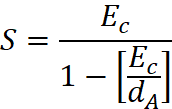
Source. (See Revision Note at chapter heading for
Env-A 1200) #9933, eff 6-1-11; ss by #12899, eff 10-17-19
Env-A 1205.02 Alternative Compliance Procedures.
(a)
The owner or operator of a coating operation that meets any of the
applicability criteria stated in Env-A 1206 through Env-A 1212 may satisfy the
applicable emission rate limits by implementing add-on control techniques or a
bubble and complying with the solids-based emission rate limits stated in the
applicable rule or calculated using the procedures of Env-A 1205.01(d) and Env-A 800.
(b)
As an alternative to the applicable emission rate limits or
technological controls specified in this chapter in cases where the owner or
operator of a source cannot meet the applicable requirements due to
technological or economic reasons, the owner or operator shall satisfy those
requirements by obtaining and complying with a modified control technique
approved by the department and EPA in accordance with the RACT order provisions
of Env-A 1205.03 through Env-A 1205.06.
Source. (See Revision Note at chapter heading for
Env-A 1200) #9933, eff 6-1-11; ss by #12899, eff 10-17-19
Env-A 1205.03 Requests for VOC RACT Orders; Initial
Determinations Regarding Sufficiency.
(a)
Owners or operators of the following sources shall comply with the
applicable provisions of (b), below, and obtain a RACT order from the department
in accordance with the provisions of (c), (d), or Env-A 1205.04(a),
below, as applicable:
(1) Owners or operators of classifiable and
RACT-applicable stationary sources seeking modified VOC RACT emission limits or
control technology; and
(2) Owners or operators of RACT-applicable
miscellaneous or multicategory stationary VOC sources seeking RACT compliance
by adopting control option 5 as set forth in Env-A 1222.02(a)(5).
(b)
The owner or operator of any stationary source meeting the criteria of
either (a)(1) or (a)(2), above, shall submit the following to the department:
(1) An inventory of all VOC-emitting devices and
processes at the stationary source not exempt under
the applicable provisions of this chapter;
(2) The TPEs of each VOC-emitting device or
process identified pursuant to (b)(1), above;
(3) The actual amount of
VOCs emitted, based on solvent throughput or units of production, from each
VOC-emitting device or process at the stationary source not
exempt under the applicable provisions of this chapter, for the
following time periods:
a. Daily average for calendar year 1990, or
other year or consecutive 12-month period as required pursuant to (d), below;
and
b. Daily average during the ozone season for
calendar year 1990, or other calendar year as required pursuant to (d), below;
(4) A study of RACT control options consisting of
the following:
a. A detailed examination of the technical and economical feasibility of available VOC control techniques,
including the technique of using emission reduction credits (ERCs) or discrete emission reductions (DERs)
as a compliance option, for all VOC-emitting devices or processes not exempt under the applicable provisions of this chapter;
and
b.
The control option selected, stating emission limits, monitoring, recordkeeping
and reporting procedures, and test methods to be used to demonstrate
compliance;
(5) The amount of VOC that is proposed to be
controlled from each VOC-emitting device or process identified in (b)(1),
above;
(6) A schedule for implementation, containing the
major increments of progress toward compliance, including:
a. Completion of engineering;
b. Awarding of contract;
c. Initiation of construction;
d. Completion of construction; and
e. Final compliance with emission or control
requirements of this chapter; and
(7) A demonstration of compliance consistent with
the requirements of this chapter.
(c)
For any source submitting a RACT order application pursuant to the
applicable provisions(s) of (a), above, the department shall:
(1) Issue to the source owner or operator within
60 days of receipt of documentation submitted pursuant to (b), above, an
initial determination of sufficiency; or
(2) Issue to the source owner or operator within
60 days of receipt of documentation submitted pursuant to (b), above, an
initial determination of insufficiency, together with a request for all
additional information necessary to issue a RACT determination for a modified
emission rate limit or modified control technique, as applicable.
(d)
The director shall approve an alternative time period
pursuant to (b)(3)a. or (b)(3)b., above, for which the source provides a
demonstration that the applicable time periods specified therein are
unrepresentative of the operation of the facility due to one or more of the
following reasons:
(1) Add-on controls were installed during the
calendar year 1990, or during the 1990 ozone season, as applicable, that
resulted in VOC emission rate reductions of 40% or more of the average emission
rate during the applicable time period immediately
preceding the specified time period;
(2) Process or product changes were implemented
during the calendar year 1990, or during the 1990 ozone season, as applicable,
that resulted in VOC emission rate reductions of 40% or more of the average
emission rate during the applicable time period
immediately preceding the specified time period;
(3) The facility was not in existence
or the applicable VOC-emitting processes or devices were not operational during
any portion of calendar year 1990, or during any portion of the 1990 ozone
season, as applicable; or
(4) Any other reason that the department,
using EPA-approved methods and procedures as specified in 40 CFR § 51.165,
determines is adequate to demonstrate that VOC emissions for calendar year
1990, or the 1990 ozone season, whichever is applicable, were unrepresentative
of normal VOC-emitting facility operations.
Source. (See Revision Note at chapter heading for
Env-A 1200) #9933, eff 6-1-11; ss by #12899, eff 10-17-19
Env-A 1205.04 Final Determinations Regarding
Sufficiency; Proposed VOC RACT Orders.
(a)
In the event that an initial determination of sufficiency is made, the department shall
issue a final determination of sufficiency and present to EPA and the owner or
operator of the affected source a proposed RACT order within 60 days of the
initial determination of sufficiency containing:
(1) An inventory of all affected VOC-emitting
devices or processes not exempt under the applicable
provisions of this chapter;
(2) Emission limits for all affected VOC-emitting
devices or processes not exempt under the applicable
provisions of this chapter;
(3) A schedule requiring compliance with the RACT
emission limits that contains the elements described in Env-A 1205.03(b)(6);
(4) Procedures for determining initial compliance
with the approved modified emission rate limits or control technology;
(5) Procedures for assessing continuous
compliance with the emission limits, if applicable; and
(6) Recordkeeping and reporting requirements in
accordance with the provisions of Env-A 903, Env-A 904, and Env-A 908.
(b)
In the event that an initial determination of insufficiency is made, the
department shall:
(1) Issue a final determination of sufficiency
and present to EPA and the owner or operator of the affected source a proposed
RACT order containing those items listed in (a)(1) through (a)(6), above,
within 60 days of the receipt of those items submitted pursuant to Env-A 1205.03(c)(2); or
(2) Terminate the permit process and issue a
final determination of insufficiency if a complete response to the initial
determination of insufficiency is not received from the owner or operator of
the affected facility within 60 days of receipt of notification of the department’s initial
determination of insufficiency.
Source. (See Revision Note at chapter heading for
Env-A 1200) #9933, eff 6-1-11; ss by #12899, eff 10-17-19
Env-A 1205.05
Public Notice;
(a)
Within 30 days of the issuance of a proposed RACT order, the department
shall issue a public notice of the proposed RACT
order, once in a newspaper of daily statewide circulation and once in a
newspaper in the general locality of the affected source.
(b)
The public notice specified in (a), above, shall:
(1) Briefly describe the proposed RACT order;
(2) Offer the opportunity for a hearing;
(3) State where the full proposal is available
for inspection, including whether the proposal can be accessed electronically;
and
(4) Identify the name and contact information for
the individual at the department to whom a request for a hearing should be
directed.
(c)
If a public hearing on the proposal is requested, the department shall:
(1) Publish a notice in a newspaper of daily
statewide circulation, stating the the place, date,
and time of the hearing at least 30 days prior to conducting the hearing; and
(2) Conduct the hearing on the proposed RACT
order in accordance with the non-adjudicative hearing procedures specified in
Env-C 200.
Source. (See Revision Note at chapter heading for
Env-A 1200) #9933, eff 6-1-11; ss by #12899, eff 10-17-19
Env-A 1205.06
Issuance of VOC RACT Order.
(a)
After
considering all public comment received and within 60 days of the date of the
public hearing on the proposed VOC RACT order, the department shall
issue a final RACT order to the owner or operator of the affected facility.
(b)
Within
60 days of the issuance of a final VOC RACT order, the
department shall submit to EPA a revision to the state implementation plan
(SIP).
Source. (See Revision Note at chapter heading for
Env-A 1200) #9933, eff 6-1-11; ss by #12899, eff 10-17-19
Env-A 1205.07 Emissions Testing and Monitoring
Requirements. A source subject to
this chapter shall comply with the applicable testing requirements as listed
for each source category pursuant to Env-A 804. When compliance with the applicable emission
standards is achieved by using a capture and control system, a capture
efficiency test shall be performed according to the procedures in Env-A 805.
Source. (See Revision Note at chapter heading for
Env-A 1200) #9933, eff 6-1-11; ss by #12899, eff 10-17-19
Env-A 1205.08 Recordkeeping and Reporting Requirements. A source subject to this chapter shall comply
with the applicable recordkeeping and reporting requirements as specified for
each source category in Env-A 900.
Source. (See Revision Note at chapter heading for
Env-A 1200) #9933, eff 6-1-11; ss by #12899, eff 10-17-19
PART
Env-A 1206 METAL CAN COATING
Env-A 1206.01
Applicability Criteria for Coating of Metal
Cans. A source whose metal can
coating operations have combined TPEs during any consecutive 12-month period
after December 31, 1989 which equal or exceed 10 tons
of VOCs shall be subject to the provisions of this part.
Source. (See Revision Note at chapter heading for
Env-A 1200) #9933, eff 6-1-11; ss by #12899, eff 10-17-19
Env-A 1206.02 Compliance
Standards for Coating of Metal Cans. A metal can coating source shall be limited at all
times to the emission rates specified below:
(a) For use in
interior or exterior sheet base-coating or over-varnish, or a 2-piece can
exterior base coat or over-varnish, 0.34 kg VOC/l, equivalent to 2.8 lb VOC/gallon, of coating as applied, excluding water and
exempt compounds or, for a source implementing add-on controls or a bubble to
achieve compliance, the solids-based emission rate determined by the procedure
described in Env-A 1205.01(d);
(b) For use in a
2-piece or 3-piece can interior body spray coating, or
a 2-piece can exterior end spray or roll coating, 0.51
kg VOC/l, equivalent to 4.2 lb VOC/gallon, of
coating, as applied, excluding water and exempt compounds;
(c) For use in 3-piece
can side-seam spray operations, 0.66 kg VOC/l, equivalent to 5.5 lb VOC/gallon, of coating, as applied, excluding water and
exempt compounds; or
(d) For use in end
sealing compound operations, 0.44 kg VOC/l, equivalent to 3.7 lb VOC/gallon, of coating, as applied, excluding water and
exempt compounds.
Source. (See Revision Note at chapter heading for
Env-A 1200) #9933, eff 6-1-11; ss by #12899, eff 10-17-19
PART
Env-A 1207 PAPER, FABRIC, FILM AND FOIL SUBSTRATES
COATING
Env-A 1207.01
Applicability and Exemptions for Coating of Paper, Fabric, Film and
Foil Substrates.
(a) Subject to (b),
below, any source at which paper, fabric, film, and foil coating operations,
including related cleaning activities, have combined actual emissions, before controls, during any consecutive 12-month
period of 3.0 tons of VOCs or more shall be subject to this part.
(b) The following
processes shall be exempt from this part:
(1) The application of a coating to vinyl or
urethane coated fabric, or vinyl or urethane sheets;
(2) Coating performed on or in-line with any
offset lithographic, screen, letterpress, flexographic, rotogravure, or digital
printing press; and
(3) Size presses and on-machine coaters on
papermaking machines that apply sizing, such as starch or water-based clays.
Source. (See Revision Note at chapter heading for
Env-A 1200) #9933, eff 6-1-11; ss by #12899, eff 10-17-19
Env-A
1207.02 Work Practice Standards for
Cleaning Materials Used in Coating of Paper, Fabric, Film and Foil Substrates. A paper, fabric,
film, or foil coating operation that uses VOC-containing cleaning materials
shall control VOC emissions from the cleaning materials using the following
work practices:
(a) Storing VOC-containing cleaning materials in
closed containers;
(b) Keeping mixing and
storage containers closed at all times except when
depositing or removing VOC-containing materials;
(c) Minimizing spills
of VOC-containing cleaning materials;
(d) Conveying
VOC-containing cleaning materials from one location to another in closed
containers or pipes; and
(e) Minimizing VOC
emissions from the cleaning of storage, mixing, and conveying equipment.
Source. (See Revision Note at chapter heading for
Env-A 1200) #9933, eff 6-1-11; ss by #12899, eff 10-17-19
Env-A 1207.03 Emission Rate Limits for Coating of Paper, Fabric,
Film and Foil Substrates.
(a) A paper, fabric,
film, or foil coating operation that has a TPE equal to or greater than 10 tons
per consecutive 12-month period, but less than 25 tons per consecutive 12-month
period, shall be limited at all times to an emission rate of 0.35 kg VOC/l, equivalent
to 2.9 lb VOC/gallon, of coating, as applied,
excluding water and exempt compounds.
(b) A paper, fabric,
film, or foil coating operation that has a TPE equal to or greater than 25 tons
per consecutive 12-month period, as applied, shall be limited at all times
before January 1, 2016, to an emission rate of 0.35 kg VOC/l, equivalent to 2.9
lb VOC/gallon, of coating, as applied, excluding
water and exempt compounds.
(c) A paper, fabric,
film, or foil coating operation that has a TPE equal to or greater than 25 tons
per consecutive 12-month period, as applied, shall be limited
at all times on and after January 1, 2016 to
either the emission rates or control efficiency, as applied, as specified in
table 1207-1, below:
Table 1207-1: VOC Limits for Sources with a TPE of 25 tons
per consecutive 12-month period or Greater
|
Units |
Pressure Sensitive Tape
and Label Surface Coating |
Paper, Film, and Foil
Surface Coating (Not including Pressure Sensitive Tape and Label Coating) |
|
Control Efficiency (%) |
90 |
90 |
|
kg VOC/kg solids (lb
VOC/lb solids) |
0.20 (0.20) |
0.40 (0.40) |
|
kg VOC/kg coating (lb
VOC/lb coating) |
0.067 (0.067) |
0.08 (0.08) |
Source. (See Revision Note at chapter heading for
Env-A 1200) #9933, eff 6-1-11; ss by #12899, eff 10-17-19
PART Env-A 1208 VINYL AND URETHANE SUBSTRATE COATING
Env-A 1208.01
Applicability for Vinyl and Urethane Substrate Coating. Any source at which vinyl or urethane
substrate coating operations have combined TPEs during any consecutive 12-month
period of 10 tons of VOCs or more shall be subject to this part.
Source. (See Revision Note at chapter heading for
Env-A 1200) #9933, eff 6-1-11; ss by #12899, eff 10-17-19
Env-A 1208.02 Compliance
Standards for Vinyl and Urethane Substrate Coating. Any process applying a coating onto vinyl or
urethane coated fabric, or vinyl or urethane sheets shall be limited
at all times to an emission rate of 0.45 kg VOC/l, equivalent to 3.8 lb VOC/gallon, of coating, as applied, excluding water and
exempt compounds.
Source. (See Revision Note at chapter heading for
Env-A 1200) #9933, eff 6-1-11; ss by #12899, eff 10-17-19
PART Env-A 1209 METAL FURNITURE COATING
Env-A 1209.01 Applicability and Exemptions for Metal
Furniture Coating.
(a)
This part shall apply to:
(1) Any source at which metal furniture coating
operations, including related cleaning activities, have combined actual
emissions, before controls, during any consecutive 12-month period of 3.0 tons
of VOCs or more; and
(2) The emissions from coating preparation
application area(s), flash-off area(s), and oven(s) of metal furniture coating
lines involved in prime and topcoat or single coating
operations.
(b) The following processes shall be exempt from
the provisions of Env-A 1209.02:
(1) Decorative,
protective, or functional materials that consist only of protective oils for
metal, acids, bases, or any combination of these substances; and
(2) Stencil
coatings, safety-indicating coatings, solid-film lubricants,
electric-insulating and thermal-conducting coatings, touch-up and repair
coatings, and coating application using hand-held aerosol cans.
(c) Env-A 1209.02
shall apply on and after January 1, 2016 to any source
that first becomes subject to this part on June 1, 2011.
Source. (See Revision Note at chapter heading for
Env-A 1200) #9933, eff 6-1-11; ss by #12899, eff 10-17-19
Env-A 1209.02 Compliance Standards for Metal Furniture
Coating. Those processes applying any coating,
including but not limited to paints, sealants, caulks, inks, adhesives, and
maskants, onto metal furniture or parts of metal furniture, including but not
limited to tables, benches, chairs, file cabinets, and waste baskets, shall comply with one or more
of the following control options:
(a) Subject to (b) and
(c), below, control option 1 shall consist of emission limits expressed in terms of mass of
VOC per volume of coating as applied, excluding water and exempt compounds, as specified
in table 1209-1, below:
Table 1209-1
VOC Emission Rates for Metal Furniture Coating
|
Coating Type |
Baked |
Air Dried |
||
|
kg VOC/l coating |
lb VOC/gal coating |
kg VOC/l coating |
lb VOC/gal coating |
|
|
General, One Component |
0.275 |
2.3 |
0.275 |
2.3 |
|
General, Multi-Component |
0.275 |
2.3 |
0.340 |
2.8 |
|
Extreme High Gloss |
0.360 |
3.0 |
0.340 |
2.8 |
|
Extreme Performance |
0.360 |
3.0 |
0.420 |
3.5 |
|
Heat Resistant |
0.360 |
3.0 |
0.420 |
3.5 |
|
Metallic |
0.420 |
3.5 |
0.420 |
3.5 |
|
Pretreatment Coatings |
0.420 |
3.5 |
0.420 |
3.5 |
|
Solar Absorbent |
0.360 |
3.0 |
0.420 |
3.5 |
(b) If a specific
coating is subject to more than one emission limit, the least stringent
emission limit shall apply;
(c) Until January
1, 2016, the emission rate for both general, one component
and general,
multi-component coatings shall be 0.36 kg VOC/l, equivalent
to 3.0 lb VOC/gallon, for
existing sources;
(d)
Subject to (e), below, control option 2 shall:
(1) Be calculated pursuant to Env-A 1205.01; or
(2) Consist of equivalent emission limits
expressed in terms of mass of VOC per volume of solids as applied, using an
assumed VOC density of 7.36 pounds per gallon, as specified in table 1209-2,
below:
Table 1209-2 VOC Emission Rates for Metal Furniture
Coating
Assuming VOC density of
7.36 pounds per gallon
|
Coating Type |
Baked |
Air Dried |
||
|
kg VOC/l solids |
lb VOC/gal solids |
kg VOC/l solids |
lb VOC/gal solids |
|
|
General, One Component |
0.40 |
3.3 |
0.40 |
3.3 |
|
General, Multi-Component |
0.40 |
3.3 |
0.55 |
4.5 |
|
Extreme High Gloss |
0.61 |
5.1 |
0.55 |
4.5 |
|
Extreme Performance |
0.61 |
5.1 |
0.80 |
6.7 |
|
Heat Resistant |
0.61 |
5.1 |
0.80 |
6.7 |
|
Metallic |
0.80 |
6.7 |
0.80 |
6.7 |
|
Pretreatment Coatings |
0.80 |
6.7 |
0.80 |
6.7 |
|
Solar Absorbent |
0.61 |
5.1 |
0.80 |
6.7 |
(e)
If a specific coating is subject to more than one emission limit, the
least stringent emission limit shall apply; and
(f)
Control
option 3 shall consist of the use of one or more add-on controls capable of
achieving an overall VOC control efficiency of 90 percent.
Source. (See Revision Note at chapter heading for
Env-A 1200) #9933, eff 6-1-11; ss by #12899, eff 10-17-19
Env-A 1209.03 Application Methods for Metal Furniture
Coating. A metal furniture coating
operation shall use one or more of the following application methods:
(a)
Electrostatic application;
(b)
High volume-low pressure (HVLP) spray;
(c)
Flow coat;
(d)
Roller coat;
(e)
Dip coat, including electrodeposition; or
(f)
A coating application method capable of achieving a transfer efficiency
equivalent or better than that achieved by HVLP spraying.
Source. (See Revision Note at chapter heading for
Env-A 1200) #9933, eff 6-1-11; ss by #12899, eff 10-17-19
Env-A 1209.04 Work Practices for Waste Materials from
Metal Furniture Coating. A metal
furniture coating operation shall control VOC emissions from VOC-containing
coatings, thinners, and coatings-related waste
materials by using the following work practices:
(a)
Storing all VOC-containing coatings, thinners, and coatings-related
waste materials in closed containers;
(b)
Keeping mixing and storage containers closed at all
times except when depositing or removing VOC-containing coatings,
thinners, and coatings-related waste materials;
(c)
Minimizing spills of VOC-containing coatings, thinners, and
coatings-related waste materials; and
(d)
Conveying VOC-containing coatings, thinners, and coatings-related waste
materials from one location to another in closed containers or pipes.
Source. (See Revision Note at chapter heading for
Env-A 1200) #9933, eff 6-1-11; ss by #12899, eff 10-17-19
Env-A 1209.05 Work Practices for Cleaning Materials
Used in Metal Furniture Coating. A
metal furniture coating operation shall control VOC emissions from cleaning
materials by using the following work practices:
(a)
Storing VOC-containing cleaning materials and used shop towels in closed
containers;
(b)
Keeping mixing and storage containers closed at all
times except when depositing or removing VOC-containing materials;
(c)
Minimizing spills of VOC-containing cleaning materials;
(d)
Conveying VOC-containing cleaning materials from one location to another
in closed containers or pipes; and
(e)
Minimizing VOC emissions from the cleaning of storage, mixing, and
conveying equipment.
Source. (See Revision Note at chapter heading for
Env-A 1200) #9933, eff 6-1-11; ss by #12899, eff 10-17-19
PART
Env-A 1210 MAGNETIC WIRE INSULATION COATING
Env-A 1210.01
Applicability Criteria for Magnetic Wire Insulation Coating. Any source at which magnetic wire insulation
coating operations have combined TPEs during any consecutive 12-month period of
10 tons of VOCs or more shall be subject to his part.
Source. (See Revision Note at chapter heading for
Env-A 1200) #9933, eff 6-1-11; ss by #12899, eff 10-17-19
Env-A 1210.02 Compliance
Standards for Magnetic Wire Insulation Coating. A process applying a coating of electrically insulating varnish or enamel onto
copper or aluminum wire or foil shall be limited at all times
to an emission rate of 0.20 kg VOC/l, equivalent to 1.7 lb
VOC/gallon, of coating, as applied, excluding water and exempt compounds.
Source. (See Revision Note at chapter heading for
Env-A 1200) #9933, eff 6-1-11; ss by #12899, eff 10-17-19
PART Env-A 1211
METAL COILS COATING
Env-A 1211.01
Applicability Criteria for Coating of Metal
Coils. Any source at which metal
coil coating operations have combined TPEs during any consecutive 12-month
period of 10 tons of VOCs or more shall be subject to this part.
Source. (See Revision Note at chapter heading for
Env-A 1200) #9933, eff 6-1-11; ss by #12899, eff 10-17-19
Env-A 1211.02 Compliance
Standards for Coating of Metal Coils. A process applying a coating onto a metal coil substrate shall be limited at all times to an emission rate of 0.31 kg VOC/l,
equivalent to 2.6 lb VOC/gallon, of coating, as
applied, excluding water and exempt compounds.
Source. (See Revision Note at chapter heading for
Env-A 1200) #9933, eff 6-1-11; ss by #12899, eff 10-17-19
PART Env-A 1212 MISCELLANEOUS METAL AND PLASTIC PARTS AND
PRODUCTS COATING
Env-A 1212.01
Applicability and Exemptions for Coating of
Miscellaneous Metal and Plastic Parts and Products.
(a) Any source at
which miscellaneous metal and plastic parts and products coating operations,
including related cleaning activities, have combined actual emissions, before controls, during any consecutive 12-month
period of 3 tons of VOCs or more shall be subject to sections Env-A 1212.02
through Env-A 1212.07, as applicable.
(b) This part shall
apply to:
(1) Any manufacturer of metal or plastic parts
and products that surface-coats the products or parts it produces; and
(2) Facilities that perform surface coating of
miscellaneous metal and plastic parts on a contract basis.
(c) This part shall
apply on and after January 1, 2016 to any
miscellaneous metal and plastic parts and products coating operation that first
becomes subject to this part on June 1, 2011.
(d) This part shall
not apply to the surface coating of a metal product or plastic part that is
specifically regulated pursuant to any other part of this chapter.
Source. (See Revision Note at chapter heading for
Env-A 1200) #9933, eff 6-1-11; ss by #12899, eff 10-17-19
Env-A 1212.02 Application
Methods for Miscellaneous Metal and Plastic Parts and Products Coating.
(a) Except as provided in (b),
below, the owner or operator of a miscellaneous metal and plastic parts and
products coating operation shall control VOC emissions by using one or more of
the following coating application methods:
(1) High
volume-low pressure (HVLP) spray;
(2) Electrostatic
spray;
(3) Zinc-arc
spray;
(4) Air-assisted
airless spray;
(5) Airless
spray;
(6) A flow
coating technique;
(7) Dip
coat, including electrodeposition; or
(8) Any
other method with a transfer efficiency equivalent to or better than that
achieved by HVLP spraying.
(b) The requirement in (a), above, shall not
apply to:
(1) A
miscellaneous metal products coating operation when:
a. Applying touchup or repair coatings;
b. Applying textured finishes; or
c.
Implementing control option 3 as specified in Env-A 1212.04;
(2) Airbrush
operations using 5 gallons or less per year of coating at a miscellaneous plastic parts coating
operation; or
(3) A pleasure craft surface coating operation
when applying extreme high-gloss coatings.
Source. (See Revision Note at chapter heading for
Env-A 1200) #9933, eff 6-1-11; ss by #12899, eff 10-17-19
(a)
The owner or operator of a miscellaneous metal and
plastic parts and products coating operation shall control VOC emissions from
VOC-containing coatings, thinners, and coatings-related waste materials by
using the following work practices:
(1) Storing
all VOC-containing coatings, thinners, and coatings-related waste materials in
closed containers;
(2) Keeping
mixing and storage containers closed at all times
except when depositing or removing VOC-containing coatings, thinners, and coatings-related waste materials;
(3) Minimizing
spills of VOC-containing coatings, thinners, and coatings-related waste
materials; and
(4) Conveying
VOC-containing coatings, thinners, and coatings-related waste materials from
one location to another in closed containers or pipes.
(b) The owner or operator of a miscellaneous metal and plastic parts and products
coating operation shall control VOC emissions from cleaning materials by using
the following work practices:
(1) Storing
VOC-containing cleaning materials and used shop towels in closed containers;
(2) Keeping
mixing and storage containers closed at all times
except when depositing or removing VOC-containing materials;
(3) Minimizing
spills of VOC-containing cleaning materials;
(4) Conveying
VOC-containing cleaning materials from one location to another in closed
containers or pipes; and
(5) Minimizing
VOC emissions from the cleaning of storage, mixing, and conveying equipment by
ensuring that:
a. Cleaning
solvents are not atomized; and
b. All spent solvent is captured
in closed containers.
Source. (See Revision Note at chapter heading for
Env-A 1200) #9933, eff 6-1-11; ss by #12899, eff 10-17-19
Env-A
1212.04 VOC Limits for Miscellaneous
Metal Parts and Products Coating.
Except as specified in Env-A 1212.05, the owner or operator of a miscellaneous metal parts
and products coating operation subject to this part shall control VOC emissions
by one of the following control options, provided that if a specific coating is
subject to more than one emission limit, the least stringent emission limit
shall apply:
(a) Subject to (b), below, control option 1 shall
consist of the use of low-VOC content coatings as applied, excluding water and
exempt compounds, as specified in table 1212-1, below:
Table
1212-1: VOC Content Limits Based on Low-VOC Coatings
|
Coating Category |
Air Dried |
Baked |
||
|
kg VOC/l coating |
lb VOC/gal coating |
kg VOC/l coating |
lb VOC/gal coating |
|
|
General, One-Component |
0.34 |
2.8 |
0.28 |
2.3 |
|
General, Multi-Component |
0.34 |
2.8 |
0.28 |
2.3 |
|
Camouflage |
0.42 |
3.5 |
0.42 |
3.5 |
|
Electric-Insulating Varnish |
0.42 |
3.5 |
0.42 |
3.5 |
|
Etching Filler |
0.42 |
3.5 |
0.42 |
3.5 |
|
Extreme High-Gloss |
0.42 |
3.5 |
0.36 |
3.0 |
|
Extreme Performance |
0.42 |
3.5 |
0.36 |
3.0 |
|
Heat-Resistant |
0.42 |
3.5 |
0.36 |
3.0 |
|
High Performance Architectural |
0.74 |
6.2 |
0.74 |
6.2 |
|
High Temperature |
0.42 |
3.5 |
0.42 |
3.5 |
|
Metallic |
0.42 |
3.5 |
0.42 |
3.5 |
|
Military Specification |
0.34 |
2.8 |
0.28 |
2.3 |
|
Mold-Seal |
0.42 |
3.5 |
0.42 |
3.5 |
|
Pan-Backing |
0.42 |
3.5 |
0.42 |
3.5 |
|
Prefabricated Architectural Multi-Component |
0.42 |
3.5 |
0.28 |
2.3 |
|
Prefabricated Architectural One-Component |
0.42 |
3.5 |
0.28 |
2.3 |
|
Pretreatment Coatings |
0.42 |
3.5 |
0.42 |
3.5 |
|
Repair and Touch Up |
0.42 |
3.5 |
0.36 |
3.0 |
|
Silicone-Release |
0.42 |
3.5 |
0.42 |
3.5 |
|
Solar-Absorbent |
0.42 |
3.5 |
0.36 |
3.0 |
|
Vacuum-Metalizing |
0.42 |
3.5 |
0.42 |
3.5 |
|
Drum Coating, New, Exterior |
0.34 |
2.8 |
0.34 |
2.8 |
|
Drum Coating, New, Interior |
0.42 |
3.5 |
0.42 |
3.5 |
|
Drum Coating, Reconditioned, Exterior |
0.42 |
3.5 |
0.42 |
3.5 |
|
Drum Coating, Reconditioned, Interior |
0.50 |
4.2 |
0.50 |
4.2 |
(b) Until January 1, 2016, the content limit for the
following coatings shall be as specified:
(1) For air-dried general, one
component and general,
multi-component coatings, 0.42 kg VOC/l,
equivalent to 3.5
lb VOC/gallon; and
(2) For baked general, one
component and general,
multi-component coatings shall be 0.36 kg VOC/l,
equivalent to 3.0
lb VOC/gallon;
(c)
Control option 2 shall consist of using a combination of low-VOC content
coatings and one or more add-on controls to meet the limits calculated pursuant
to Env-A 1205.01 or specified in table 1212-2, below:
Table
1212-2 VOC Content Limits Per Volume
Solids
|
Coating Category |
Air Dried |
Baked |
||
|
kg VOC/l solids |
lb VOC/gal solids |
kg VOC/l solids |
lb VOC/gal solids |
|
|
General, One-Component |
0.54 |
4.52 |
0.40 |
3.35 |
|
General, Multi-Component |
0.54 |
4.52 |
0.40 |
3.35 |
|
Camouflage |
0.80 |
6.67 |
0.80 |
6.67 |
|
Electric-Insulating Varnish |
0.80 |
6.67 |
0.80 |
6.67 |
|
Etching Filler |
0.80 |
6.67 |
0.80 |
6.67 |
|
Extreme High-Gloss |
0.80 |
6.67 |
0.61 |
5.06 |
|
Extreme Performance |
0.80 |
6.67 |
0.61 |
5.06 |
|
Heat-Resistant |
0.80 |
6.67 |
0.61 |
5.06 |
|
High Performance Architectural |
4.56 |
38.0 |
4.56 |
38.0 |
|
High Temperature |
0.80 |
6.67 |
0.80 |
6.67 |
|
Metallic |
0.80 |
6.67 |
0.80 |
6.67 |
|
Military Specification |
0.54 |
4.52 |
0.40 |
3.35 |
|
Mold-Seal |
0.80 |
6.67 |
0.80 |
6.67 |
|
Pan Backing |
0.80 |
6.67 |
0.80 |
6.67 |
|
Prefabricated Architectural Multi-Component |
0.80 |
6.67 |
0.40 |
3.35 |
|
Prefabricated Architectural One-Component |
0.80 |
6.67 |
0.40 |
3.35 |
|
Pretreatment Coatings |
0.80 |
6.67 |
0.80 |
6.67 |
|
Silicone Release |
0.80 |
6.67 |
0.80 |
6.67 |
|
Solar-Absorbent |
0.80 |
6.67 |
0.61 |
5.06 |
|
Vacuum-Metalizing |
0.80 |
6.67 |
0.80 |
6.67 |
|
Drum Coating, New, Exterior |
0.54 |
4.52 |
0.54 |
4.52 |
|
Drum Coating, New, Interior |
0.80 |
6.67 |
0.80 |
6.67 |
|
Drum Coating, Reconditioned, Exterior |
0.80 |
6.67 |
0.80 |
6.67 |
|
Drum Coating, Reconditioned, Interior |
1.17 |
9.78 |
1.17 |
9.78 |
(d) Control option 3 shall consist of the use of
one or more add-on controls capable of achieving an overall VOC capture and
control efficiency of 90 percent.
Source. (See Revision Note at chapter heading for
Env-A 1200) #9933, eff 6-1-11; amd by #10145, eff
6-19-12; ss by #12899, eff 10-17-19
Env-A 1212.05 Exceptions
to Env-A 1212.04. The VOC limits
specified in Env-A 1212.04 shall not apply to the following types of coatings and coating operations:
(a) Stencil coatings;
(b) Safety-indicating
coatings;
(c) Solid-film
lubricants;
(d) Electric-insulating and thermal-conducting coatings;
(e) Magnetic data
storage disk coatings; and
(f) Plastic extruded
onto metal parts to form a coating.
Source. (See Revision Note at chapter heading for
Env-A 1200) #9933, eff 6-1-11; ss by #12899, eff 10-17-19
Env-A 1212.06
VOC Limits for Miscellaneous Plastic Parts and Products Coating.
(a) Except as specified in (b), below, the owner
or operator of a miscellaneous plastic parts and products coating operation shall
control VOC emissions by one of the following control options, provided that if a specific coating is
subject to more than one emission limit, the least stringent emission limit
shall apply:
(1) Control
option 1 shall consist of the use of low-VOC content coatings as applied,
excluding water and exempt compounds, as specified in table 1212-3, below:
Table 1212-3 VOC
Content Limits Based on Low-VOC Coatings
|
Coating Category |
kg VOC/l coating |
lb VOC/gal coating |
|
General, One-Component |
0.28 |
2.3 |
|
General, Multi-Component |
0.42 |
3.5 |
|
Electric Dissipating Coatings and Shock-Free
Coatings |
0.80 |
6.7 |
|
Extreme Performance |
0.42 (2-pack coatings) |
3.5 (2-pack coatings) |
|
Metallic |
0.42 |
3.5 |
|
Military Specification |
0.34 (1 pack) 0.42 (2 pack) |
2.8 (1 pack) 3.5 (2 pack) |
|
Mold-Seal |
0.76 |
6.3 |
|
Multi-Colored Coatings |
0.68 |
5.7 |
|
Optical Coatings |
0.80 |
6.7 |
|
Vacuum-Metalizing |
0.80 |
6.7 |
(2) Control
option 2 shall consist of the use of one or more add-on controls capable of
achieving an overall VOC control efficiency of 90 percent; or
(3) Control
option 3 shall consist of using a combination of low-VOC content coatings and
one or more add-on controls to meet the limits calculated pursuant to Env-A
1205.01 or specified in table 1212-4, below:
Table 1212-4 VOC Content Limits
Per Volume Solids
|
Coating Category |
kg VOC/l solids |
lb VOC/gal solids |
|
General, One-Component |
0.40 |
3.35 |
|
General, Multi-Component |
0.80 |
6.67 |
|
Electric Dissipating Coatings and Shock-Free
Coatings |
8.96 |
74.7 |
|
Extreme Performance |
0.80 (2-pack coatings) |
6.67 (2-pack coatings) |
|
Metallic |
0.80 |
6.67 |
|
Military Specification |
0.54 (1 pack) 0.80 (2 pack) |
4.52 (1 pack) 6.67 (2 pack) |
|
Mold-Seal |
5.24 |
43.7 |
|
Multi-Colored Coatings |
3.04 |
25.3 |
|
Optical Coatings |
8.96 |
74.7 |
|
Vacuum-Metalizing |
8.96 |
74.7 |
(b) The VOC limits
specified in (a), above, shall not apply to the following types of coatings and
coating operations:
(1) Touch-up and repair coatings;
(2) Stencil coatings applied on clear or translucent substrates;
(3) Clear or translucent coatings;
(4) Coatings applied at a paint manufacturing facility while conducting performance
tests on the coatings;
(5) Any individual coating category used in volumes less than 50 gallons in
any one year, if substitute compliant coatings are not available, provided that
the total usage of all such coatings does not exceed 200 gallons per year, per
facility;
(6) Reflective coating applied to highway cones;
(7) Mask coatings that are less than 0.5
millimeter thick when dried and the area coated is less than 25 square inches;
(8) EMI/RFI shielding coatings; and
(9) Heparin-benzalkonium chloride (HBAC)-containing coatings applied to medical
devices, provided that the total usage of all such coatings does not exceed 100
gallons per year, per facility.
Source. (See Revision Note at chapter heading for
Env-A 1200) #9933, eff 6-1-11; ss by #12899, eff 10-17-19
Env-A 1212.07
VOC Limits for Automotive/Transportation and Business Machine Plastic
Part Coating.
(a) Except as specified in (b) and (c), below, the
owner or operator of an automotive/ transportation or business machine plastic part coating operation
subject to this section shall control VOC emissions by using one of the
following control options, provided that if a
specific coating is subject to more than one emission limit, the least
stringent emission limit shall apply:
(1) Control
option 1 shall consist of the use of low-VOC content coatings as applied,
excluding water and exempt compounds, as specified in table 1212-5, below:
Table 1212-5
VOC Content Limits Based on Low-VOC Coatings
|
Coating Category |
kg VOC/l coating |
lb VOC/gal coating |
|
Automotive/Transportation Coatings |
||
|
I. High Bake Coatings – Interior and
Exterior Parts |
||
|
Flexible
Primer |
0.54 |
4.5 |
|
Non-Flexible
Primer |
0.42 |
3.5 |
|
Basecoat |
0.52 |
4.3 |
|
Clear Coat |
0.48 |
4.0 |
|
Non-Basecoat/Clear Coat |
0.52 |
4.3 |
|
II. Low Bake/Air Dried Coatings – Exterior
Parts |
||
|
Primers |
0.58 |
4.8 |
|
Basecoat |
0.60 |
5.0 |
|
Clear Coat |
0.54 |
4.5 |
|
Non-Basecoat/Clear Coat |
0.60 |
5.0 |
|
III. Low Bake/Air Dried Coatings – Interior
Parts |
0.60 |
5.0 |
|
IV.
Touchup and Repair Coatings |
0.62 |
5.2 |
|
Business Machine Coatings |
||
|
I. Primers |
0.35 |
2.9 |
|
II. Topcoat |
0.35 |
2.9 |
|
III. Texture Coat |
0.35 |
2.9 |
|
IV. Fog Coat |
0.26 |
2.2 |
|
V.
Touchup and Repair |
0.35 |
2.9 |
(2) Control
option 2 shall consist of the use of one or more add-on controls capable of
achieving an overall VOC control efficiency of 90 percent; or
(3) Control
option 3 shall consist of using a combination of low-VOC content coatings and
one or more add-on controls to meet the limits calculated pursuant to Env-A
1205.01 or specified in table 1212-6, below:
Table 1212-6 VOC Content Limits Per Volume Solids
|
Coating Category |
kg VOC/l solids |
lb VOC/gal solids |
|
Automotive/Transportation Coatings |
|
|
|
I. High Bake Coatings – Interior and
Exterior Parts |
|
|
|
Flexible
Primer |
1.39 |
11.58 |
|
Non-Flexible
Primer |
0.80 |
6.67 |
|
Basecoat |
1.24 |
10.34 |
|
Clear Coat |
1.05 |
8.76 |
|
Non-Basecoat/Clear Coat |
1.24 |
10.34 |
|
II. Low Bake/Air Dried Coatings – Exterior
Parts |
|
|
|
Primers |
1.66 |
13.80 |
|
Basecoat |
1.87 |
15.59 |
|
Clearcoat |
1.39 |
11.58 |
|
Non-Basecoat/Clear Coat |
1.87 |
15.59 |
|
III. Low Bake/Air Dried Coatings – Interior
Parts |
1.87 |
15.59 |
|
IV. Touchup and Repair Coatings |
2.13 |
17.72 |
|
Business Machine Coatings |
|
|
|
I. Primers |
0.57 |
4.80 |
|
II. Topcoat |
0.57 |
4.80 |
|
III. Texture Coat |
0.57 |
4.80 |
|
IV. Fog Coat |
0.38 |
3.14 |
|
V. Touchup and Repair |
0.57 |
4.80 |
(b) For red, yellow, and black
automotive/transportation coatings other than touch up and repair coatings, the
limit shall be determined by multiplying the appropriate limit in table 1212-5
or 1212-6, as applicable, by 1.15; and
(c) The VOC limits specified in (a), above, shall
not apply to the following types of coatings and
coating operations:
(1) Texture coatings;
(2) Vacuum-metalizing coatings;
(3) Gloss reducers;
(4) Texture topcoats;
(5) Adhesion primers;
(6) Electrostatic preparation coatings;
(7) Resist coatings; and
(8) Stencil coatings.
Source. (See Revision Note at chapter heading for
Env-A 1200) #9933, eff 6-1-11; ss by #12899, eff 10-17-19
Env-A 1212.08 VOC Limits for Pleasure Craft Surface Coating. The owner or operator of a pleasure craft
surface coating operation subject to this part shall control VOC emissions by
using one of the following control options, provided that if a specific coating
is subject to more than one emission limit, the least stringent emission limit
shall apply:
(a) Control option 1 shall consist of the use of
low-VOC content coatings as applied, excluding water and exempt compounds, as
specified in table 1212-7, below:
Table 1212-7 VOC Content Limits Based on Low-VOC Coatings
|
Coating Category |
kg VOC/l coating |
lb VOC/gal coating |
|
Extreme High-Gloss Topcoat |
0.60 |
5.1 |
|
High-Gloss Topcoat |
0.42 |
3.5 |
|
Pretreatment |
0.78 |
6.5 |
|
Finish
Primer/Surfacer |
0.42 |
3.5 |
|
High Build Primer Surfacer |
0.34 |
2.8 |
|
Aluminum Substrate Antifoulant Coating |
0.56 |
4.7 |
|
Antifouling Sealer/Tie Coating |
0.42 |
3.5 |
|
Other Substrate Antifoulant Coating |
0.40 |
3.3 |
|
All Other Pleasure Craft Surface Coatings
for Metal or Plastic |
0.42 |
3.5 |
(b) Control option 2 shall consist of using a
combination of low-VOC content coatings and one or more add-on controls to meet
the limits calculated pursuant to Env-A 1205.01 or specified in table 1212-8,
below:
Table 1212-8
VOC Content Limits Per Volume Solids
|
Coating Category |
kg VOC/l solids |
lb VOC/gal solids |
|
Extreme High-Gloss Topcoat |
1.10 |
9.2 |
|
High-Gloss Topcoat |
0.80 |
6.7 |
|
Pretreatment |
6.67 |
55.6 |
|
Finish
Primer/Surfacer |
0.80 |
6.7 |
|
High Build Primer Surface |
0.55 |
4.6 |
|
Aluminum Substrate Antifoulant Coating |
1.53 |
12.8 |
|
Other Substrate Antifoulant Coating |
0.53 |
4.4 |
|
All other pleasure craft surface coatings
for metal or plastic |
0.80 |
6.7 |
(c) Control option 3 shall consist of the use of
one or more add-on controls capable of achieving an overall VOC control
efficiency of 90 percent.
Source. (See Revision Note at chapter heading for
Env-A 1200) #9933, eff 6-1-11; ss by #12899, eff 10-17-19
Env-A 1212.09
VOC Limits for Motor Vehicle Materials. The owner or operator of a coating operation subject to this part,
located at a facility that is not an automobile or light-duty truck assembly
coating facility, shall control VOC
emissions by using motor vehicle coatings as applied, excluding water and
exempt compounds, that do not exceed the VOC limits specified in table 1212-9,
below,
provided that if a specific
coating is subject to more than one emission limit, the least stringent
emission limit shall apply:
Table 1212-9
VOC Content Limits Based on Low-VOC Coatings
|
Coating Category |
kg VOC/l coating |
lb VOC/gal coating |
|
Motor vehicle cavity wax |
0.65 |
5.4 |
|
Motor vehicle sealer |
0.65 |
5.4 |
|
Motor vehicle deadener |
0.65 |
5.4 |
|
Motor vehicle gasket/gasket sealing material |
0.20 |
1.7 |
|
Motor vehicle underbody coating |
0.65 |
5.4 |
|
Motor vehicle trunk interior coating |
0.65 |
5.4 |
|
Motor vehicle bedliner |
0.20 |
1.7 |
|
Motor vehicle lubricating wax/compound |
0.70 |
5.8 |
Source. (See Revision Note at chapter heading for
Env-A 1200) #9933, eff 6-1-11; ss by #12899, eff 10-17-19
PART Env-A 1213
WOOD FURNITURE, BURIAL CASKETS, AND GUNSTOCK COATING
Env-A 1213.01
Applicability Criteria for the Coating of Wood Furniture, Burial
Caskets, and Gunstock. The following
sources shall be subject to this part:
(a) Any source at
which wood furniture coating and finishing operations, including related
cleaning activities, have combined TPEs during any consecutive 12-month period
of 25 tons of VOCs or more;
(b) Any source at
which wood burial casket coating and finishing operations, including related
cleaning activities, have combined TPEs during any consecutive 12-month period
of 50 tons of VOCs or more; and
(c) Any source at
which gunstock coating and finishing operations, including related cleaning
activities, have combined TPEs during any consecutive 12-month period of 50
tons of VOCs or more.
Source. (See Revision Note at chapter heading for
Env-A 1200) #9933, eff 6-1-11; ss by #12899, eff 10-17-19
Env-A 1213.02
RACT Emission Rates for Wood Furniture and Burial Casket Finishing
Operations.
(a) Except as
specified in (b), below, a wood furniture or burial casket finishing operation,
shall be limited at all times to the VOC RACT emission
rates specified below:
(1) Using a topcoat with a VOC content no greater
than 0.8 kg VOC/kg solids, equivalent to 0.8 lb VOC/lb solids, as applied; or
(2) Using a finishing system of topcoats and
sealers with a VOC content no greater than the limits specified below:
a. For topcoats, 1.8 kg VOC/kg solids,
equivalent to 1.8 lb VOC/lb
solids, as applied; and
b. For sealers, 1.9 kg VOC/kg solids, equivalent
to 1.9 lb VOC/lb solids, as
applied.
(b) A wood furniture
finishing operation using either acid-cured alkyd amino vinyl sealers or
acid-cured alkyd amino conversion varnish topcoats shall be limited
at all times to the VOC RACT emission rates specified below:
(1) Using a finishing system of topcoats and
sealers consisting exclusively of acid-cured alkyd amino vinyl sealers and
acid-cured alkyd amino conversion varnish topcoats with a VOC content no
greater than the following:
a. For the sealers, 2.3 kg VOC/kg solids, equivalent to
2.3 lb VOC/lb solids, as
applied; and
b. For the topcoats, 2.0 kg VOC/kg solids,
equivalent to 2.0 lb VOC/lb
solids, as applied;
(2) Using a finishing system of topcoats and
sealers consisting of acid-cured alkyd amino conversion varnish topcoats
and sealers other than acid-cured alkyd amino vinyl sealers with a VOC content
no greater than the limits specified below:
a. For the sealers, 1.9 kg VOC/kg solids,
equivalent to 1.9 lb VOC/lb
solids, as applied; and
b. For the topcoats, 2.0 kg VOC/kg solids,
equivalent to 2.0 lb VOC/lb
solids, as applied; or
(3) Using a finishing system of topcoats and
sealers consisting of acid-cured alkyd amino vinyl sealers and topcoats other
than acid-cured alkyd amino conversion varnish topcoats with a VOC content no
greater than the limits specified below:
a. For the sealers, 2.3 kg VOC/kg solids,
equivalent to 2.3 lb VOC/lb
solids, as applied; and
b. For the topcoats, 1.8 kg VOC/kg solids,
equivalent to 1.8 lb VOC/lb
solids, as applied.
Source. (See Revision Note at chapter heading for
Env-A 1200) #9933, eff 6-1-11; ss by #12899, eff 10-17-19
Env-A 1213.03
RACT Emission Rates for Gunstock Coating. Those processes applying a protective,
decorative, or functional coating onto the wood surfaces of gunstock shall be limited at all times to using a finishing system of topcoats
and sealers with a VOC content no greater than the limits specified below:
(a)
For topcoats, 2.0 kg VOC/kg solids, equivalent to 2.0 lb
VOC/lb solids, as applied, averaged over any 24-hour
period; and
(b) For sealers, 2.3 kg VOC/kg solids, equivalent to 2.3 lb VOC/lb solids, as applied,
averaged over any 24-hour period.
Source. (See Revision Note at chapter heading for
Env-A 1200) #9933, eff 6-1-11; ss by #12899, eff 10-17-19
Env-A 1213.04
VOC Content Limits for Spray Booth Cleaning Operations in Wood
Furniture, Wood Burial Casket Finishing Operations and Gunstock Coating
Processes.
(a) The VOC content or
amount of organic solvents and strippable booth
coatings associated with a spray booth cleaning operation for a spray booth
used in a wood furniture or wood burial casket finishing operation or gunstock
coating process shall not, at any time, exceed the following limits:
(1) For organic solvents used to clean spray
booth components other than conveyors, continuous coaters and their enclosures,
or metal filters of spray booths that are not being refurbished, 8.0% by weight
of VOC;
(2) For organic solvents used to clean a spray
booth that is being refurbished, 1.0 gallon of organic
solvent; and
(3) For strippable booth coatings, 0.8 kg VOC/kg
solids, equivalent to 0.8 lb VOC/lb
solids, as applied.
(b) In addition to the
requirements of (a), above, VOC emissions associated with materials
storage or solvent cleaning operations applicable to wood furniture or burial
casket finishing operations, or gunstock coating, shall be controlled as
follows:
(1) All finishing and cleaning materials shall be
stored in a normally closed container;
(2) All organic solvent
used for line cleaning shall be pumped or drained into a normally closed
container;
(3) All organic solvent
used to clean spray guns shall be collected into a normally closed container;
and
(4) Emissions from washoff
operations shall be controlled by:
a. Using normally closed containers for washoff; and
b. Minimizing dripping by tilting or rotating
the part to drain as much organic solvent as possible.
Source. (See Revision Note at chapter heading for
Env-A 1200) #9933, eff 6-1-11; ss by #12899, eff 10-17-19
Env-A 1213.05
Control Techniques for Wood Furniture, Wood Burial Casket, and
Gunstock Coating Facilities.
(a)
For a wood furniture, wood burial casket, or
gunstock coating operation, one or more of the following control techniques
shall be used:
(1) High volume-low pressure (HVLP) spray;
(2) Airless spray;
(3) Air-assisted airless spray;
(4) Flow coating techniques; or
(5) Conventional air spray under any one or more
of the following circumstances:
a. The finishing materials have a VOC content
not greater than 1.0 kg VOC/kg solids, equivalent to 1.0 lb
VOC/lb solids, as applied;
b. The spray is
automated;
c. The emissions from
the finishing application station are directed to
add-on control equipment;
d. The conventional air spray gun is used to
apply finishing materials and the cumulative total
usage of that finishing material is less than 5.0% of the total gallons of
finishing material used during the applicable semi-annual reporting period;
e. The conventional air gun is used to apply
stain on a part for which it is technically or economically infeasible to use
any other spray application technology, as demonstrated in accordance with the
provisions of (b), below; or
f. Touch-up and repair
activities are conducted in accordance with the provisions of Env-A 1213.06.
(b) Any source
intending to use conventional air spray pursuant to (a)(5)e.,
above, shall demonstrate technical or economic infeasibility by submitting to
the department a videotape, a technical report, or other documentation that
supports the affected source's claim of technical or economic feasibility, to
be determined in accordance with (c), below.
(c)
The following criteria shall be used, either independently or in
combination, to support the affected source's claim of technical or economic
infeasibility pursuant to (b), above:
(1) The production speed is too high or the part shape is too complex for a single operator
to coat the part and the application station is not large enough to accommodate
an additional operator; or
(2) The excessively large vertical spray area of
the part makes it difficult to avoid runs in the stain
or sagging of the part.
Source. (See Revision Note at chapter heading for
Env-A 1200) #9933, eff 6-1-11; ss by #12899, eff 10-17-19
(a) Touch-up and repair activities using
conventional air spray shall conform to one or more of the following
requirements:
(1)
The touch-up and repair finishing materials
shall be applied after the completion of the finishing
operation; or
(2)
The touch-up and repair finishing materials
shall be:
a.
Applied after the application of the stain and prior to the application
of any other types of finishing material; and
b.
Applied from a container with a capacity of not more than 2 gallons;
(b) Total VOC consumption associated with
touch-up and repair activities using conventional air spray shall not exceed 5
gallons per day at a stationary source; and
(c) Consumption of touch-up and repair finishing materials shall not exceed 10 gallons per day
where such activities employ:
(1)
The use of aerosol containers; or
(2)
One or more non-compliant coating materials in conjunction with any of
the application techniques listed in Env-A 1213.05(a).
Source. (See Revision Note at chapter heading for
Env-A 1200) #9933, eff 6-1-11; ss by #12899, eff 10-17-19
Env-A 1213.07
Training Requirements for Wood Furniture Coating Operations.
(a) Owners or
operators of RACT-applicable wood furniture coating sources shall:
(1) Prepare an initial training
course and an annual refresher course as specified in (b), below; and
(2) Present the training courses
to all source personnel, including contract personnel, who are directly
involved in the implementation of this part.
(b) The personnel
training courses shall consist of the following elements:
(1) A list of all personnel, including contract
personnel, who are required to attend the courses, by name and job description;
(2) An outline of the subjects to be covered, for
each individual or group of personnel, in the initial training course and each
refresher course;
(3) Lesson plans for the initial training course
and each refresher course that include, at a minimum:
a. Application techniques;
b. Cleaning procedures,
including appropriate management of cleanup wastes;
and
c. Appropriate equipment assembly and adjustment
to minimize coating and finishing material usage and overspray;
(4) A description of the personnel examination
methods to be used at the completion of the initial and refresher training to
demonstrate and document successful completion; and
(5) Any additional information deemed necessary by the owner or operator to
ensure that personnel understand the requirements of this part and how to
comply with them.
(c) The source owner
or operator shall maintain at the source a copy of all course materials
developed pursuant to (b), above.
Source. (See Revision Note at chapter heading for
Env-A 1200) #9933, eff 6-1-11; ss by #12899, eff 10-17-19
Env-A 1213.08
Leak Inspection and Maintenance Plan for Wood Furniture Coating
Sources. Each owner or operator of a
wood furniture coating source shall prepare, maintain, and implement a leak
inspection and maintenance plan that contains the following:
(a) A minimum visual
inspection frequency of once per month for all equipment used to transfer or
apply finishing materials or organic solvents;
(b) An inspection
schedule;
(c) Methods for
documenting the date and results of each inspection and any repairs that were
made and any maintenance that was performed; and
(d) The timeframe
between identifying a leak and repairing the leak, in accordance with the
following schedule:
(1) The first repair attempt, such as tightening
of packing glands, shall be made no later than 5 working days after the leak is
initially detected; and
(2) Final repairs shall be made within the
following time periods:
a. If the leaking equipment is to be replaced by
a new purchase, not later than 90 calendar days after initial leak detection;
or
b. If the leaking equipment is not to be
replaced by a new purchase, not later than 15 working days after initial leak
detection.
Source. (See Revision Note at chapter heading for
Env-A 1200) #9933, eff 6-1-11; ss by #12899, eff 10-17-19
Env-A 1213.09
Accounting Form Requirements for Wood Furniture Coating Sources. Each owner or operator of a wood furniture
coating source shall develop an organic solvent accounting form to record the
following for each calendar month:
(a)
The quantity and type of organic solvent used for washoff
and cleaning;
(b)
The number of pieces washed off, and the reason for the washoff; and
(c)
The quantity of spent organic solvent generated from each activity and
the quantity of said solvent that is recycled on-site or disposed off-site.
Source. (See Revision Note at chapter heading for
Env-A 1200) #9933, eff 6-1-11; ss by #12899, eff 10-17-19
Env-A 1213.10
Alternatives to Requirements for Wood Furniture, Wood Burial Casket,
and Gunstock Coating and Finishing Operations. As an alternative to the applicable emission
rate limits, technological controls, operation and maintenance controls, and
work practice standards specified in Env-A 1213.02 through Env-A 1213.09, as
applicable, wood furniture, wood burial casket, or gunstock coating and
finishing operations meeting the applicability criteria of Env-A 1213.01 may
implement one or more of the following methods:
(a)
Install and use an add-on control system that results in emissions to the atmosphere that do not numerically exceed the
applicable VOC content limits, validated by the procedure described in Env-A 1213.11;
(b) Meet either a
coatings-based or solids-based modified emission rate or VOC content limit as
approved by the director and EPA in accordance with the RACT order provisions
in Env-A 1205.03 through Env-A 1205.06 in the event that the source owner or
operator demonstrates that, because of technological or economic reasons, the
source owner or operator cannot meet one or more of the following:
(1) The applicable
specified emission rate limit(s) in Env-A 1213.02 or Env-A 1213.03; or
(2) The applicable VOC content limit prescribed
in Env-A 1213.04(a); or
(c) Comply with one or
more modified control techniques approved by the director and EPA in accordance
with the RACT order provisions in Env-A 1205.03 and Env-A 1205.06 in the event that the source owner
or operator demonstrates that the applicable specified control technique in
Env-A 1213.04(b), Env-A 1213.05, Env-A 1213.06, Env-A 1213.07, Env-A 1213.08,
or Env-A 1213.09 cannot be met because of technological or economic reasons.
Source. (See Revision Note at chapter heading for
Env-A 1200) #9933, eff 6-1-11; ss by #12899, eff 10-17-19
Env-A 1213.11
Validation Procedure for An Alternative Add-On Control System. A source selecting an alternative compliance
technique pursuant to Env-A 1213.10(a) shall demonstrate, in accordance with
the procedures of Env-A 804.09, that the overall
percentage reduction achieved by the add-on control system equals or exceeds
the percentage reduction required to meet the applicable VOC content limit.
Source. (See Revision Note at chapter heading for
Env-A 1200) #9933, eff 6-1-11; ss by #12899, eff 10-17-19
PART Env-A 1214 FLAT WOOD PANELING COATINGS
Env-A
1214.01 Applicability Criteria for
Flat Wood Paneling Coatings. A
source whose flat wood paneling coatings operation, has combined actual emissions, before
controls, during any consecutive 12-month period of 3 tons of VOCs or more
shall be subject to this part.
Source. (See Revision Note at chapter heading for
Env-A 1200) #9933, eff 6-1-11; ss by #12899, eff 10-17-19
Env-A
1214.02 Compliance Standards for Flat
Wood Paneling Coatings. The owner or
operator of a source subject to this part shall limit VOC emissions on and
after January 1, 2016 to one of the following
standards:
(a) An overall control efficiency of 90 percent
when using an add-on control device;
(b) An emission limit of 2.9 pounds of VOC per
gallon of solids, equivalent to 350 grams of VOC per liter of solids; or
(c) An emission limit of 2.1 pounds of VOC per
gallon of material, equivalent to 250 grams of VOC per liter of material,
excluding water and exempt compounds.
Source. (See Revision Note at chapter heading for
Env-A 1200) #9933, eff 6-1-11; ss by #12899, eff 10-17-19
Env-A
1214.03 Work Practices for Flat Wood
Paneling Coatings. The owner or
operator of a source subject to this part shall control VOC emissions from
VOC-containing coatings, thinners, cleaning materials, and coatings-related
waste materials by using the following work practices:
(a) Storing all
VOC-containing coatings, thinners, and cleaning materials in closed containers;
(b) Keeping mixing and
storage containers closed at all times except when
depositing or removing VOC-containing coatings, thinners, and coatings-related waste materials;
(c) Minimizing and
immediately cleaning up spills of VOC-containing coatings, thinners, and
coatings-related waste materials;
(d) Conveying
VOC-containing coatings, thinners, and cleaning materials from one location to
another in closed containers or pipes; and
(e) Minimizing
emissions of VOC during cleaning of storage, mixing, and conveying equipment.
Source. (See Revision Note at chapter heading for
Env-A 1200) #9933, eff 6-1-11; ss by #12899, eff 10-17-19
PART Env-A 1215 ROTOGRAVURE AND FLEXOGRAPHIC PRINTING
Env-A 1215.01
Applicability Criteria for Rotogravure and Flexographic Printing. Except for flexible-packaging printing, a
source whose rotogravure or flexographic printing operations have combined TPEs during any consecutive 12-month period which
equal or exceed 50 tons of VOCs shall be
subject to the provisions of sections Env-A 1215.02 through Env-A 1215.04.
Source. (See Revision Note at chapter heading for
Env-A 1200) #9933, eff 6-1-11; ss by #12899, eff 10-17-19
Env-A 1215.02 VOC
Content Standards for Rotogravure
and Flexographic Printing.
Except as provided in Env-A 1215.03, those processes using packaging
rotogravure, publication rotogravure, or flexographic printing shall be subject
to one of the following:
(a) Each ink, as it is
applied to the substrate, less water and non-volatile organic compounds, shall
contain no more than 40% by volume of VOCs;
(b) The volatile
fraction of each ink, as it is applied to the substrate, shall contain no more
than 25% by volume of VOCs and at least 75% by volume of water and non-volatile
organic compounds; or
(c) For packaging
rotogravure and flexographic printing only, each ink, as it is applied to the
substrate, shall have a VOC content that is less than or equal to 0.5 kg
VOC/kg, equivalent to 0.5 lb VOC/lb,
coating solids.
Source. (See Revision Note at chapter heading for
Env-A 1200) #9933, eff 6-1-11; ss by #12899, eff 10-17-19
Env-A 1215.03 Control
Equipment Standards for Rotogravure
and Flexographic Printing. In
lieu of the requirements in Env-A 1215.02, the owner or operator of such
processes shall install and operate one of the following:
(a) A carbon adsorption system which reduces the
rate of VOC emissions delivered from the capture system to the control
equipment by at least 90% by weight over the adsorption cycle or 24 hours,
whichever is less; or
(b) Incineration
control equipment which reduces the rate of VOC emissions delivered from the
capture system to the incineration inlet by at least 90% by weight.
Source. (See Revision Note at chapter heading for
Env-A 1200) #9933, eff 6-1-11; ss by #12899, eff 10-17-19
Env-A 1215.04
Capture System Standards for Rotogravure and Flexographic Printing.
(a) A capture system
shall be used in conjunction with the emission control system selected pursuant
to Env-A 1215.03 and subject to the requirements of (b), below.
(b) The design and
operation of a capture system installed pursuant to (a), above, shall provide
for an overall reduction in VOC emissions from each printing press of:
(1) At least 75% where a publication rotogravure
process is employed;
(2) At least 65% where a packaging rotogravure
process is employed; or
(3) At least 60% where a flexographic printing
process is employed.
Source. (See Revision Note at chapter heading for
Env-A 1200) #9933, eff 6-1-11; ss by #12899, eff 10-17-19
Env-A 1215.05 Applicability
Criteria for Flexible-Packaging Printing.
A source whose flexible-packaging printing operations have, including
related cleaning activities, combined actual emissions, before controls, during
any consecutive 12-month period which equal or exceed 3 tons of VOCs shall be
subject to the provisions of sections Env-A 1215.06 and Env-A 1215.07.
Source. (See Revision Note at chapter heading for
Env-A 1200) #9933, eff 6-1-11; ss by #12899, eff 10-17-19
Env-A 1215.06 Compliance
Standards for Flexible-Packaging Printing.
On and after January 1, 2016, the owner or operator of an individual
flexible-packaging printing press with a TPE of 25 tons or more per year of
VOCs from inks, coatings, and adhesives combined, shall comply with one of the
following control options:
(a) Control option 1
shall consist of the use of low-VOC
content materials or a combination of low-VOC content materials and add-on
controls so as to comply with one of the following
equivalent VOC content limits:
(1) 0.8 kg VOC/kg solids applied; or
(2) 0.16 kg VOC/kg materials applied;
(b) Control option 2 shall consist of averaging the VOC content of
materials used on a single press within one line; or
(c) Control option 3 shall consist of the use of
one or more add-on controls capable of achieving an overall
VOC control efficiency, as specified in table 1215-1, below:
Table 1215-1
Overall VOC Control Efficiency
|
Press First Installed
→ Add-on control device
first installed ↓ |
Prior To March 14, 1995 |
On or After March 14,
1995 |
|
Prior to June 1, 2011
|
65% |
75% |
|
On or after June 1, 2011
|
70% |
80% |
Source. (See Revision Note at chapter heading for
Env-A 1200) #9933, eff 6-1-11; ss by #12899, eff 10-17-19
Env-A 1215.07 Work
Practice Standards for Flexible-Packaging Printing. The owner or operator of a flexible-packaging printing operation shall
control VOC emissions from cleaning materials by using the following work
practices:
(a) Storing
VOC-containing cleaning materials and used shop towels in closed containers;
and
(b) Conveying
VOC-containing cleaning materials from one location to another in closed
containers or pipes.
Source. (See Revision Note at chapter heading for
Env-A 1200) #9933, eff 6-1-11; ss by #12899, eff 10-17-19
PART Env-A 1216 OFFSET LITHOGRAPHIC AND LETTERPRESS PRINTING
Env-A 1216.01
Applicability Criteria for Offset Lithographic and Letterpress
Printing.
(a) This part shall
apply to any offset lithographic or letterpress printing operation, including
related cleaning activities:
(1) Whose combined actual emissions, before
controls, during any consecutive
12-month period equal or exceed 3 tons of VOCs;
(2) For a non-heatset
printing operation, whose total volume of cleaning solution, fountain solution
additives, and alcohol substitutes, purchased or used in any 30-day rolling
period is greater than 64 gallons per month, or equivalently, 768 gallons in
any 12-month rolling period; or
(3) For a heatset
printing operation, whose total weight of heatset inks, cleaning solution, alcohol, and fountain
solution additives purchased or used in any 30-day rolling period is greater
than 450 pounds per month, or equivalently, 5400 pounds per 12-month rolling
period.
(b) The provisions of
Env-A 1216.03(a) shall apply on and after January 1, 2016
to any offset lithographic or letterpress printing operation that first becomes
subject to this part on June 1, 2011.
Source. (See Revision Note at chapter heading for
Env-A 1200) #9933, eff 6-1-11; ss by #12899, eff 10-17-19
Env-A 1216.02 Cleaning Material Control Requirements for
Offset Lithographic and Letterpress Printing. The owner or operator of an offset
lithographic printing press or letterpress shall comply with the cleaning
material control requirements described below:
(a) Except for 110
gallons per consecutive 12-month period, blanket and ink roller washes, plate cleaners, metering roller
cleaners, impression cylinder cleaners, rubber rejuvenators, and other cleaners
used for cleaning a press, press parts, or to remove dried ink from areas
around a press, shall not exceed the following VOC RACT limits:
(1) VOC content of less than 70.0% by weight, as
applied; or
(2) VOC content of 0.9 kg/liter, equivalent to
7.43 lb/gallon, of cleaning solution, as applied,
with a VOC composite vapor pressure of not more than 10 mm Hg, equivalent to
0.19 psi, at 20C, equivalent to 68F; and
(b) All cleaning
materials and soiled towels used for manual cleaning shall be kept in closed
containers.
Source. (See Revision Note at chapter heading for
Env-A 1200) #9933, eff 6-1-11; ss by #12899, eff 10-17-19
Env-A 1216.03
Emission Standards for Offset Lithographic and Letterpress Printing.
(a) Except as provided
in (b), below, the owner or operator of an individual press with
a TPE from the dryer of at least 25 tons per consecutive 12-month period, shall
comply with one of the following control options:
(1) Control option 1 shall consist of the use of
an add-on control with an overall control efficiency of at least 90.0%, by
weight, for a dryer whose first installation date was prior to the 2011 effective date of this rule;
(2) Control option 2 shall consist of the use of
an add-on control with an overall control efficiency of at least 95%, by
weight, for a dryer whose first installation date was on or after the 2011
effective date of this rule; or
(3) Control option 3 shall consist of the use of
an add-on control to reduce the outlet VOC concentration to less than or equal
to 20 parts per million
(ppm), by volume, as hexane on a dry basis, prior to dilution, where there is
no identifiable measurable inlet, or the inlet VOC concentration is so low that
the applicable control efficiency in either (1) or (2), above, can not be achieved.
(b) The following heatset ink presses shall be exempt from the requirements
of (a), above:
(1) Book printing; and
(2) Presses with a maximum web width of 22
inches.
(c) The fountain
solution used in a heatset web offset lithographic
printing press shall be limited to one of the following:
(1) VOC content of 1.6% or less, by weight;
(2) VOC content of 3.0% or less, by weight, if
the fountain solution is refrigerated to a temperature below 16C, equivalent to 60F; or
(3) VOC content of 5.0% or less, by weight, if
the fountain solution contains no alcohol.
(d) The fountain
solution used in a sheet-fed offset
lithographic printing press shall be limited to either of the following:
(1) VOC content of 5.0% or less, by weight; or
(2) VOC content of 8.5% or less, by weight, if
the fountain solution is refrigerated to a temperature below 16C, equivalent to 60F.
(e) The fountain
solution used in a non-heatset web-fed offset
lithographic printing process, including both newspaper and non-newspaper
facilities, shall contain no alcohol and the concentration of total VOCs shall
not exceed 5.0%, by weight, in the final solution.
(f) The control
requirements for fountain solution in (c), (d), and (e), above, shall not be
applied to sheet-fed presses with a maximum sheet size of 11 by 17 inches or
smaller, or to any press with a total fountain solution reservoir of less than
one gallon.
Source. (See Revision Note at chapter heading for
Env-A 1200) #9933, eff 6-1-11; ss by #12899, eff 10-17-19
Env-A 1216.04 Recordkeeping.
(a) Any source subject
to this part shall keep records in accordance with Env-A 900.
(b) To prove that a
source is not subject to this part, the owner or operator shall maintain for 5
years monthly purchase records and Material Safety Data Sheets for each process
chemical, as used to comply with the Occupational Safety and Health Administration’s
hazard communication standard at 29 CFR 1910.1200.
Source. (See Revision Note at chapter heading for
Env-A 1200) #9933, eff 6-1-11; ss by #12899, eff 10-17-19
PART Env-A 1217 VOL STORAGE AND TRANSFER
Env-A 1217.01
Applicability Criteria for Fixed-Roof Tank VOL Storage.
(a) Env-A 1217.02
shall not apply to the following vertical fixed-roof VOL storage tanks:
(1) Any such tank having a storage capacity
between 150,000 and 1,600,000 liters (equivalent to between 40,000 and 420,000
gallons), which is used to store produced crude oil and condensate prior to
lease custody transfer; and
(2) Any such tank used to store a VOL with a
maximum true vapor pressure of less than 10.5 kPa (equivalent to 1.52 pounds
per square inch atmospheric (psia)) under actual storage conditions, as
verified by records maintained consistent with the provisions of Env-A 900.
(b) Except as provided
in (a), above, Env-A 1217.02 shall apply to any vertical fixed-roof VOL storage
tank with a storage capacity greater than 150,000 liters,
equivalent to
40,000 gallons.
Source. (See Revision Note at chapter heading for
Env-A 1200) #9933, eff 6-1-11; ss by #12899, eff 10-17-19
Env-A 1217.02
Control Techniques for Fixed-Roof Tank VOL Storage. An above-ground, vertical, fixed roof tank
meeting the applicability criteria of Env-A 1217.01 shall use the following
control techniques:
(a) The tank shall be
retrofitted with an internal floating roof equipped with a closure seal, or
seals, to close the space between the roof edge and tank wall;
(b) Closure seals
shall be maintained such that there are no visible holes, tears, or other
openings in the seal(s) or any seal fabric or materials;
(c) All openings,
except stub drains, shall be equipped with covers, seals, or lids that are kept closed at all
times except when in actual use;
(d) Automatic bleeder
vents shall remain closed at all times except when the
roof is floated off or being landed on the roof leg supports;
(e) Rim vents, if
provided, shall be set to open when the roof is being floated off the roof leg
supports or at the manufacturer's recommended setting;
(f) For a tank
equipped with a single-seal system, visual inspections
shall be conducted:
(1) Of the internal floating roof and its closure
seal(s) through roof hatches at least once every 12 months; and
(2) Of the internal floating roof, seal(s),
gaskets, slotted membranes, and sleeve seals at least once every 10 years or
each time the tank is emptied and degassed, whichever occurs first; and
(g) For a tank
equipped with a double-seal system, visual inspections shall be conducted
either:
(1) As specified in (f) above; or
(2) Of the internal floating roof, seal(s),
gaskets, slotted membranes, and sleeve seals at least once every 5 years or
each time the tank is emptied and degassed; whichever occurs first.
Source. (See Revision Note at chapter heading for
Env-A 1200) #9933, eff 6-1-11; ss by #12899, eff 10-17-19
Env-A 1217.03
Applicability Criteria for External Floating Roof Tanks.
(a) Env-A 1217.04
shall not apply to the following external floating roof tanks:
(1) Any external floating roof tank having a
storage capacity between 150,000 and 1,600,000 liters,
equivalent
to between
40,000 and 420,000 gallons, which is used to store produced crude oil and
condensate prior to lease custody transfer;
(2) Any such tank used to store a VOL with a
maximum true vapor pressure of less than 10.5 kPa, equivalent to 1.52 psia,
under actual storage conditions, as determined by methods described in API
Chapter 19.2, "Evaporative Loss From Floating Roof Tanks", first
edition, April 1997, and as verified by records maintained consistent with the
provisions of Env-A 900;
(3) Any such tank used to store waxy, heavy-pour
crude oil;
(4) Any such tank used to store VOL which:
a. Has a maximum true vapor pressure of less
than 27.6 kPa, equivalent to 4.0 psia;
b. Is of welded
construction; and
c. Was equipped with one of the
following prior to August 31, 1995:
1. A metallic shoe seal;
2. A liquid-mounted foam seal;
3. A liquid-mounted liquid-filled type seal; or
4. An EPA-approved closure equipment of
demonstrated equivalence; or
(5) Any such tank that:
a. Is of welded construction; and
b. Was equipped with the following
prior to August 31, 1995:
1. A metallic-type shoe primary seal; and
2. A shoe-mounted secondary seal.
(b)
Except as provided in (a), above, Env-A 1217.04 shall apply to an external
floating roof VOL storage tank with a storage capacity greater than 150,000
liters, equivalent to 40,000 gallons.
Source. (See Revision Note at chapter heading for
Env-A 1200) #9933, eff 6-1-11; ss by #12899, eff 10-17-19
Env-A 1217.04 Control
Techniques for External Floating Roof Tanks. An external floating roof tank meeting the
applicability criteria of Env-A 1217.03 shall use the following VOC control
techniques:
(a) The tank shall be
fitted with:
(1) A rim-mounted secondary seal; or
(2) A closure or other device that:
a. Controls VOC emissions with an effectiveness
equal to or greater than a rim-mounted secondary seal; and
b. Is approved by the
EPA Administrator as a SIP or federal implementation plan revision;
(b) All seal closure
equipment shall be maintained such that there are no visible holes, tears, or
other openings in the seal or seal fabric;
(c) The seal
shall remain intact and uniformly in place around the circumference of the
floating roof between the floating roof and the tank wall;
(d) For a floating
roof equipped with a vapor-mounted primary seal, the accumulated area of gaps
exceeding 0.32 cm, equivalent to 0.125 in., in width between the secondary seal
and the tank wall shall not exceed 21.2 sq. cm. per m., equivalent to 1.0 sq.
in. per ft., of tank diameter, as determined by the method referenced in Env-A 800;
(e) All openings in
the external floating roof, except for automatic bleeder vents, rim space
vents, and leg sleeves, shall be equipped with covers, seals, or lids in the
closed position, except when the openings are in actual use;
(f) All openings in
the external floating roof, except for automatic bleeder vents, rim space
vents, and leg sleeves, shall have projections into the tank that remain below the liquid surface at all times;
(g) Automatic bleeder
vents shall remain closed at all times except when the
roof is being floated off or being landed on the roof
leg supports;
(h) Rim vents shall be
set to open when the roof is being floated off the leg supports or at the
manufacturer's recommended setting;
(i)
Emergency roof drains shall be provided with slotted membrane fabric
covers or equivalent covers which cover at least 90% of the area of the
opening;
(j) Inspections in
accordance with the provisions of Env-A 800 shall be
performed at least semi-annually to ensure compliance with (b), (c), (e), and
(f), above; and
(k) The secondary seal
gap shall be measured at least annually in accordance with (d), above, and Env-A 800 when the floating roof is equipped with a
vapor-mounted primary seal.
Source. (See Revision Note at chapter heading for
Env-A 1200) #9933, eff 6-1-11; ss by #12899, eff 10-17-19
Env-A 1217.05
Applicability Criteria for Bulk Gasoline Loading Terminals. A bulk gasoline loading terminal meeting the
definition of Env-A 1202.22 on or after January 1, 1990
shall comply with the requirements of Env-A 1217.06 and Env-A 1217.07.
Source. (See Revision Note at chapter heading for
Env-A 1200) #9933, eff 6-1-11; ss by #12899, eff 10-17-19
Env-A 1217.06 Control
Techniques for Bulk Gasoline Loading Terminals. A bulk gasoline loading terminal operation
shall use the following control techniques:
(a) VOC vapor emitted
from tank truck loading operations at a bulk gasoline loading terminal shall be
collected and controlled by equipment limiting the total VOC emission rate from
the controlled operations over any one-hour period to
80 mg of VOC per liter, equivalent to 0.08 ounces per cubic foot, of gasoline
loaded;
(b) All equipment such
as pumps, tanks, couplings, hoses, and seals, used in loading gasoline trucks
and controlling VOC emissions during loading, shall be maintained in leak-tight
condition, as determined through test and maintenance
procedures specified in the following document published by EPA:
EVALUATION
OF VAPOR LEAKS AND DEVELOPMENT OF MONITORINGPROCEDURES FOR GASOLINE TANK TRUCKS
AND VAPOR PIPING
Document
number EPA-450/3-79-018
Office
of Air Quality Planning and Standards
U.S.
Environmental Protection Agency
Research Triangle Park,
April,
1979; and
(c) The bulk
gasoline loading terminal shall be equipped with a vapor control system capable
of complying with (a), above, and consisting of one of the following:
(1) An adsorber or condensation system which
processes and recovers at least 90% by weight of all vapors and gases from the
devices being controlled;
(2) A vapor collection system which directs all
vapors to a fuel gas system and destroys at least 90% by
weight all vapors and gases from the devices being controlled; or
(3) A control system demonstrated to have control
efficiency equivalent to or greater than (1) or (2) above, and approved by
the director in accordance with the procedures of Env-A
809.01.
Source. (See Revision Note at chapter heading for
Env-A 1200) #9933, eff 6-1-11; ss by #12899, eff 10-17-19
Env-A 1217.07 Work Practice Standards for Bulk Gasoline
Loading Terminals.
(a) All displaced vapors
and gases shall be vented only to the vapor control system.
(b) The terminal owner or operator shall not:
(1) Allow
gasoline to be discarded in sewers or stored in open containers or handled in
any manner that would result in evaporation; or
(2) Allow
the pressure in the vapor collection system to exceed the tank truck or trailer
pressure relief settings.
(c) Liquid product shall
be loaded only into vapor-tight gasoline trucks.
(d) During a loading operation, the terminal
owner or operator shall:
(1) Obtain
the vapor tightness documentation from the tank truck driver for each gasoline
tank truck that is to be loaded at the bulk gasoline terminal loading rack;
(2) Require
the tank identification number to be recorded as each gasoline tank truck is
loaded at the terminal;
(3) Cross-check
each tank identification number obtained in (d)(2), above, with the file of
tank vapor tightness documentation within 2 weeks after the corresponding tank
is loaded;
(4) Notify
the owner or operator of each non-vapor-tight gasoline tank truck loaded at the
bulk gasoline terminal loading rack within 3 weeks after the loading has
occurred that the truck is not vapor-tight; and
(5) Develop and follow procedures to assure that
no gasoline tank truck deemed to be non-vapor-tight under (d)(1)(2) and (3),
above, will be reloaded until vapor tightness documentation for that tank is
obtained.
(e) The terminal owner
or operator shall take measures to ensure that:
(1) Loadings of gasoline tank trucks at the bulk
gasoline terminal loading rack are made only into tanks equipped with vapor
collection equipment that is compatible with the terminal's vapor collection
system; and
(2) The vapor collection systems of the terminal
and tank truck are connected at the bulk gasoline tank truck at the bulk
gasoline terminal loading racks during each loading.
(f) The vapor
collection and liquid loading equipment shall be designed and operated to
prevent gauge pressure in the delivery tank from exceeding 4,500 Pa, equivalent
to 0.65 psi or 18 in. of water, during product loading.
(g) Measurement of the
gauge pressure shall be as follows:
(1) A pressure measuring instrument, such as a
liquid manometer or equivalent, capable of measuring up to 500 mm mercury,
equivalent to 20 in. water, gauge pressure, with a precision of +2.5 mm
mercury, equivalent to +20 in. water, shall be calibrated and installed;
(2) The pressure measuring instrument shall be
connected to a pressure tap in the vapor collection system of the terminal,
located as close as possible to the connection with the gasoline tank truck;
and
(3) During the performance test, gauge pressures
shall be recorded at least once for each loading position according to the
following procedure:
a. The pressure shall be recorded every 5
minutes during the loading of a gasoline tank truck; and
b. The highest instantaneous pressure that
occurs during each loading shall be recorded.
(h) No pressure-vacuum
vent in the bulk gasoline loading terminal's vapor collection system shall
begin to open at a system pressure less than 4500 Pa, equivalent to 0.65 psi.
(i)
At least once each calendar month, the vapor collection system, vapor
control system, and each loading rack handling gasoline shall be inspected by
visual, sound, or odor detection methods for total liquid or vapor organic
compound leaks during the loading of gasoline tank trucks.
(j) Each detection of
a leak shall be recorded and the source of the leak repaired within 15 calendar
days after it is detected.
(k) Loading of outgoing gasoline tank trucks
shall be restricted to the use of submerged fill.
Source. (See Revision Note at chapter heading for
Env-A 1200) #9933, eff 6-1-11; ss by #12899, eff 10-17-19
Env-A 1217.08
Applicability Criteria for Bulk Gasoline Plants.
(a) A source with a
bulk gasoline plant meeting the definition of Env-A 1202.23 on or after January
1, 1990 shall comply with the requirements of Env-A
1217.09.
(b) "Stage I
vapor balance system," for the purpose of Env-A 1217.09, means a closed
system that allows the transfer of balancing of vapors, displaced during the
loading or unloading of gasoline at a bulk gasoline plant, from the tank being
loaded to the tank being unloaded.
Source. (See Revision Note at chapter heading for
Env-A 1200) #9933, eff 6-1-11; ss by #12899, eff 10-17-19
Env-A 1217.09 Control
Techniques for Bulk Gasoline Plants.
(a) A bulk gasoline
plant, regardless of storage capability or average daily throughput, shall use
the following VOC control techniques:
(1) The filling of a storage tank shall be
restricted to the use of submerged fill;
(2) The loading of an outgoing gasoline tank
truck shall be restricted to the use of submerged fill; and
(3) The bulk plant owner or operator and the
owner or operator of each tank truck engaged in transfer operations at the bulk
plant shall:
a. Observe all transfer operations involving the
subject tank truck; and
b. Discontinue transfer immediately upon the
observation of any vapor or liquid leaks associated with the transfer operation.
(b) A bulk gasoline
plant having an average daily throughput of 15,000 liters, equivalent to 4,000
gallons, or more based on any consecutive 30-day period during the ozone season
for the calendar year 1989 or any subsequent year
shall be equipped with the following VOC control equipment:
(1) A Stage I vapor balance system between each
incoming gasoline tank truck and any gasoline storage tank having a capacity of
more than 2,082 liters, equivalent to 550 gallons; and
(2) A Stage I vapor balance system between each
outgoing gasoline tank truck and any gasoline storage tank having a capacity of
more than 2,082 liters, equivalent to 550 gallons.
(c) A Stage I vapor
balance system installed pursuant to (b), above, shall be as follows:
(1) A Stage I vapor balance system installed
pursuant to (b)(1), above, shall be equipped with line fittings that:
a. Are vapor-tight; and
b. Automatically close upon
disconnection; and
(2) A Stage I vapor balance system installed
pursuant to (b)(2), above, shall be designed to prevent any transfer of
collected vapors between loading racks.
(d) The owner or
operator of any bulk gasoline plant having an average daily throughput of
15,000 liters, equivalent to 4,000 gallons, or more based on any consecutive
30-day period during the ozone season for the calendar year 1989 or any
subsequent year shall ensure that the following VOC control procedures are
observed during all transfer and storage operations:
(1) The Stage I vapor balance system required in
(b), above, shall remain connected between the tank truck and storage tank;
(2) For a storage tank with a capacity of more
than 2,082 liters, equivalent to 550 gallons, tank openings, including
inspection hatches and gauging and sampling devices, shall remain vapor-tight
when not in use;
(3) The gasoline tank truck compartment hatch
cover shall remain closed during product transfer;
(4) Gauge pressure shall not:
a. Exceed 450 mm, equivalent to 18 in.,
of water in the gasoline tank truck; or
b. Exceed 150 mm, equivalent to
5.9 in., of water in the vapor balance system vacuum during product transfer operations;
(5) Compliance with (4), above, shall be
determined by means of a pressure measuring device, such as a liquid manometer,
magnehelic gauge, or equivalent instrument, as
follows:
a. The device shall be capable of measuring 500
mm, equivalent to 20 in., of water gauge pressure with
a precision of +2.5 mm, equivalent to +0.098 in.; and
b. The device shall be calibrated and installed
on the bulk gasoline plant vapor balance system at a pressure tap that is
located as close as possible to the connection with the gasoline tank truck;
(6) No pressure vacuum relief valve in the bulk
gasoline plant vapor balance system shall begin to open at:
a. A system pressure of less than 450 mm, equivalent to 18 in., of water; or
b. A vacuum of less than 150 mm, equivalent to 5.9 in., of water;
(7) Loading of liquid product into gasoline tank
trucks shall be limited to vapor-tight tank trucks;
(8) At least once each calendar month, the vapor
balance systems required by (b), above, and each loading rack used in loading
gasoline tank trucks shall be inspected by visual, sound, or odor detection
methods for liquid or vapor leaks during product transfer operations; and
(9) Each detection of a
leak shall be recorded and the source of the leak repaired within 16 calendar
days after it is detected.
Source. (See Revision Note at chapter heading for
Env-A 1200) #9933, eff 6-1-11; ss by #12899, eff 10-17-19
PART Env-A 1218 CUTBACK AND EMULSIFIED ASPHALT
Env-A 1218.01
Applicability Criteria for Cutback and Emulsified Asphalt. A source using cut-back asphalt or emulsified
asphalt in the paving of public roads or highways shall comply with the
requirements of this part.
Source. (See Revision Note at chapter heading for
Env-A 1200) #9933, eff 6-1-11; ss by #12899, eff 10-17-19
Env-A 1218.02 Compliance
Standards for Cutback and Emulsified Asphalt.
(a) Cutback asphalt
shall not be used in the paving and maintenance of public roads and highways
during the months of June through September with the following exceptions:
(1) The use of medium curing cutback asphalts
solely as penetrating primecoat for aggregate bases
prior to paving;
(2) The use of medium curing cutback asphalts for
the manufacture of long-term storage or stockpiling of patching mixes used in
pavement maintenance; or
(3) The use of cutback asphalts for which the
user can demonstrate, in accordance with (b), below, that minimal emissions
shall occur under conditions of normal use.
(b) For a cutback
asphalt user seeking an application permit during the months of June through
September, an acceptable demonstration of minimal emissions shall be the
submittal of distillation test data in accordance with ASTM D402-97, “Standard
Test Method for Distillation of Cutback Asphaltic (Bituminous) Products”,
showing that less than 5% of the total solvent has evaporated at temperatures
up to and including 260C, equivalent to 500F.
(c) Emulsified asphalt
used in the paving and maintenance of public roads and highways shall contain
no petroleum solvents except for uses and with a maximum solvent content (MSC)
as follows:
(1) For use as seal coats, the MSC shall be 3%;
(2) For use as chip seals when dusty or dirty
aggregate is used, the MSC shall be 3%;
(3) For use as seal coats or chip seals when good
particle coating cannot be attained with emulsions containing 3% or less
solvent, by weight, when tested according to the ASTM D244-00 "Standard
Test Methods for Emulsified Asphalts", Coatability
Test, Sections 52 through 57, by the New Hampshire department of transportation
(NHDOT) or an independently owned laboratory designated by the NHDOT, the MSC
shall be 5%;
(4) For use as mixing with open graded aggregate
that is not well washed, the MSC shall be 8%; or
(5) For use as mixing with dense graded
aggregate, the MSC shall be 12%.
Source. (See Revision Note at chapter heading for
Env-A 1200) #9933, eff 6-1-11; ss by #12899, eff 10-17-19
PART Env-A 1219 FIBERGLASS BOAT MANUFACTURING
Env-A
1219.01 Applicability Criteria for
Fiberglass Boat Manufacturing Materials.
(a) On and after January 1, 2016, a source whose
fiberglass boat manufacturing operations have combined actual emissions, before
controls, during any consecutive 12-month period, which equal or exceed 3 tons
of VOCs from the use of gel coats, resins, and materials used to clean
application equipment, shall be subject to the provisions of this part.
(b) This part shall not apply to the following:
(1) Any
facility that solely manufactures parts of boats, such as hatches, seats, or
lockers, or boat trailers, but does not manufacture hulls or decks of boats
from fiberglass or build molds to make fiberglass boat hulls or decks;
(2) Surface
coating applied to fiberglass boats and metal recreational boats or pleasure
crafts; and
(3) Industrial
adhesives used in the assembly of fiberglass boats, with the
exception of polyester resin putties used to assemble fiberglass parts, which are
not considered adhesives for the purpose of this chapter.
Source. (See Revision Note at chapter heading for
Env-A 1200) #9933, eff 6-1-11; ss by #12899, eff 10-17-19
Env-A
1219.02 Control Options for
Fiberglass Boat Manufacturing Materials.
Except as specified in Env-A 1219.05, the owner or operator of a
fiberglass boat manufacturing facility subject to this part shall limit VOC
emissions from molding operations other than closed molding by one or more of
the following control options:
(a) Control option 1 shall consist of using
resins and gel coats that meet the applicable individual monomer VOC content
limits as specified in table 1219-1, below:
Table 1219-1
Compliant Materials Monomer VOC Content Limits for Open Molding Resin
and Gel Coat
|
Material Used |
Application Method |
Weighted Average Monomer VOC Content Limit (in weight percent) |
|
Production resin |
Atomized (spray) |
28 |
|
Production resin |
Nonatomized |
35 |
|
Pigmented gel coat |
Any method |
33 |
|
Clear gel coat |
Any method |
48 |
|
Tooling resin |
Atomized |
30 |
|
Tooling resin |
Nonatomized |
39 |
|
Tooling gel coat |
Any method |
40 |
(b) Control option 2 shall consist of using
resins and gel coats of a certain type that meet the applicable monomer VOC content limit
for a specific application method specified in table 1219-1, above, on a
12-month weighted-average basis, as calculated using the following formula:
(1) “Mi”
means the mass of open molding resin or gel coat i
used in the past 12 consecutive months in an operation, in megagrams;
(2) “VOCi” means monomer VOC content, by weight
percent, of open molding resin or gel coat i used in
the past 12 consecutive months in an operation;
(3) “n”
means number of different open molding resins or gel coats used in the
past 12 consecutive months in an operation;
and
(4) The
weighted average monomer VOC content shall equal the sum of the products of Mi
and VOCi
for open molding resin or gel coats one through n, divided by Mi
one through n, as in the following equation:
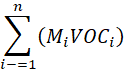
 Weighted average monomer VOC content = __________________________

(c) Control option 3 shall consist of meeting a
facility-specific monomer VOC mass emission limit on a consecutive 12-month
period that is determined using the formulas specified in Env-A 1219.03; or
(d) Control option 4 shall consist of using
add-on controls to achieve a numerical monomer VOC emission limit that is
determined for each facility in accordance with the equation in Env-A
1219.03(a), based on the mix of application methods and materials used at that
facility, except that instead of using the mass of each material used over the
past 12 consecutive months, the facility shall use the mass of each material
used during the control device performance test.
Source. (See Revision Note at chapter heading for
Env-A 1200) #9933, eff 6-1-11; ss by #12899, eff 10-17-19
Env-A
1219.03 Determining Compliance with
Option 3.
(a) A facility choosing option 3 in Env-A
1219.02(c) for any of its operations shall determine a facility-specific
monomer VOC mass emission limit, calculated on a consecutive 12-month period at
the end of every month, by using the following formula:
(1) “Monomer
VOC Limit” means total allowable monomer VOC that can be emitted from the open
molding operations included in the average, kilograms per 12-month period;
(2) “MR”
means mass of production resin used in the past 12 months, excluding any
materials that are exempt, in megagrams;
(3) “MPG”
means the mass of pigmented gel coat used in the past 12 months, excluding any
materials that are exempt, in megagrams;
(4) “MCG”
means the mass of clear gel coat used in the past 12 months, excluding any
materials that are exempt, in megagrams;
(5) “MTR”
means the mass of tooling resin used in the past 12 months, excluding any
materials that are exempt, in megagrams;
(6) “MTG”
means the mass of tooling gel coat used in the past 12 months, excluding any
materials that are exempt, in megagrams; and
(7) The
monomer VOC limit shall equal the sum of the products of 46 times MR,
159 times MPG, 291 times MCG, 54 times MTR,
and 214 times MTG, as in the following equation:
Monomer VOC Limit = 46(MR) + 159(MPG) + 291(MCG)
+ 54(MTR) + 214(MTG)
(b) At the end of the first 12-month averaging
period and at the end of every subsequent month, a facility choosing option 3
shall use the following equation to show that the monomer VOC emissions from
the operations included in the average do not exceed the emission limit
calculated using the equation in (a), above, for the same 12-month period:
(1) “Monomer
VOC emissions” means monomer VOC emissions calculated using the monomer VOC
emission equations for each operation included in the average, in kilograms;
(2) “PVR”
means weighted-average monomer VOC emission rate for production resin used in
the past 12 months, in kilograms per megagram;
(3) “MR”
means mass of production resin used in the past 12 months, in megagrams;
(4) “PVPG”
means weighted-average monomer VOC emission rate for pigmented gel coat used in
the past 12 months, in kilograms per megagram;
(5) “MPG”
means mass of pigmented gel coat used in the past 12 months, in megagrams;
(6) “PVCG”
means weighted-average monomer VOC emission rate for clear gel coat used in the
past 12 months, in kilograms per megagram;
(7) “MCG”
means mass of clear gel coat used in the past 12 months, in megagrams;
(8) “PVTR”
means weighted-average monomer VOC emission rate for tooling resin used in the
past 12 months, in kilograms per megagram;
(9) “MTR”
means mass of tooling resin used in the past 12 months, in megagrams;
(10) “PVTG”
means weighted-average monomer VOC emission rate for tooling gel coat used in
the past 12 months, in kilograms per megagram;
(11) MTG”
means mass of tooling gel coat used in the past 12 months, in megagrams; and
(12) Monomer
VOC emissions shall equal the sum of the products of PVR times MR,
PVPG times MPG, PVCG times MCG, PVTR
times MTR, and PVTG times MTG, as in the
following equation:

(c) A facility choosing option 3 shall use the
following equation to compute the weighted-average monomer VOC emission rate
for the previous 12 consecutive months for each open molding resin and gel coat
operation included in the average:
(1) “PVOP”
means the weighted-average monomer VOC emission rate for each open molding
operation (PVR, PVPG, PVCG, PVTR,
and PVTG) included in the average, in kilograms of monomer VOC per
megagram of material applied;
(2) “Mi”
means the mass of resin or gel coat i used within an
operation in the past 12 months, in megagrams;
(3) “n”
means the number of different open molding resins and gel coats used within an
operation in the past 12 months;
(4) “PVi” means the monomer VOC emission rate for
resin or gel coat i used within an operation in the
past 12 months, in kilograms of monomer VOC per megagram of material
applied. Use the formulas in table
1219-2 to compute PVi; and
(5) PVOP
shall equal the sum of the products of Mi and PVi
for open molding resin or gel coats one through n, divided by Mi one
through n, as in the following equation:

 _________________


Table 1219-2
Monomer VOC Emission Rate Formulas for Open Molding Operations
|
Material Used |
Application Method |
Formula to Calculate
the Monomer VOC Emission Rate or PVi |
|
1. Production
resin, tooling resin |
a. Atomized |
0.014 x (Resin VOC%)2.425 |
|
b. Atomized, plus vacuum bagging with
roll-out |
0.01185 x (Resin VOC%)2.425 |
|
|
c. Atomized, plus vacuum bagging without
roll-out |
0.00945 x (Resin VOC%)2.425 |
|
|
d. Nonatomized |
0.014 x (Resin VOC%)2.275 |
|
|
e. Nonatomized,
plus vacuum bagging with roll-out |
0.0110 x (Resin VOC%)2.275 |
|
|
f. Nonatomized,
plus vacuum bagging without roll-out |
0.0076 x (Resin VOC%)2.275 |
|
|
2. Pigmented gel coat, clear gel coat,
tooling gel coat |
All methods |
0.445 x (Gel coat VOC%)1.675 |
Source. (See Revision Note at chapter heading for
Env-A 1200) #9933, eff 6-1-11; ss by #12899, eff 10-17-19
Env-A 1219.04 Non-monomer
VOC Content.
(a) Up to 5 percent of the non-monomer VOC
content of a resin or gel coat shall be exempt from the VOC content limits of
this part.
(b) If the non-monomer VOC content of a resin or gel coat exceeds 5
percent, then the excess non-monomer VOC over 5 percent shall be added to the
monomer VOC content.
Source. (See Revision Note at chapter heading for
Env-A 1200) #9933, eff 6-1-11; ss by #12899, eff 10-17-19
Env-A 1219.05 Controls for Specified Resins, Gel Coats,
and Operations.
(a) The control options specified in Env-A
1219.02 shall not apply to the following:
(1) Production
resins, including skin coat resins, that must meet specifications for use in
military vessels or must be approved by the U.S. Coast Guard for use in the
construction of lifeboats, rescue boats, and other life-saving appliances
approved under 46 CFR subchapter Q, or the construction of small passenger
vessels regulated by 46 CFR subchapter T;
(2) Production
and tooling resins, and pigmented, clear, and tooling gel coats used for part
or mold repair and touch up;
(3) Pure,
100-percent vinylester resin used for skin coats; and
(4) Closed
molding operations.
(b) The resins specified in (a)(1) and (a)(3),
above, shall be applied with nonatomizing resin
application equipment.
(c) The total resin and gel coat materials
specified in (a)(2), above, shall not exceed one percent by weight of all
resins and gel coats used at that fiberglass boat manufacturing facility during
any 12 consecutive month period.
(d) The total resin materials specified in
(a)(3), above, shall not exceed 5 percent by weight of all resins and gel coats
used at that fiberglass boat manufacturing facility on a 12 consecutive month
period.
Source. (See Revision Note at chapter heading for
Env-A 1200) #9933, eff 6-1-11; ss by #12899, eff 10-17-19
Env-A 1219.06 Calculating Emission Rates for Filled
Resins.
(a) When using a filled production resin or
filled tooling resin, the owner or operator shall calculate the emission rate
for the filled material on an as-applied basis using the following formula:
(1) “PVF”
means the as-applied monomer VOC emission rate for the filled production resin
or tooling resin, kilograms monomer VOC per megagram of filled material;
(2) “PVU”
means the monomer VOC emission rate for the neat or unfilled resin, before
filler is added, as calculated using the formulas in Table 1219-2;
(3) “%
filler” means the weight-percent of filler in the as-applied filled resin
system; and
(4) PVF
shall be equal to 100 minus the weight-percent of filler, divided by 100,
the entire quantity multiplied by PVU, as in the following equation:

(b) If the filled resin is used as a production
resin, the value of PVF calculated by the equation in (a), above,
shall not exceed 46 kilograms of monomer VOC per megagram of filled resin
applied.
(c) If the filled resin is used as a tooling
resin, the value of PVF calculated by the equation in (a), above,
shall not exceed 54 kilograms of monomer VOC per megagram of filled resin
applied.
(d) If the facility is
including a filled resin in the emissions averaging procedure specified
in Env-A 1219.03, the facility shall use the value of PVF calculated
using the equation in (a), above, for the value of PVi
in the equation specified in Env-A 1219.03(c)(4).
Source. (See Revision Note at chapter heading for
Env-A 1200) #9933, eff 6-1-11; ss by #12899, eff 10-17-19
Env-A
1219.07 Work Practice Standards.
(a) All resin and gel coat mixing containers with
a capacity equal to or greater than 208 liters, equivalent to 55
gallons, including those used for on-site mixing of putties and polyputties, shall have a cover with no visible gaps in
place at all times, except when material is being manually added to or removed
from a container, or when mixing or pumping equipment is being placed in or
removed from a container.
(b) VOC cleaning solvents for routine application
equipment cleaning shall contain no more than 5 percent VOC, by weight, or have
a composite vapor pressure of no more than 0.50 mm Hg at 68 ºF.
(c) Only non-VOC solvents shall be used to remove
cured resin and gel coat from application equipment.
Source. (See Revision Note at chapter heading for
Env-A 1200) #9933, eff 6-1-11; ss by #12899, eff 10-17-19
PART Env-A 1220 MISCELLANEOUS INDUSTRIAL ADHESIVES
Env-A 1220.01 Applicability Criteria for Miscellaneous
Industrial Adhesives.
(a)
On and after January 1, 2016, a source whose miscellaneous industrial
adhesive and adhesive primer application processes, including related cleaning
activities, have combined actual emissions, before controls, during any
consecutive 12-month period which equal or exceed 3 tons of VOCs shall be
subject to this part.
(b)
Any source that is
subject to this chapter and whose use of industrial adhesives is associated
with a category listed below shall be exempt from this part:
(1) Metal furniture coatings;
(2) Flat wood paneling coatings;
(3) Paper, film, and foil coatings;
(4) Offset lithographic printing and letterpress
printing;
(5) Flexible package printing;
(6) Coil coating; and
(7) Fabric coating.
Source. (See Revision Note at chapter heading for
Env-A 1200) #9933, eff 6-1-11; ss by #12899, eff 10-17-19
Env-A 1220.02 Compliance
Standards for Miscellaneous Industrial Adhesives.
(a) Except as provided in (d) or (e), below, and Env-A
1220.03, those processes using general or specialty adhesive applications or
adhesive primer applications shall control VOC emissions by using adhesives
that meet the limits specified in Table 1220-1, below, subject to (b) and (c),
below:
Table
1220-1 VOC Content Limits for Adhesive
and Adhesive Primer Application Processes
|
Type of Adhesive Application Process |
VOC Emission Limit |
|
|
(g/l) |
(lb/gal) |
|
|
General |
|
|
|
Reinforced
plastic composite |
200 |
1.7 |
|
Flexible
vinyl |
250 |
2.1 |
|
Metal
|
30 |
0.3 |
|
Porous
material (except wood) |
120 |
1.0 |
|
Rubber |
250 |
2.1 |
|
Wood |
30 |
0.3 |
|
Other
substrates |
250 |
2.1 |
|
Specialty |
|
|
|
Ceramic
tile installation |
130 |
1.1 |
|
Contact
bond adhesive |
250 |
2.1 |
|
Cove
base installation |
150 |
1.3 |
|
Floor
covering installation (Indoor) |
150 |
1.3 |
|
Floor
covering installation (Outdoor) |
250 |
2.1 |
|
Perimeter-bonded
sheet vinyl flooring installation |
660 |
5.5 |
|
Metal
to urethane/rubber molding or casting |
850 |
7.1 |
|
Motor
vehicle adhesive |
250 |
2.1 |
|
Motor
vehicle weatherstrip adhesive |
750 |
6.3 |
|
Multipurpose
construction |
200 |
1.7 |
|
Plastic
solvent welding (ABS) |
400 |
3.3 |
|
Plastic
solvent welding (Except ABS) |
500 |
4.2 |
|
Sheet
rubber lining installation |
850 |
7.1 |
|
Single-ply
roof membrane installation/repair (except EPDM) |
250 |
2.1 |
|
Structural
glazing |
100 |
0.8 |
|
Thin
metal laminating |
780 |
6.5 |
|
Tire
repair |
100 |
0.8 |
|
Waterproof
resorcinol glue |
170 |
1.4 |
|
Adhesive
Primer |
|
|
|
Motor
vehicle glass bonding primer |
900 |
7.5 |
|
Plastic
solvent welding adhesive primer |
650 |
5.4 |
|
Single-ply
roof membrane adhesive primer |
250 |
2.1 |
|
Other
adhesive primer |
250 |
2.1 |
(b)
“VOC emission limit” means the mass of VOC per volume of adhesive or
adhesive primer, excluding water and exempt compounds, as applied.
(c)
If an adhesive is used to bond dissimilar substrates together, then the
applicable substrate category with the least stringent VOC emission limit shall
be the limit for such application.
(d)
To meet the limits in Table 1220-1, above, a source may combine low-VOC
content adhesives, the application methods specified in Env-A 1220.04, and
add-on control equipment.
(e)
As an alternative to the
VOC emission limits Table 1220-1, above, a source shall achieve an overall
control efficiency of at least 85%.
Source. (See Revision Note at chapter heading for
Env-A 1200) #9933, eff 6-1-11; ss by #12899, eff 10-17-19
Env-A
1220.03 Excluded Adhesives and
Processes. The standards specified
in Env-A 1220.02 shall not apply to the following types of adhesives and
adhesives primer application processes:
(a) Adhesives or adhesive primers being tested or
evaluated in any research and development, quality assurance, or analytical
laboratory;
(b) Adhesives or adhesive primers used in the
assembly, repair, or manufacture of aerospace or undersea-based weapon systems;
(c) Adhesives or adhesive primers used in medical
equipment manufacturing operations;
(d) Cyanoacrylate adhesive application processes;
(e) Aerosol adhesive and aerosol adhesive primer
application processes;
(f) Processes using polyester bonding putties to
assemble fiberglass parts at fiberglass boat manufacturing facilities and at
other reinforced plastic composite manufacturing facilities; and
(g) Processes using
adhesives and adhesive primers that are supplied to the manufacturer in
containers with a net volume of 16 ounces or less, or a net weight of one pound
or less.
Source. (See Revision Note at chapter heading for
Env-A 1200) #9933, eff 6-1-11; ss by #12899, eff 10-17-19
Env-A
1220.04 Application Methods. A source that is subject to Env-A 1220.02
shall use one of the following application methods:
(a) Electrostatic spray;
(b) HVLP spray;
(c) Flow coat, roll coat, or hand application,
including non-spray application methods similar to
hand or mechanically powered caulking gun, brush, or direct hand application;
(d) Dip coat, including electrodeposition;
(e) Airless spray;
(f) Air-assisted airless spray; or
(g) Other adhesive application methods capable of
achieving a transfer efficiency equivalent to or better than that achieved by
HVLP spraying.
Source. (See Revision Note at chapter heading for
Env-A 1200) #9933, eff 6-1-11; ss by #12899, eff 10-17-19
Env-A
1220.05 Work Practices for Waste
Materials. A source shall implement
the following work practices for adhesives, thinners and adhesive-related waste
materials, including those specified in Env-A 1220.03:
(a) Store all VOC-containing adhesives, adhesive
primers, and process-related waste materials in closed containers;
(b) Ensure that mixing and storage containers
used for VOC-containing adhesives, adhesives primers, and process-related waste
materials are kept closed at all times except when
depositing or removing these materials;
(c) Minimize spills of VOC-containing adhesives,
adhesive primers, and process-related waste materials; and
(d) Convey VOC-containing adhesives, adhesive
primers, and process-related waste materials from one location to another in
closed containers or pipes.
Source. (See Revision Note at chapter heading for
Env-A 1200) #9933, eff 6-1-11; ss by #12899, eff 10-17-19
Env-A
1220.06 Work Practices for Cleaning
Materials. A source shall implement
the following work practices for cleaning materials used for surface
preparation or for application equipment cleaning:
(a) Store all VOC-containing cleaning materials
and used shop towels in closed containers;
(b) Ensure that storage containers used for
VOC-containing cleaning materials are kept closed at all
times except when depositing or removing these materials;
(c) Minimize spills of VOC-containing cleaning
materials;
(d) Convey VOC-containing cleaning materials from
one location to another in closed containers or pipes; and
(e) Minimize VOC emissions from the cleaning of
application, storage, mixing, and conveying equipment by ensuring that
equipment cleaning is performed without atomizing the cleaning solvent and that
all spent solvent is captured in closed containers.
Source. (See Revision Note at chapter heading for
Env-A 1200) #9933, eff 6-1-11; ss by #12899, eff 10-17-19
PART Env-A 1221 INDUSTRIAL CLEANING SOLVENTS
Env-A 1221.01
Applicability Criteria for Solvent Metal Cleaning.
(a) A cold cleaning
machine that has an operating capacity of not more than one liter, equivalent to 0.26 gallon, of VOC shall be exempt from Env-A 1221.02.
(b) An open top vapor
degreaser with an open top area less than 1.0 square meter (m2) ,
equivalent to 10.8 square feet (ft2), shall be exempt from Env-A
1221.03 if the owner or operator uses appropriate work practices to reduce VOC
emission and prevent solvent spillage including, but not limited to, keeping
the cover closed on the machine at all times except when processing work loads through the degreaser and storing waste solvent
in closed containers.
(c) A conveyorized
degreaser with an air/solvent interface area less than 2.0 m2,
equivalent to 21.6 ft2, shall be exempt from Env-A 1221.04(a).
Source. (See Revision Note at chapter heading for
Env-A 1200) #9933, eff 6-1-11; ss by #12899, eff 10-17-19
Env-A 1221.02 Compliance
Standards for Cold Cleaning.
(a)
The owner or operator of a cold cleaning process shall control such
process by using the control techniques, operating requirements, and equipment
described below:
(1) Control techniques shall include the
following:
a. To prevent spillage, either:
1. A freeboard height that gives a freeboard
ratio greater than or equal to 0.75 unless the machine is equipped with a cover
that is kept closed except when parts are being placed into or being
removed from the machine; or
2. A water cover at least 2.54 centimeter (cm) , equivalent to 1
inch (in), deep, where the solvent
is insoluble in and heavier than water;
b. If a solvent spray is used, the spray nozzle
shall be capable of delivering a cohesive fluid stream, rather than a fine,
atomized or shower type spray, operated according to (2)f., below; and
c. A permanent,
legible, and conspicuous label, summarizing the operating requirements
specified in (2), below, affixed to each solvent container or other location
where it can be easily seen by the operator;
(2) Operating
requirements shall be as follows:
a. Waste
solvent shall be stored only in covered containers;
b. The degreaser
cover shall be closed whenever parts in the cleaner are not being handled
manually;
c. Cleaned parts shall
be drained for at least 15 seconds or until dripping ceases, whichever is
longer;
d. Solvent leaks shall
be repaired immediately or the degreaser shall be shut
down;
e. Drafts across the
top of each cold cleaning unit shall be minimized;
f. Where a solvent
spray is used, such spraying shall be:
1. Operated at
a pressure which does not exceed 10 psig as measured
at the pump outlet; and
2. Performed
only within the confines of the degreasing unit;
g. Sponges,
fabric, wood, leather, paper products, and other absorbent materials shall not
be cleaned in a cold cleaning machine;
h. No solvent
shall be used if it has a vapor pressure of 1.0 millimeters of mercury (mm Hg)
or greater, measured at 20oC, equivalent to 68oF; and
i. The operator of
a cold cleaning machine shall maintain for not less than 2 years and shall
provide to the department, on request:
1. The
information specified in (c)(1), below, in the form of an invoice, bill of
sale, or certificate that corresponds to a number of
sales; and
2. The material
safety data sheet (MSDS) as specified in (c)(2), below; and
(3) If the cold
cleaning machine can hold more than 7.5 liters, control equipment shall include
the following:
a. A tank cover
that is easily operated with one hand; and
b. An
internally mounted drainage device that operates such that parts to be cleaned
are enclosed under the cover while draining, except that the drainage device
may be external for applications where an internal type cannot fit into the
cleaning system.
(b) No person shall sell or offer for sale for
use in a cold cleaning machine in New Hampshire any solvent having a vapor
pressure of 1.0 mm Hg or greater, measured at 20oC, equivalent to 68oF.
(c)
Any person who sells or offers for sale any solvent for use in a cold
cleaning machine in
(1) The name and address of the solvent supplier;
and
(2) A MSDS listing the type of solvent, the
product or vendor identification number, and the vapor pressure of the solvent
measured in mm Hg at 20oC, equivalent to 68oF.
Source. (See Revision Note at chapter heading for
Env-A 1200) #9933, eff 6-1-11; ss by #12899, eff 10-17-19
Env-A 1221.03
Compliance Standards for Open Top Vapor Degreasers. Open top vapor degreasers shall be controlled
using the control equipment, techniques, and operating requirements described
below:
(a)
Control equipment shall consist of the following:
(1) A cover, located below the lip exhaust, if
any, that can be opened and closed easily without disturbing the vapor zone;
(2) Safety switches, as follows:
a. Equipment preventing heat input to the sump
when the condenser coolant is not circulating or when the liquid solvent level
drops down to the height of the sump heater coils;
b. Equipment preventing spraying outside the
vapor level; and
c. Equipment that shuts off the sump heat if the
upper vapor level rises above the height of the primary condenser;
(b)
Control techniques shall consist of the following:
(1) For degreasers with an open area equal to or
greater than one m2, equivalent to 10.8 ft2, at least one
of the following techniques or combination of techniques:
a. The combination of:
1. A freeboard ratio greater than or equal to 0.75; and
2. A powered cover;
b. An enclosed design, such as a
cover or door which opens only when the dry part is actually
entering or exiting the degreaser;
c. A refrigerated chiller that is capable of maintaining the chilled air blanket
temperature, measured at the centroid of the degreaser at the coldest point, at
no more than 30% of the solvent's boiling point (F); or
d. A carbon adsorption system
meeting the requirements of (c), below; and
(2) For degreasers with an open area less than
one m2, equivalent to 10.8 ft2, at least one of the
following techniques:
a. A freeboard ratio greater than or equal to
0.75; or
b. An enclosed design, such as a cover or door
which opens only when the dry part is actually entering
or exiting the degreaser;
(c)
A carbon adsorption system installed pursuant to (b)(1)d., above, shall
comply with the following operational requirements:
(1) Ventilation greater than or equal to 15 m3/min
per m2, equivalent to 50 cfm/ft2 of air/vapor area when
cover is open; and
(2) Exhausting less than 25 ppm solvent averaged
over one complete adsorption cycle or 24 hours, whichever is less; and
(d)
Operating requirements shall be as follows:
(1) The cover shall be kept closed
at all times except when processing work loads
through the degreaser;
(2) Solvent carry-out shall be minimized by using
the following measures:
a. Racking parts to allow full drainage;
b. Moving parts in and out of the degreaser at
less than 3.3 m/min, equivalent to 11 ft/min;
c. Degreasing the work load in the vapor zone at least 30 seconds or until
condensation ceases, whichever is longer;
d. Tipping out any pools of solvent on the
cleaned parts before removal; and
e. Allowing parts to dry
within the freeboard zone of the degreaser for at least 15 seconds or until
visually dry, whichever is longer;
(3) The unit shall not be
used to degrease porous or absorbent materials, such
as cloths, leather, wood, or rope;
(4) Work loads shall not occupy more
than half of the degreaser's open top area;
(5) The degreaser shall
not be loaded to the point where the vapor level would drop
more than 10 centimeters, equivalent to 4 inches, when the workload is removed
from the vapor zone;
(6) No spraying shall occur above
the vapor level;
(7) Solvent leaks shall be repaired immediately,
or the degreaser shut down;
(8) The evaporation of waste solvent
into the ambient air shall not exceed 20% of the weight of the waste during the
process of:
a. Disposing of the waste solvent; or
b. Transferring the waste solvent to another
person;
(9) Waste solvent shall
be stored only in closed containers;
(10) Exhaust ventilation shall not exceed 20 m3/min
per m2, equivalent to 65 cfm per ft2, of degreaser open
area, unless necessary to meet OSHA requirements;
(11) Drafts shall be minimized across the top of
each degreasing unit such that whenever the cover is open, the unit is not
exposed to drafts greater than 40 meters, equivalent to 131 feet, per minute, as measured
between 1 and 2 meters, equivalent to 3.3 and 6.6 feet, upwind and at the same
elevation as the tank lip;
(12) Water shall not be visually detectable in
solvent exiting the water separator; and
(13) A permanent, legible, and conspicuous label,
summarizing the operating requirements listed above, shall be affixed to each
solvent container or other location where it can be easily seen by the
operator.
Source. (See Revision Note at chapter heading for
Env-A 1200) #9933, eff 6-1-11; ss by #12899, eff 10-17-19
Env-A 1221.04
Compliance Standards for Conveyorized Degreasers. Conveyorized degreasers shall be controlled
using the control equipment, techniques, and operating requirements
described below:
(a)
The degreaser shall be controlled by one of the following major control
techniques:
(1)
Refrigerated
chiller; or
(2) Carbon adsorption system meeting the
operational requirements of (c)(10), below;
(b)
Control equipment shall consist of the following:
(1) A drying tunnel, or another means to prevent
cleaned parts from carrying out solvent liquid or vapor, such as a rotating or
tumbling basket;
(2) Safety switches, as follows:
a. Equipment preventing heat input to the sump
when the liquid solvent level drops down to the height of the sump heater coils
or the condenser coolant is not circulating;
b. Equipment preventing spraying outside the
vapor level; and
c. A vapor level control thermostat which shuts
off the sump heat if the vapor level rises above the height of the primary
condenser;
(3) Entrances and exits that silhouette work loads so that the average clearance between parts and
the edge of the degreaser opening is either less than 10 cm, equivalent to 4
in., or less than 10% of the width of the opening; and
(4) Covers for closing off the entrance
and exit during shut-down hours; and
(c) Operating
requirements shall be as follows:
(1) Exhaust ventilation shall
not exceed 20 m3/min per m2, equivalent to 65 cfm per ft2,
of degreaser open area, unless necessary to meet OSHA requirements;
(2) Drafts shall be minimized across the top of
each degreasing unit such that whenever the cover is open, the unit is not
exposed to drafts greater than 40 meters per minute, as measured between
1 and 2 meters upwind and at the same elevation as the tank lip;
(3) Draft velocity shall be determined by the testing
method prescribed in Env-A 804.21;
(4) Carry-out emissions shall be minimized by:
a. Racking parts for best drainage; and
b. Maintaining vertical conveyor speed at less
than 3.3 m/min,
equivalent to 11 ft/min;
(5) The evaporation of waste solvent into the
ambient air shall not exceed 20% of the weight of the waste
during the process of:
a. Disposing of the waste solvent; or
b. Transferring the waste solvent to another
person;
(6) Waste solvent shall be stored only in covered
containers;
(7) Solvent leaks shall be repaired immediately,
or the degreaser shut down;
(8) Water shall not be visibly detectable in the
solvent exiting the water separator;
(9) Down-time covers shall:
a. Be placed over entrances and exits of
conveyorized degreasers immediately after the conveyor and exhaust are
shutdown; and
b. Be removed just before the conveyor and
exhaust are started up; and
(10) All carbon adsorption systems installed pursuant
to (a)(2), above, shall:
a. Provide ventilation greater than or equal to
15 m3/min
per m2, equivalent to 50
cfm/ft2,
of the air/solvent interface area when down-time covers are open; and
b. Exhaust less than 25 ppm of solvent by volume
averaged over the length of one complete adsorption cycle or 24 hours,
whichever is less.
Source. (See Revision Note at chapter heading for
Env-A 1200) #9933, eff 6-1-11; ss by #12899, eff 10-17-19
Env-A 1221.05 Applicability
Criteria for the Use of Industrial Cleaning Solvents. Except as provided in Env-A 1221.06, the
owner or operator of a source that uses organic solvents in its cleaning
activities and which has actual emissions, before controls, during any
consecutive 12-month period of 3 tons of VOCs from the cleaning activities
shall comply with the requirements in Env-A 1221.07 on and after January 1,
2016.
Source. (See Revision Note at chapter heading for
Env-A 1200) #9933, eff 6-1-11; ss by #12899, eff 10-17-19
Env-A 1221.06 Exemptions. The use of industrial cleaning solvents at the
following sources or in conjunction with the following activities shall be
exempt from Env-A 1221.07:
(a) Any source that is
subject to this chapter and whose cleaning activities are associated with a
category listed below:
(1) Paper, fabric, film, and foil coating;
(2) Metal furniture coating;
(3) Wood furniture coating;
(4) Flexible packaging printing;
(5) Offset lithographic and letterpress printing;
(6) Flat wood paneling coating;
(7) Miscellaneous metal products coating;
(8) Plastic parts coating;
(9) Fiberglass boat manufacturing materials; and
(10) Miscellaneous industrial adhesives;
(b) Solvent metal
cleaning activities performed pursuant to Env-A 1221.02, Env-A 1221.03, or
Env-A 1221.04, as applicable;
(c) Any aerospace manufacturing and rework
facility, provided that the cleaning solvent is used in accordance with the
requirements of 40 CFR 63.744, inclusive of exemptions;
(d) A
cleaning activity, including surface preparation prior to coating, necessary to
meet a standard or specification issued or approved by the United States
Department of Defense, Federal Aviation Administration or other federal
government entity, provided that any person claiming exemption pursuant to this
paragraph shall maintain records of the standard or specification;
(e) Quality control or laboratory testing;
(f) Medical device manufacturing;
(g) Pharmaceutical manufacturing;
(h) Any source that exceeds the applicable limit
of Env-A 1221.07(b) where the quantity used does not exceed 55 gallons per any
12-month rolling aggregate, provided that any person claiming exemption
pursuant to this paragraph shall record and maintain monthly records sufficient
to demonstrate compliance with this exemption;
(i) A digital printing press;
(j) The cleaning of screen
printing equipment, if the cleaning solvent used has an as-applied VOC
content that does not exceed 500 grams per liter, equivalent to 4.2 pounds per gallon;
(k) Stripping;
(l) Cleaning of electrical and electronic
components;
(m) Cleaning of high-precision optics; and
(n) Cleaning of resin, coating, ink, and adhesive
mixing, molding, and application equipment by applicators of those substances.
Source. (See Revision Note at chapter heading for
Env-A 1200) #9933, eff 6-1-11; ss by #12899, eff 10-17-19
Env-A 1221.07 Compliance
Standards for the Use of Industrial Cleaning Solvents.
(a) The owner or
operator of a source subject to this section shall limit VOC emissions from the
use, handling, storage, and disposal of cleaning solvents and shop towels by
implementing the following work practices:
(1) Covering open containers and used
applicators;
(2) Minimizing air circulation around cleaning
operations;
(3) Properly disposing of used solvents and shop
towels; and
(4) Maintaining cleaning equipment to prevent and
repair solvent leaks.
(b) Except as provided
in (c) or (d), below, the owner or operator of a source subject to this section
shall limit VOC emissions by using cleaning solvents with a maximum VOC content
limit of 50 grams VOC per liter, equivalent to 0.42 lb/gal.
(c) As an alternative
to the content limit in (b), above, an owner or operator shall either:
(1) Use a cleaning solvent with a composite vapor pressure of 8.0 millimeters
or less of mercury (mm Hg), measured at 20oC, equivalent to 68oF;
or
(2) Comply with the RACT order provisions in
Env-A 1205.03 through Env-A 1205.06.
(d) As an alternative
to the content limit in (b), above, a manufacturer of coatings, inks, resin, or
adhesives shall control VOC emissions when cleaning portable or stationary mixing vats, high dispersion mills, grinding
mills, tote tanks, and roller mills by:
(1) Collecting and venting the emissions to a VOC
emission control system that has an overall capture and control efficiency of
at least 80 percent, by weight, for the VOC emissions, provided that where the
reduction is achieved by incineration, at least 90 percent of the organic
carbon shall be oxidized to carbon dioxide;
(2) Using a cleaning solvent that contains less
than 200 g/l VOC, equivalent to 1.67 lb/gal; or
(3) Using organic solvents other than those
allowed in (b) or (c)(1), above, provided that:
a. No more than 60 gallons of fresh cleaning
solvent shall be used per month; and
b. The owner or operator shall maintain records
for 5 years on the total volume of fresh cleaning solvent used and the total
volume of cleaning solvent recovered for on-site or off-site recycling.
Source. (See Revision Note at chapter heading for
Env-A 1200) #9933, eff 6-1-11; ss by #12899, eff 10-17-19
PART Env-A 1222 MISCELLANEOUS AND MULTICATEGORY STATIONARY
VOC SOURCES
Env-A 1222.01
Applicability Criteria for Miscellaneous and Multicategory Stationary
VOC Sources.
(a) Any miscellaneous
or multicategory stationary VOC source whose combined
TPEs for all processes and devices equal or exceed 50 tons of VOC in any
consecutive 12-month period shall be subject to Env-A 1222.02 and Env-A
1222.03, except as specified in (b) through (e), below.
(b) The following
processes and devices shall be exempt from the provisions of Env-A 1222.02 and
Env-A 1222.03:
(1) VOC-emitting processes and devices that are subject to
regulation under 40 CFR 61 or 40 CFR 63, in accordance with Env-A 600, subject
to the provisions of (c), below;
(2)
VOC-emitting processes and devices that have been determined to be
achieving Best Available Control Technology (BACT) for VOC or the Lowest
Achievable Emission Rate (LAER) for VOC imposed in a enforceable permit or
license that contains specific emission limitations, work practice standards,
or both for all affected VOC-emitting processes and devices and which was
issued pursuant to federally enforceable permitting rules;
(3) VOC-emitting processes and devices that have
been determined to be achieving RACT pursuant to a federally enforceable rule
or permit;
(4) Incomplete combustion, except where material
is heated, burned, combusted, or otherwise chemically changed under
oxygen-deficient conditions by design;
(5) VOC emissions from non-core activities listed
in Env-A 1203.53;
(6) Testing and research activities excluded
under Env-A 1201.04(d).
(c) VOC-emitting processes and devices, unless a
prior extension of compliance as provided in 40 CFR 63, Subpart D, has been
granted, shall be exempt from the provisions of Env-A 1222.02 and Env-A 1222.03
provided that the total VOC emissions to the atmosphere from such equipment are
reduced, on a daily basis, to a percentage equal to or greater than the
percentage of hazardous air pollutants, excluding particulate matter hazardous
air pollutants, required to be reduced in the applicable subpart under 40 CFR
61 or 40 CFR 63.
(d) Control option 3 in Env-A 1222.02(a)(3) shall
be applicable only to the unclassifiable coating processes of RACT-applicable
multicategory or miscellaneous stationary VOC sources.
(e) Control option 4 in Env-A 1222.02(a)(4) shall
be applicable only to the classifiable components of RACT-applicable
multicategory stationary VOC sources.
Source. (See Revision Note at chapter heading for
Env-A 1200) #9933, eff 6-1-11; amd by #10145, eff
6-19-12; ss by #12899, eff 10-17-19
Env-A 1222.02 Compliance
Options for Miscellaneous and Multicategory Stationary VOC Sources.
(a)
VOC emissions from miscellaneous or multicategory stationary VOC sources
meeting the applicability criteria in Env-A 1222.01 and not
explicitly exempted by that section shall be
controlled using one of the following control options:
(1) Control option 1 shall consist of the
installation and operation of capture and control systems that result in a
facility-wide reduction in the actual uncontrolled VOC emission rate to the
atmosphere, calculated as a 24-hour
calendar day average, of at least 81%, as determined by dividing the
difference between the facility-wide uncontrolled VOC emissions from all
non-exempt processes and the facility-wide VOC emissions after controls from
all non-exempt processes by the facility-wide uncontrolled VOC emissions from
all non-exempt processes;
(2) Control option 2 shall consist of a program
to reduce VOC use and emissions that is implemented such that the actual VOC
emission rate does not exceed 20% of the actual VOC emission rate in calendar
year 1990, or alternative year required pursuant to Env-A 1222.04, below,
calculated on either:
a. A mass of VOC per mass of solids basis if the
affected VOC-emitting process(es) or device(s) applies surface coatings; or
b. A mass of VOC per unit of
production basis;
(3) Control option 3 shall consist of:
a. Limiting the daily weighted average VOC
emission rate from any unclassifiable coating process or device to 0.40 kg
VOC/l,
equivalent to 3.5 lb VOC/gallon, of coating, as
applied, excluding water and exempt compounds, as calculated using the
procedure described in Env-A 804.06; and
b. Complying with the provisions of (1) or (2)
above, or (4) or (5) below, where applicable, for the unclassifiable non-coating and
classifiable components of the source;
(4) Control option 4 shall consist of:
a. Complying with the provision(s) in Env-A
1206.01 through Env-A 1221.06 for each
classifiable component of a multicategory source, whichever
provision(s) are relevant, irrespective of whether the component meets the
relevant applicability criteria for the relevant classifiable category;
b. Complying with the provisions of (1), (2), or
(3) above, or (5) below, where applicable, for the unclassifiable components of the
source;
c. Complying with the applicable provisions of
Env-A 1206.01 through Env-A 1221.06, regardless of the option in this
paragraph chosen by the source owner of operator, for all RACT-applicable
classifiable components of the source; or
(5) Control option 5 shall consist of the
implementation of a department and EPA-approvable plan, issued as a RACT order,
pursuant to the provisions of Env-A 1205.03 and Env-A 1205.06.
(b)
VOC emissions from RACT-applicable classifiable processes or devices at
miscellaneous stationary VOC sources meeting the applicability criteria of
Env-A 1222.01
shall be subject to the control requirements of the particular
sections of this chapter pertaining to the appropriate classifiable
process or device.
(c) VOC emissions from
RACT-applicable classifiable processes or devices at multicategory stationary
VOC sources adopting control option 4 shall be subject to the control
requirements of the particular sections of this
chapter pertaining to the appropriate classifiable process or device.
Source. (See Revision Note at chapter heading for
Env-A 1200) #9933, eff 6-1-11; ss by #12899, eff 10-17-19
Env-A
1222.03 Documentation Required for
Miscellaneous and Multicategory Stationary VOC Sources.
(a) The following documentation shall be
submitted to the department by the owner or operator of all applicable sources
subject to the requirements of Env-A 1222.02, regardless of the control option
selected:
(1)
An inventory of all VOC-emitting processes or devices at the source;
(2)
An inventory of all VOC-emitting processes or devices at the source not exempt under the applicable provisions of Env-A 1201.04;
(3)
The maximum capacity of each affected VOC-emitting process or device to
emit VOCs at the source not exempt under the
applicable provisions of Env-A 1201.04; and
(4)
The daily average of actual VOCs emitted, based on solvent throughput or
units of production, for each RACT-applicable VOC-emitting process or device at
the source for the following time periods:
a.
Calendar year 1990, or alternative calendar year or consecutive 12-month
period required pursuant to Env-A 1222.04; and
b.
The ozone season of calendar year 1990, or alternative calendar
year required pursuant to Env-A 1222.04.
(b) The owner or operator of a source that adopts
control option 1 shall submit to the department, in addition to the
documentation required in (a), above, a detailed description of the capture and
control system proposed.
(c) The owner or operator of a source that adopts
control option 2 shall submit the following to the department:
(1)
A calculation of the daily weighted average amount of VOCs emitted to
the atmosphere each day during which the facility or VOC-emitting process or
device operated, stated in terms of either:
a.
A mass of VOC emitted per quantity of solids basis; or
b.
A mass of VOC emitted on a per unit of
production basis; and
(2)
A calculation of the average amount of VOCs anticipated to be emitted to
the atmosphere each day during which the VOC-emitting process(es) or device(s)
operates upon implementation of control option 1, stated in terms of either:
a.
A mass of VOC emitted per quantity of solids basis; or
b.
A mass of VOC emitted on a per unit of production basis.
(d) The owner or operator of a source that adopts
control option 3 shall submit to the department a calculation of the daily
weighted average amount of VOCs anticipated to be emitted to the atmosphere
each day during which VOC-emitting processes or devices operate upon
implementation of the control option. The
daily weighted average VOC shall be stated in terms of a mass of VOC emitted
per quantity of liquid coating, as applied and calculated in accordance with
the procedure described in Env-A 804.06.
(e) The owner or operator of a source that adopts
control option 5 shall submit to the department documentation pursuant to the
RACT order process, as specified in Env-A 1205.03(c) and (d).
Source. (See Revision Note at chapter heading for
Env-A 1200) #9933, eff 6-1-11; ss by #12899, eff 10-17-19
Env-A 1222.04 Alternative Time Periods for Miscellaneous
and Multicategory Stationary VOC Sources.
The department shall approve an alternative time
period pursuant to Env-A 1222.02(a)(2) or Env-A 1222.03(a)(4) for which
the source provides a demonstration that the applicable time periods specified
therein are unrepresentative of the operation of the facility due to one or
more of the following reasons:
(a)
Add-on controls were installed during the calendar year 1990, or during
the 1990 ozone season, whichever is applicable, that resulted in VOC emission
rate reductions of 40% or more of the average emission rate during the
applicable time period immediately preceding the
specified time period;
(b)
Process or product changes were implemented during the calendar year
1990, or during the 1990 ozone season, whichever is applicable, that resulted
in VOC emission rate reductions of 40% or more of the average emission rate
during the applicable time period immediately
preceding the specified time period;
(c)
The facility was not in existence or the
applicable VOC-emitting processes or devices were not operational during any
portion of calendar year 1990, or during any portion of the 1990 ozone season,
whichever is applicable; or
(d) Any other reason that the department, using
EPA-approved methods and procedures as specified in 40 CFR § 51.165, determines
is adequate to demonstrate that VOC emissions for calendar year 1990, or the
1990 ozone season, whichever is applicable, were unrepresentative of
normal VOC-emitting facility operations.
Source. (See Revision Note at chapter heading for
Env-A 1200) #9933, eff 6-1-11; ss by #12899, eff 10-17-19
Appendix
A: State Statute(s) and Federal
Statute(s) and Regulation(s) Implemented
|
Rule
Section(s) |
State
Statute(s) Implemented |
Federal
Statute(s) and Regulation(s) Implemented |
|
Env-A 1201.01 - 1201.03(c) |
RSA
125-C:4, I(a) RSA
125-C:6, II |
42
U.S.C. §7410, §7502(c) & §7511c |
|
Env-A 1201.03(d) |
RSA
125-C:4, I(a) & (n); RSA 125-C:6, II |
42
U.S.C. §7410, §7502(c), & §7511c |
|
Env-A 1201.04 – 1204.32 |
RSA
125-C:4, I(a) RSA 125-C:6, II |
42
U.S.C. §7410, §7502(c) & §7511c |
|
Env-A 1204.33 |
RSA
125-C:4, I(a) & (n) RSA 125-C:6, II |
42
U.S.C. §7410, §7502(c) & §7511c |
|
Env-A 1204.34 -1220 |
RSA
125-C:4, I(a) RSA 125-C:6, II |
42
U.S.C. §7410, §7502(c) & §7511c |
|
Env-A 1221.01 & 1221.02 |
RSA
125-C:4, I(a) & (n) RSA 125-C:6, II |
42
U.S.C. §7410, §7502(c) & §7511c |
|
Env-A 1221.03 - 1222 |
RSA
125-C:4, I(a) RSA 125-C:6, II |
42
U.S.C. §7410, §7502(c) & §7511c |
Appendix B: Incorporation By Reference Information
|
Rule |
Title (Date) |
Obtain at: |
|
Env-A 1217.06(b) |
EVALUATION OF
VAPOR LEAKS AND DEVELOPMENT OF MONITORING PROCEDURES FOR
GASOLINE TANK TRUCKS AND VAPOR PIPING Document number
EPA-450/3-79-018; April, 1979 |
Office of Air Quality Planning and Standards U.S. Environmental Protection Agency Research Triangle Park, NC
27711 Free online at: https://nepis.epa.gov/EPA/html/DLwait.htm?url=/Exe/ZyPDF.cgi/91010OB9.PDF?Dockey=91010OB9.PDF |
Appendix C: Federal Definitions
40
CFR 60.721(a):
Business
machine
means a device that uses electronic or mechanical methods to process
information, perform calculations, print or copy information, or convert sound
into electrical impulses for transmission, such as:
(1) Products
classified as typewriters under SIC Code 3572;
(2) Products
classified as electronic computing devices under SIC Code 3573;
(3) Products
classified as calculating and accounting machines under SIC Code 3574;
(4) Products
classified as telephone and telegraph equipment under SIC Code 3661;
(5) Products
classified as office machines, not elsewhere classified, under SIC Code 3579;
and
(6) Photocopy
machines, a subcategory of products classified as photographic equipment under
SIC code 3861.