STATE
LIQUOR COMMISSION
Storrs
Street
Concord,
New Hampshire 03301
CHAPTER
Liq 100
ORGANIZATIONAL RULES
Statutory
Authority: RSA 176:14
PART
Liq 101
DEFINITIONS
Liq 101.01 Statutory
Definitions Adopted. Unless otherwise indicated, all words used
in these rules shall have the same meaning given them by RSA 126-K and RSA 175
- RSA 180.
Source. Editorial Addition.; ss by #5043, eff
1-11-91; ss by #6363, eff 10-26-96; ss by 13612, eff 4-25-23
Liq 101.02 Definitions. The
words and phrases used in these rules shall mean and be construed as follows,
except where a different meaning is clearly intended from the context:
(a)
“Commission” means the New
Hampshire liquor commission;
(b)
“Chairman”
means the executive director of the commission, also known as the liquor commissioner;
(c)
“Deputy commissioner” means the person appointed to exercise authority
over the divisions of the commission subject to the supervision of the
chairman; and
(d)
“New Hampshire liquor commission
records” means governmental records as defined in RSA 91-A:1-a, III. The term also includes “commission records”.
Source. #95, filed 12-05-73, as in effect 8-31-73
under 1973, 507:4; #727, eff 12-18-75; ss by #1251, eff 9-27-78; ss by #2137,
eff 9-30-82; ss by #2931, eff 12-26-84, EXPIRED 12-26-90
New. #5043, eff 1-11-91; ss by #5289, eff 1-1-92;
ss by #6363, eff 10-26-96; ss by #13612, eff 4-25-23
PART Liq 102 DESCRIPTION
OF THE COMMISSION
Liq 102.01 General
Description.
(a)
The
liquor commission is comprised of a chairman, a deputy commissioner, and 3
divisions. The commission regulates the manufacture, possession,
sale, consumption, importation, use, storage, transportation, and delivery of
wine, spirits, and malt or brewed beverages in New Hampshire. The commission also restricts the use of
tobacco by persons under the legal age.
(b)
The commission has the statutory authority to issue or deny licenses for
the manufacture, sale, warehousing, or distribution of
liquor or beverage within the state. Application forms shall be
provided by the commission’s enforcement division for all licensees at https://www.nh.gov/liquor/enforcement/licensing/index.htm.
Source. #94, filed 12-5-73, as in effect 8-31-73
under l973, 507:4; ss by #2137, eff 9-30-82; ss by #2931, eff 12-10-84, EXPIRED
12-26-90
New. #5043, eff 1-11-91; ss by #6363, 10-26-96; ss by #13612, eff
4-25-23
Liq
102.02 Division of Enforcement
and Licensing. The division of enforcement and licensing
shall be responsible for licensing businesses that sell alcohol, regulating and
enforcing state law and rules governing the manufacture, distribution, and
sales of alcohol, and educating licensees and the
community. This division shall be responsible for licensing and regulating
entities that sell tobacco products.
Source.
#13612,
eff 4-25-23
Liq
102.03 Division of Marketing,
Merchandising, and Warehousing.
The division of marketing, merchandising, and warehousing shall oversee
the commission’s functions related to marketing, merchandising, purchasing,
store operations, warehousing, and distribution.
Source.
#13612,
eff 4-25-23
Liq
102.04 Division of Administration. The division of administration shall oversee
all aspects of the commission’s administrative functions
including accounting, financial management, information technology, internal
audit, human resources, legal, and contracting.
Source.
#13612,
eff 4-25-23
Liq 102.05 Location of the Commission. The commission is located at 50 Storrs
Street, Concord, New Hampshire 03301.
Source.
#13612,
eff 4-25-23
Liq
102.06 Telephone
Numbers of the Commission. The commission’s telephone number is (603)
230-7015, the fax number is (603) 271-1107, and the TTY number is 1 (855)
735-2964.
Source.
#13612,
eff 4-25-23
Liq
102.07 Commission
website. The website is https://www.nh.gov/liquor/index.shtml.
Source.
#13612,
eff 4-25-23
PART
Liq 103
METHODS BY WHICH THE PUBLIC MAY REQUEST OR OBTAIN INFORMATION PURSUANT
TO RSA 91-A:4
Liq
103.01 Access to New Hampshire Liquor Commission Records.
(a) The commission's administrative rules shall be available for examination
at:
(1) The
commission's offices at 50 Storrs
Street, Concord, New Hampshire 03301;
(2) On
the division of enforcement and licensing
website at https://www.nh.gov/liquor/enforcement/; and
(3) https://www.gencourt.state.nh.us/rules/.
(b) Information available
on the commission’s website includes:
(1) Annual reports;
(2) Monthly
reports; and,
(3) Industry
circulars.
Source. #1586, eff 6-3-80; ss by #2137, eff 9-30-82;
ss by #2931, eff 12-26-84, EXPIRED 12-26-90
New. #5043, eff 1-11-91; rpld
by #5180, eff 7-22-91
New. #6363,
eff 10-26-96; ss by #13612, eff 4-25-23
Liq
103.02 Requests for New Hampshire Liquor Commission Records.
(a) Persons seeking
commission records shall request the information in a manner that
gives the commission notice of what records the requestor is seeking.
(b) Persons may deliver a request for commission records to the
commission:
(1) In person;
(2) By U.S. mail or courier service to
the commission’s office;
(3) By email
to RightToKnow@liquor.nh.gov.
Source.
#13612,
eff 4-25-23
Liq 103.03 Response to Request for Records.
(a) The commission shall respond to all requests for records in accordance
with RSA 91-A.
(b) When inspection of
publicly available records is not immediately feasible, the requesting party
and the commission shall agree upon a mutually convenient time and manner for
such inspection.
(c) By agreement between
the requesting party and the commission, the commission shall send copies
electronically to a valid email address provided by the requesting party.
Source.
#13612,
eff 4-25-23
PART Liq 104 GENERAL
MEETING AND SPECIAL MEETING PROCEDURES
Liq 104.01 Applicability. The
procedures set forth in this section shall apply to
all regular and special meetings conducted by the commission and to all matters
scheduled to be presented to or heard by the commission at any regular or special meeting that are not rulemaking
hearings, adjudicatory hearings, or other hearings addressed in Liq 200.
Source. #12207-A,
eff 6-14-17; ss by #13612, eff 4-25-23
Liq 104.02 Place of Meetings.
(a) All regular meetings of the commission shall be in its Concord
offices.
(b) Special meetings, including meetings held to inform the public or
solicit public comments, shall be in Concord or at such other places as the
chairman shall determine based on considerations of maximizing access of
interested parties to the meeting.
Source. #12207-A,
eff 6-14-17; ss by #13612, eff 4-25-23
Liq 104.03 Scheduled Meetings.
(a) Regular meetings of the commission shall
be weekly or as reasonably practicable.
(b) Special meetings shall
be held at the call of the chairman or his or her designee.
(c) Any regular meeting scheduled in accordance with this rule may be
canceled or rescheduled.
Source. #12207-A,
eff 6-14-17; ss by #13612, eff 4-25-23
Liq 104.04 Record of Meetings.
(a)
All regular and special meetings of the commission shall be recorded.
(b)
Minutes of the meeting shall be prepared and
distributed to the chairman, deputy commissioner, and applicable commission
headquarters staff.
(c)
Approved minutes shall be posted on the
commission’s website.
Source. #12207-A,
eff 6-14-17; ss by #13612, eff 4-25-23
Liq 104.05 Conduct of Meetings.
(a) The chairman or his or her designee shall be the presiding officer of
all special and regular meetings.
(b) The presiding officer shall:
(1) Regulate
the conduct of the meeting;
(2) Rule
on issues of procedure; and
(3) Take such other actions as necessary for
the efficient and orderly conduct of the meeting, consistent with commission rules and state law.
Source. #12207-A,
eff 6-14-17; ss by #13612, eff 4-25-23
CHAPTER Liq
200 PROCEDURAL RULES
Statutory Authority: RSA 176:14
REVISION
NOTE #1:
Document #5180, effective 7-22-91,
made extensive changes to the wording and format of Chapter Liq
200. Document #5180 superseded all prior
filings for the sections in this chapter.
The filings prior to Document #5180 for former Chapter Liq 200 included the following documents:
#94, filed 12-05-73, as in
effect 8-31-73 under 1973, 507:4
#727, eff 12-18-75
#1585, eff 6-2-80
#2137, eff 9-30-82
#2931, eff 12-26-84 - EXPIRED
12-26-90
#5043, eff 1-11-91
Please note that the rules in the
former Chapter Liq 200 were out of effect between
12-26-90 and 1-11-91.
The rules in the former Chapter Liq 200 filed as part of Document #5043 were numbered Liq 201.01, 202.01 through 202.03, and 203.01 through
203.05. These rules were amended and renumbered in Liq
200 by Document #5180. Former Liq 201.01 was
amended and renumbered as Liq 202.01. Former Liq 202.01
was amended and renumbered as Liq 201.01. Former Liq 202.02 was
amended and renumbered as Liq 201.02. Former Liq 202.03
was amended and renumbered as Liq 201.03. The
rules in the former Part Liq 203 were amended and
incorporated into different sections of Liq 200 by
Document #5180.
Former rules Liq
602.03 through Liq 602.09 were amended and
incorporated into different sections of Liq 200 by
Document #5180. See the source notes to
former Liq 602.03 through Liq
602.09 for the prior filings for these rules.
REVISION
NOTE #2:
Document #13992, effective 5-31-24,
adopted, repealed, readopted, or readopted wth
amendment all of the rules in Chapter Liq 200 titled “Procedural Rules.” These actions made extensive changes to the
former Chapter Liq 200, especially in Part Liq 201 through Part Liq
205. Document #13992 repealed Part Liq 201 through Part Liq 203,
deleted reserved number Part Liq 204, repealed Part Liq 205, Part Liq 207, and
Part Liq 208, and readopted with amendment
Part Liq 206, formerly titled “Procedures and Considerations
after Adjudicative Hearings” and now titled “Procedures and Considerations
after Adverse Commission Order”.
Document #13992 also readopted Part Liq 209
without change.
Document #13992 also adopted new Part Liq 201 through Part Liq
205. Document #13992 adopted Part Liq
207 and Part Liq 208, which retained the structure of
the former Part Liq 207 and Liq
208.
Part Liq 201
was formerly titled “Declaratory Ruling Procedures” and is now titled
“Definitions”. Part Liq
202 was formerly titled “Petitions for Rulemaking” and is now titled
“Declaratory Ruling Procedures”. Part Liq 203 was formerly titled “Rulemaking Hearings
Procedures” and is now titled “Petitions for Rulemaking”. Part Liq 204 was
formerly reserved after its rules expired 7-1-14, and it is now titled
“Rulemaking Public Hearings and Comment Procedures”. Part Liq 205 was
formerly titled “Adjudicative Hearings and Other Hearings” and is now titled
“Adjudicative Proceedings and Nonadjudicative
Processes”. Liq
207 is still titled "Petitions for Revocation”, and Part Liq 208 is still titled “Licensing Process”. Part Liq 209, which
was readopted, is still titled “Suspensions of Licenses Prior to a Hearing.”
Document
#13992 replaces all prior filings affecting the rules in the former Chapter Liq 200.
The prior filings for the rules in the
formerly reserved Part Liq 204 since Document #5180,
effective 7-22-91, included the following documents:
#6545, eff
7-23-97
#6667, eff
1-1-98,
#8531, INTERIM,
eff 12-31-05, EXPIRED 6-29-06
#7061, eff
7-23-99
#8670-B, eff
7-1-06, EXPIRED 7-1-14 (Liq 204 reserved)
The prior filings since Document #5180
for Part Liq 201 through Part Liq
203 and Part Liq 205 through Part Liq
209 included the following documents. Italics
indicate the rules were subject to expiration only pursuant to RSA 541-A:17,
II:
#6667,
eff 1-1-98,
#8531,
INTERIM, eff 12-31-05, EXPIRED 6-29-06
#7061,
eff 7-23-99 (Liq 207)
#8670-A,
eff 7-1-06 (Liq 201-Liq 203 and Liq 205)
#8670-B,
eff 7-1-06, EXPIRED 7-1-14 (Liq 204 and Liq 206-Liq 208)
#12207-A, eff
6-14-17 (Liq 207 and Liq
208)
#12207-B, eff
6-14-17 (Liq 209)
#12208, eff
6-14-17
As practice and procedure
rules, the rules in Document #13992 will not expire except pursuant to RSA
541-A:17, II.
PART Liq
201 DEFINITIONS
Liq
201.01 Definitions.
(a)
“Address” means a postal address or, for the purposes of electronic
communication, a fax number, or an e-mail address.
(b)
"Adjudicative proceeding" means the procedure followed in
contested cases, as set forth in RSA 541-A:31 through RSA 541-A:36.
(c)
"Administrative fine" means any dollar amount allowed by law
which is assessed by the commission for any violation of statute, order, or
administrative rule.
(d)
"Administrative notice" means the final disposition in an
adverse commission order that results in an administrative penalty and remains
on a licensee’s violation history. It does not include an administrative notice
issued by the marketing division pursuant to Liq
401.03.
(e)
"Administrative penalty" means conditions, administrative
fine, points, suspension, or revocation.
(f) "Aggravated violation" means any
violation of statute, rule, or commission order that endangers the public or
results in serious bodily injury or death.
(g)
"Aggravating factor" means any conduct described in Liq 602.02 (c).
(h)
“Chairman” means the chairman of the New Hampshire liquor commission.
(i) "Commission" means the New
Hampshire liquor commission.
(j)
"Commission order" means a document issued by the commission,
the director, or the presiding officer making factual findings, declaring
rights of parties, requiring a person to do or abstain from doing something, or
determining a person's rights or privileges.
(k)
"Contested case" means “contested case” as defined in RSA
541-A:1, IV, namely “a proceeding in which the legal rights, duties, or
privileges of a party are required by law to be determined by an agency after
notice and an opportunity for hearing.”
(l) "Director" means the director of
the division of enforcement and licensing.
(m)
“Division” means the division of enforcement and licensing.
(n)
“Document” means any accounts, books, contracts, records, memoranda, and
papers of any kind whatever including electronically stored material.
(o)
"File" means to place a document in the actual possession of
the commission.
(p)
“Final recommendation of commission action” means the document reviewed
by the division,
provided to the
presiding officer, and served on the licensee with a
hearing notice.
(q)
"Hearing" means “adjudicative proceeding” as defined by RSA
541-A:1, I, namely, “the procedure to be followed in contested cases, as set
forth in RSA 541-A:31 through RSA 541-A:36,” .
(r)
“Hearing notice” means a document containing the docket number and the
schedule for a hearing.
(s)
"Investigator" means a liquor enforcement officer who is
authorized under RSA 126-K:9, RSA 176:9, and RSA 179:59 to enforce statutes
administrative rules and commission orders.
(t) "License" means the
authority granted by the commission to engage in the sale of liquor, wine,
beverages, tobacco products, or e-cigarettes otherwise unlawful unless
evidenced by such document.
(u)
“Licensee” means the person to whom a license of any kind is issued by
the commission.
(v)
"Licensing" means the process including but not limited to the
issuance, denial, renewal, revocation, suspension, annulment, withdrawal or
amendment of a license, or the imposition of terms for the exercise of a
license.
(w)
"Mitigating factor" means any conduct described in Liq 602.02 (d).
(x)
"Nonadjudicative processes” means nonadjudicative processes as defined by RSA 541-A:1, X,
namely, all agency procedures and actions other than an adjudicative
proceeding.
(y) "Party" means ‘party’ as defined by
RSA 541-A:1, XII, namely, each person or agency named or admitted as a party,
or properly seeking and entitled as a right to be admitted as a party.
(z)
"Person" means "person" as defined by RSA 175:1,
LIII, RSA 126-K:2, VI, or RSA 541-A:1 XIII, as applicable, and includes any
individual, partnership, corporation, association, governmental subdivision, or
public or private organization of any character other than an agency or
commission.
(aa)“Petition" means any
application, complaint, request, or other communication to the commission other
than a motion, seeking an order, license, or other relief.
(ab)
"Point" means a numerical value assigned to a violation, used
to determine a licensee's overall record for an administrative penalty or
renewal of license.
(ac)
"Presiding officer" means that individual to whom the chairman
has delegated the authority to preside over a proceeding, if any; otherwise, it
means the chairman.
(ad)
“Proof by a preponderance of the
evidence” means a demonstration by admissible evidence that a fact is more
probable than not to be true.
(ae)
“Public hearing and comment” means ‘public hearing and comment’ as
described by RSA 541-A:11, I. (a), namely, at least one
public hearing held on all proposed rules filed pursuant to RSA 541-A:3 that
affords all interested persons reasonable opportunity to testify and to submit
data, views, or arguments in writing or in electronic format, in accordance
with the terms of the notice filed pursuant to RSA 541-A:3, I.
(af) “Recommendation of commission action” means
the allegation of violation served on the person in charge of the premises
licensed by the commission, by, or at the direction of, an investigator,
setting forth the statute(s), commission orders, or rules violated, the facts
supporting the violation(s), and the division’s recommendation.
(ag)
"Revocation" means to void, annul by recalling, withdraw, or
rescind any license issued by the commission.
(ah)
“Serious bodily injury” means any harm to the body which causes severe,
permanent, or protracted loss of or impairment to the health or of the function
of any part of the body.
(ai)
"Signature" means a person's written name used as a form of
identification, whether in original, photocopied, or electronic form.
(aj) "Suspension" means that the license
allowing sale of alcoholic beverages or tobacco, as applicable, is to be
discontinued until such time as the suspension ends.
(ak) "Violation" means failure to comply
with the requirements of RSA 175 through RSA 180, RSA 126-K, the commission
administrative rules, or a commission order.
(al) “Violation history” means the record of
violations.
(am)
"Warning" means the final disposition in an adverse commission
order that remains on the licensee’s violation history but does not impose an
administrative penalty.
Source. (See Revision Note #1 and Revision Note #2 at
chapter heading for Liq 200) #13992,
eff 5-31-24
PART Liq 202 DECLARATORY
RULING PROCEDURES
Liq
202.01 Interpretation of
Statutes/Administrative Rules. Any question relating to the specific
applicability of RSA 175 through RSA 180, RSA 126-K relating to the commission,
administrative rules adopted by the commission, or a commission order shall be
submitted in writing as a petition to the commission requesting a declaratory
ruling.
Source. (See Revision Note #1 and
Revision Note #2 at chapter heading for Liq 200) #13992, eff 5-31-24
Liq
202.02 Declaratory Rulings by
Commission.
(a)
The chairman or the chairman’s designee shall, within 30 calendar days
after submission of a petition under Liq 202.01, make
a declaratory ruling in writing to the petitioner.
(b)
The chairman or the chairman’s designee shall notify the petitioner in
writing of the reason for delay if more than 30 calendar days are required to
obtain:
(1) Data from outside sources; or
(2) A legal opinion of the department of justice.
(c)
Upon receipt of the information required in (b) above, the chairman or
the chairman’s designee shall make a declaratory ruling within 30 calendar
days.
Source. (See Revision Note #1 and
Revision Note #2 at chapter heading for Liq 200) #13992, eff 5-31-24
PART Liq 203 PETITIONS
FOR RULEMAKING
Liq
203.01 Petition for Adoption of Rules.
(a)
Any person may petition the chairman to adopt, amend, or repeal a rule.
(b)
The petition shall:
(1) Be in writing;
(2) Be sent to the chairman of the liquor commission;
(3) If amendment or
repeal of a rule is sought, include the specific section numbers and the
precise text of the existing rule
or rules that the petitioner seeks to amend or delete;
(4) If
amendment or adoption of a rule is sought, include the specific section number
or numbers at issue, or the new section number or numbers proposed, and the
precise new language proposed; and
(5) State clearly:
a. The name and address of the petitioner and
their representative, if any;
b. All relevant supporting information and
arguments; and
c. Identification of any statutes, rules, or
other authority which authorize the commission to act as requested.
Source. (See Revision Note #1 and
Revision Note #2 at chapter heading for Liq 200) #13992, eff 5-31-24
Liq
203.02 Process. Upon receipt of a complete petition as
described in Liq 203.01, the commission shall follow
the process provided in RSA 541-A:4.
Source. (See Revision Note #1 and
Revision Note #2 at chapter heading for Liq 200) #13992, eff 5-31-24
PART Liq 204 RULEMAKING
PUBLIC HEARINGS AND COMMENT PROCEDURES
Liq
204.01 Purpose. The purpose of this part is to provide a
uniform procedure for the conduct of public hearings and comment concerning
rulemaking.
Source. (See Revision Note #1 and
Revision Note #2 at chapter heading for Liq 200) #13992, eff 5-31-24
Liq
204.02 Scope.
(a)
These rules shall apply to all public hearings and comment
conducted by the commission to solicit public comment
concerning rulemaking.
(b)
If any requirement set by these rules conflicts with an applicable
statute, that statutory authority shall control.
Source. (See Revision Note #1 and
Revision Note #2 at chapter heading for Liq 200) #13992, eff 5-31-24
Liq
204.03 Notice. Notice for public hearings and comment
concerning rulemaking shall appear within the commission state liquor stores at
least 20 calendar days prior to the hearing date(s) and shall provide the same
information as required by RSA 541-A:6.
Source. (See Revision Note #1 and
Revision Note #2 at chapter heading for Liq 200) #13992, eff 5-31-24
Liq
204.04 Moderator.
(a)
The public hearing shall be presided over by a moderator who shall act
as the presiding officer.
(b)
The moderator shall:
(1) Call the public hearing
to order;
(2) Make a recording of the public hearing;
(3) Allow participation as specified in Liq 204.06;
(4) Remove or have removed any person who
disrupts the public hearing; and
(5) Close the public hearing.
Source. (See Revision Note #1 and
Revision Note #2 at chapter heading for Liq 200) #13992, eff 5-31-24
Liq
204.05 Media Access.
(a)
Public t hearings shall be open to print and electronic media.
(b)
Television cameras shall only be placed in designated locations in the
hearing room and interviews shall not be conducted in the hearing room during
the hearing.
Source. (See Revision Note #1 and
Revision Note #2 at chapter heading for Liq 200) #13992, eff 5-31-24
Liq
204.06 Public Participation.
(a)
Any person who wishes to speak on the issue or issues that are the
subject of the public hearing shall place their name,
contact information, and the names and addresses of organizations, entities, or
other persons whom they represent, if any, on a speakers list before the last
speaker on the list has finished speaking.
(b)
All those whose names appear on the speakers list shall receive an
opportunity to speak at the public hearing.
(c)
The moderator shall recognize speakers who have not put their names and
contact information on the speakers list after those who were on the speakers
list have spoken.
(d)
The commission through the moderator shall:
(1) Refuse to recognize a person who refuses to
give their full name and contact information;
(2) Limit the amount of time each speaker may
speak to a reasonable time, considering the number of people who wish to speak;
(3) Limit a group to no more than 3
spokespersons, provided the members who are present may enter their names and
contact information into the record as supporting the position by the group or
organization; and
(4) Revoke recognition of a speaker who refuses
to keep their comments relevant to the issue or issues that are subject of the
hearing, exceeds the specified time limitations, or is otherwise disruptive to
the hearing.
Source. (See Revision Note #1 and
Revision Note #2 at chapter heading for Liq 200) #13992, eff 5-31-24
PART Liq 205 ADJUDICATIVE
PROCEEDINGS AND NONADJUDICATIVE PROCESSES
Liq 205.01 Purpose.
This part shall provide the rules of
practice and procedure for the conduct of adjudicative proceedings in contested
cases and nonadjudicative processes.
Source. (See Revision Note #1 and
Revision Note #2 at chapter heading for Liq 200) #13992, eff 5-31-24
Liq
205.02 Applicability.
(a) Any
statement required by the commission or law, made under oath and known to be
false, shall constitute sufficient cause for the denial or revocation of a
license.
(b)
All licenses issued by the commission under RSA 175 through RSA 180
automatically expire at the end of the licensing
year with no presumption of renewal.
(c)
Pursuant to RSA 178:3, X any applicant denied a new or renewal
license shall be granted a hearing upon the applicant’s request.
Source. (See Revision Note #1 and
Revision Note #2 at chapter heading for Liq 200) #13992, eff 5-31-24
Liq
205.03 Presiding Officer; Withdrawal and Waiver of Rules.
(a) All hearings shall be
conducted by a presiding officer.
(b) A presiding officer shall as
necessary:
(1) Schedule and hold hearings;
(2) Regulate
and control the course of a hearing;
(3) Facilitate
an informal resolution of a hearing;
(4) Administer
oaths and affirmations;
(5)
Issue subpoenas to compel the attendance of witnesses at hearings or the
production of documents as provided in RSA 179:56, I;
(6) Receive
evidence at hearings, including oral testimony and documentary evidence, as provided in RSA
541-A:33;
(7) Rule
on procedural requests, including adjournments or continuances at the
request of a party or at the presiding officer’s discretion;
(8) Question
any person who testifies;
(9) Cause
a complete record of any hearing to be made, as specified in RSA
541-A:31, VI; and
(10) Take
any other action consistent with applicable statutes, rules, and
case law necessary to conduct the hearing and complete the record in a fair and
timely manner.
(c) Unless waived by the
parties, at the presiding officer’s discretion, or upon the motion of any
party, a presiding officer shall, for good cause
withdraw from any hearing.
(d) Good cause shall
include but not be limited to if a presiding officer:
(1) Has
a direct interest in the outcome of a proceeding, including, but not limited
to, a financial interest or family relationship, within the third degree of
relationship, with any party;
(2) Has
made statements or engaged in behavior which objectively demonstrates that
the presiding officer has prejudged the facts of a case; or
(3) Believes
that the presiding officer cannot fairly judge the facts of a case.
(e) Mere knowledge of the
issues, the parties, or any witness shall not constitute good cause for
withdrawal.
Source. (See Revision Note #1 and
Revision Note #2 at chapter heading for Liq 200) #13992, eff 5-31-24
Liq
205.04 Filing of Documents.
(a)
All documents filed under this part shall:
(1) Unless provided solely in electronic format,
be on good quality,
non-clinging paper, 8-1/2 x 11 inches in size, clear,
legible, and printed only on one side of the page or typed in clear size 12 font;
(2) Contain the title of the proceeding and the
docket number when assigned on the first page;
(3) Be dated and signed; and
(4)
State the signer's title, if applicable, and e-mail address, and telephone number.
(b)
A document conforming to the above requirements shall be considered
filed with the presiding officer when it is actually received by the office of
the commission in hard copy through the mail or at HearingsOffice@liquor.nh.gov.
(c) Copies of all petitions, motions, exhibits, memoranda, or other
documents filed by any party to a proceeding governed by these rules shall be
served by that party on all other parties to the proceeding.
(d) All notices, orders, decisions, or other documents issued by
the presiding officer or commission shall be served on all parties to the
proceeding.
(e) Service of all documents relating to a proceeding shall be made by
personal delivery, e-mail, or first-class mail, postage
prepaid, addressed to the last address given to the commission by the party.
(f) When a party appears by a representative, service of a document
on the party's representative at the postal or e-mail address stated on the
appearance shall constitute delivery to the party.
Source. (See Revision Note #1 and
Revision Note #2 at chapter heading for Liq 200) #13992, eff 5-31-24
Liq
205.05 Signature and Certification of
Veracity.
(a)
All petitions, motions, objections, and replies filed with the presiding
officer shall be signed by the party, or if represented, by their
representative.
(b)
The signature on the document shall constitute certification by the
signer that the signer:
(1) Has read the document;
(2) Is authorized to file it;
(3) To the best of the signer’s information,
knowledge, or belief, there are reasonable grounds to support it; and
(4) Has not filed it for the purpose of delaying
the proceedings or any other improper purpose.
Source. (See Revision Note #1 and
Revision Note #2 at chapter heading for Liq 200) #13992, eff 5-31-24
Liq 205.06 Waiver or
Suspension of Rules by Presiding Officer. The presiding officer,
acting at the presiding officer’s discretion,
or upon the motion of any party, shall suspend or waive any requirement or
limitation imposed by this chapter upon reasonable notice to parties when the
proposed waiver or suspension is lawful, and more likely to promote the fair,
accurate, and efficient resolution of pending issues than adherence to a
particular rule or procedure.
Source. (See Revision Note #1 and
Revision Note #2 at chapter heading for Liq 200) #13992, eff 5-31-24
Liq
205.07 Computation of Time; Changes
in Time.
(a)
Any time period specified in this part shall:
(1) Begin with the day following the event, act,
or default;
(2) Include the last day of the period unless it
is a Saturday, Sunday, federal, or state legal holiday, in which event the
period shall run to the end of the next day that is not a Saturday, Sunday,
federal, or state legal holiday; and
(3) Unless otherwise provided by rule or statute,
all time periods for days shall be calendar days.
(b)
When the period prescribed or allowed is less than 7 days, intermediate
Saturdays, Sundays, federal, and state legal holidays shall be excluded from
the computation.
Source. (See Revision Note #1 and
Revision Note #2 at chapter heading for Liq 200) #13992, eff 5-31-24
Liq
205.08 Limitations.
(a)
Prosecutions shall be
commenced within the following time periods:
(1) Violations, 2 years;
(2) Aggravated
violations that endanger the public or result in serious bodily injury,
2 years; and
(3) Aggravated violations involving a fatality, 3 years provided that the violation was not
discovered, and could not reasonably be discovered, by the division within 2
years.
(b)
Time shall begin to run on the day after a violation occurs or, in the
case of a violation comprised of a continuous course of conduct, on the day
after that conduct or the licensee’s complicity thereinterminates.
(c)
A prosecution shall be commenced on the day
when a recommendation of commission action is served on the licensee.
Source. (See Revision Note #1 and
Revision Note #2 at chapter heading for Liq 200) #13992, eff 5-31-24
Liq
205.09 Settlements.
(a)
In the case of a violation as defined by Liq
201.01(ak), except aggravated violations as defined
in Liq 201.01(f), the director or the director’s
designee and the licensee shall consult on a settlement by a nonadjudicative process in advance of an initial
hearing. No party shall be required to
settle.
(b)
Upon agreement, if any, the parties shall complete a Form E-153 “Terms
and conditions of Settlement” (revised 6/2024) containing the terms of
settlement.
(c)
The agreement shall not be final and binding until all parties sign the
document, the presiding officer issues a commission order after a hearing, and
all parties receive copies of the fully executed document. Upon agreement of
the parties, the presiding officer shall waive the hearing or review the
settlement document in a remote proceeding.
(d)
By signing the document, the parties agree to the settlement in lieu of
an adjudicative proceeding as a knowing and voluntary waiver of the licensee's
due process rights.
(e)
Settlement agreements shall be in accordance with the requirements of
RSA 179:57 or RSA 126-K.
Source. (See Revision Note #1 and
Revision Note #2 at chapter heading for Liq 200) #13992, eff 5-31-24
Liq
205.10 Standard and Burden of Proof. In all
proceedings governed by this chapter the party asserting the affirmative of proposition shall have the burden of proving the truth
of that proposition by a preponderance of the evidence.
Source. (See Revision Note #1 and
Revision Note #2 at chapter heading for Liq 200) #13992, eff 5-31-24
Liq
205.11 Appearance Before the
Presiding Officer.
(a)
An individual shall file a written appearance in a proceeding either on
the individual’s own behalf or by a representative appointed in writing by the
individual no later than 10 calendar days prior to the hearing.
(b)
Persons other than individuals shall file a written appearance by:
(1) A licensed attorney;
(2) An officer, director, member, owner, or
designated manager; or
(3) A representative of good character appointed
in writing by an individual with authority to act for the person.
(c)
Anyone who ceases a representation for which a written notice of
appearance is filed shall immediately file a written notice of withdrawal of
appearance.
Source. (See Revision Note #1 and
Revision Note #2 at chapter heading for Liq 200) #13992, eff 5-31-24
Liq 205.12 Recommendation of Commission Action and
Hearing Notice.
(a)
When a violation occurs, a recommendation of commission action” shall be
served on the licensee. The
recommendation of agency action shall include the licensee’s name and license
number, the facts supporting the alleged violation, and the law or rule
allegedly violated.
(b)
After service, the recommendation shall be reviewed by a division
supervisor and approved in its final form
(c)
The final recommendation of commission action
of administrative notice or contested waiver
shall be filed with the presiding officer within 30 days of initial
service on the licensee.
(d) The presiding officer
shall issue a hearing notice after receiving the recommendation of commission
action. The hearing notice shall include the time, date, and location of the
hearing.
(e)
The presiding officer shall serve the hearing notice and the
final recommendation of commission action on the division and the licensee
within 30 days after receipt of the final recommendation of commission action.
(f)
The hearing notice shall contain the docket number and the date for a
hearing, which shall be at least 60 days from the date of service.
(g)
The docket number shall appear on all subsequent pleadings by
the parties and orders or decisions of the commission.
(h)
The presiding officer shall carry out service in the following manner:
(1) The presiding officer shall serve the hearing
notice and final recommendation upon all parties to the
proceeding by certified mail,
e-mail, or by personal service, at least 60 days before the first hearing date;
(2) The date of service shall be the date of
personal delivery, receipt of certified mail, or date sent by e-mail; and
(3) Service to the licensee at the address
provided to the commission pursuant to RSA 178:3, VIII or the address provided
by the licensee’s representative shall constitute prima facia evidence that the licensee received the document.
(i) Upon a written motion to change a hearing date showing good cause, which shall include, but
not be limited to a party requesting a speedy hearing, the presiding officer
shall reschedule the hearing, provided that the change does not result in
prejudice to any party.
(j)
The presiding officer shall provide reasonable notice of any change to
the hearing notice to all parties. All hearing
notices shall be prepared and forwarded to all parties or their
representatives to afford all parties sufficient opportunity to prepare for and
develop the issues to be considered and decided at the hearing.
Source. (See Revision Note #1 and
Revision Note #2 at chapter heading for Liq 200) #13992, eff 5-31-24
Liq
205.13 Production of Information. The director shall provide the party or the
party’s duly appointed representative with all exculpatory evidence, reports,
and a list of any documents obtained during an investigation within 15 days
after the service of the hearing notice. Production of newly obtained evidence
shall be an ongoing obligation for the director.
Source. (See Revision Note #1 and
Revision Note #2 at chapter heading for Liq 200) #13992, eff 5-31-24
Liq
205.14 Pleadings, Petitions, and
Responses.
(a) The following procedures shall apply to all pleadings,
petitions, and responses:
(1) The
only pleadings permitted other than motions shall be petitions and replies thereto;
(2) Unless otherwise specified by statute or rule,
all petitions shall contain:
a. The name and address of
the petitioner;
b. The name and address of
the petitioner's representative, if any;
c. A concise statement of the facts which cause
the petitioner to request the commission to act;
d. The action which the
petitioner requests the commission to take;
e. The identification of any statutes, rules,
orders, or other authority which entitles the petitioner to have the commission
to act as requested; and
f. The name and address of the licensee, if any,
against whom the petitioner complains, or against whom the petitioner requests
the commission to act;
(3) Unless otherwise required by rule or statute,
all replies shall contain the following:
a. The name and address of
the respondent;
b. The name and address of
the respondent's representative, if any;
c. A statement admitting,
denying, or claiming to have insufficient information to respond to, each and every fact in the petition;
d. A statement admitting or denying the
authority identified in support of the action requested by the petitioner;
e. A statement admitting or denying the
authority identified in support of the action requested by the petitioner;
f. A concise statement of each
and every additional or different fact which causes the respondent to
request the commission not to act, or to act differently from that requested by
the petitioner; and
g. The action which the
respondent requests the commission to take;
(4) Unless otherwise provided by statute or rule, a
reply shall be filed within 30 days after service of a petition;
(5) Any fact
contained in the petition shall be deemed admitted unless specifically denied
by the respondent or the respondent states that the respondent lacks sufficient
information to deny or admit the fact; and
(6) The petitioner shall be presumed to deny all
allegations in the reply and no response shall be permitted to the reply
without advance authorization requested from and granted by the presiding
officer for good cause.
(b) The following procedures and criteria shall apply to all
motions and objections thereto:
(1) Unless
presented in an oral session of a proceeding, all motions and replies shall be
served in writing upon all parties;
(2) All
motions shall state clearly and concisely:
a. The purpose of the motion;
b. The
statutes, rules, orders, or other authority
authorizing the relief sought in the motion; and
c. The
facts claimed to constitute the grounds requiring the relief requested by the motion;
(3) Objections
to motions shall state clearly and concisely:
a. The grounds for the objection of the party;
b. The action which the party requests the presiding
officer to take on the motion; and
c. The statutes, rules,
order, or other authority relied upon in opposition to the motion;
(4) An
objection shall admit, deny, or state that the respondent has insufficient
information to admit or deny each and every fact
contained in the motion;
(5) Failure
to object or claim insufficient information shall constitute the admission of
fact for the purpose of the motion only;
(6) All
motions shall be decided upon the writings submitted or statements made during
an oral session of a proceeding;
(7) Repetitious
motions shall not be accepted;
(8) Unless
provided by statute, this chapter, or orders of a court, objections to written
motions shall be filed within 10 calendar days after the party receives a copy
of the motion; and
(9) Failure
to object to a motion within the time allowed shall constitute a waiver of
objection to the motion.
Source. (See Revision Note #1 and
Revision Note #2 at chapter heading for Liq 200) #13992, eff 5-31-24
Liq
205.15 Exhibits.
(a) The division shall mark all exhibits with numbers
and the other party(ies) shall mark all exhibits with
capital letters. If there are multiple
other parties, each party’s exhibits shall also be marked with its name.
(b) Other than original documents, all exhibits
shall be PDF documents and bates stamped.
Source. (See Revision Note #1 and
Revision Note #2 at chapter heading for Liq 200) #13992, eff 5-31-24
Liq 205.16
Calendar of Hearings. The person delegated authority by the
chairman shall maintain a calendar of all hearings scheduled before the
commission.
Source. (See Revision Note #1 and
Revision Note #2 at chapter heading for Liq 200) #13992, eff 5-31-24
Liq
205.17 Pre-Hearing Conferences.
(a)
Any party may request, or the presiding officer shall schedule at the
presiding officer’s discretion, one or more nonadjudicative
pre-hearing conferences in accordance with RSA
541-A:31, V and RSA 541-A:38.
(b)
The presiding officer shall provide notice to all parties prior to
holding any pre-hearing conference.
(c)
Topics addressed during pre-hearing conferences may include, but are not
limited to, consideration of the following:
(1) Offers of settlement;
(2) Changes to
standard procedures desired during the hearing, by
consent of the parties;
(3) Consolidation of examination of witnesses by
the parties;
(4) Stipulation of the maximum and minimum
penalties for the alleged offense under statute or rule;
(5) Stipulation of the issues;
(6) Stipulations or admissions of the issues of
fact or proof;
(7) Limiting the number of witnesses;
(8) Stipulation as to the recommendation of the
director or the director’s designee for the disposition of the alleged violation;
(9) Identification of, and stipulation to,
evidence and exhibits; and
(10) Any other matters that may aid in the
disposition of the case.
(d)
The presiding officer shall issue and serve upon all parties a
pre-hearing order incorporating the matters determined at the pre-hearing
conference.
(e)
Any party to a pre-hearing conference may waive their right to a hearing
based on the stipulations agreed to, provided that any such stipulations and
waiver are signed in writing or are electronically recorded with the consent of
the party.
Source. (See Revision Note #1 and
Revision Note #2 at chapter heading for Liq 200) #13992, eff 5-31-24
Liq
205.18 Role of Division Staff and Complainants.
(a)
Division staff shall participate in
adjudicatory proceedings as assigned by the director.
(b)
Unless called as a witness or granted party or intervener status, a
person who initiates an investigation by petition,
complaint, or other inquiry to the commission about the conduct of a licensee
who becomes a party shall have no role in any enforcement or disciplinary
hearing.
Source. (See Revision Note #1 and
Revision Note #2 at chapter heading for Liq 200) #13992, eff 5-31-24
Liq
205.19 Intervention, Joinder,
and Severance.
(a)
Petitions to intervene in an adjudicative proceeding shall meet the
following requirements:
(1) Petitions for intervention shall be filed at
least 3 business days before the commencement of a hearing or at any time if
the presiding officer determines that such intervention is in the interests of
justice and shall not impair the orderly and prompt conduct of the proceeding;
(2) Petitions for intervention shall state, with particularity:
a. The petitioner's interest in the subject
matter of the proceeding;
b. The petitioner's position with respect to the
subject matter of the hearing;
c. Why the interest of the parties and the
orderly and prompt conduct of the proceeding shall not be impaired; and
d. Any other reasons why the petitioner should
be permitted to intervene;
(3) An intervener shall be subject to the same
limitations that are applicable if the intervenor had been a party from the
commencement of the proceeding; and
(4) An intervener shall participate in the
remaining aspects of the proceeding from the time of intervention, and no phase
or portion of the proceeding shall be repeated for the benefit of the
intervener.
(b)
Joinder and severance shall be carried out in the following manner:
(1) Whenever it appears to the presiding officer,
upon motion or at the presiding officer’s discretion, that 2 or more
proceedings involve substantially similar or substantially related issues, the
presiding officer shall join those proceedings for hearings, decision, or both,
provided no party shall be prejudiced by the joinder; and
(2) Whenever it appears to the presiding officer,
upon motion or at the presiding officer’s discretion, that prejudice to a party
or parties or undue delay might be avoided, the presiding officer shall sever
one or more issues or parties, and dispose of those
issues in a separate proceeding.
Source. (See Revision Note #1 and
Revision Note #2 at chapter heading for Liq 200) #13992, eff 5-31-24
Liq 205.20
Conduct of Hearings.
(a) All parties shall have
the opportunity to present testimonial and documentary evidence, cross-examine
adverse witnesses, and make opening and closing statements.
(b) Introduction and
admissibility of evidence shall be governed by the following:
(1) Hearings
shall not be bound by the New Hampshire rules of evidence or the federal rules
of evidence;
(2) All
relevant, reliable, and material evidence shall be admissible;
(3) Evidence
that is irrelevant, immaterial, unduly repetitive, or legally privileged shall
be excluded; and
(4) Evidence
may include, but not be limited to, depositions, affidavits, official
documents, and testimony of witnesses.
(c) The presiding officer
shall:
(1)
Officially notice facts;
(2) So state in the official record; and
(3) Set
a time for any party to show the contrary.
(d) Any person offering testimony,
evidence, or arguments shall state for the record their name, and role in the proceeding and if the person is representing another
person, the represented person shall also be identified.
(e) Testimony shall be offered in the following order:
(1) The
party or parties bearing the burden of proof and such witnesses as the party
may call;
(2) The opposing party or parties and such witnesses as the party may call;
(3) Rebuttal
witnesses; and
(4) Surrebuttal
witnesses.
(f)
During a hearing, the process shall be:
(1) In a hearing concerning proof
of an alleged violation, the director or the director’s designee
shall open the proceedings through presentation of the director’s witnesses and
exhibits;
(2) The presiding officer shall, if the presiding
officer has questions, ask them of the witnesses during or subsequent
to direct or cross-examination;
(3) The opposing party may present witnesses,
their own statements, or choose to provide a narrative presentation of their testimony;
(4) All objections to the admissibility of
evidence shall be stated as early as possible in the hearing, but not later than the time when the evidence is offered; and
(5) Transcripts of testimony and documents or
other materials, admitted into evidence shall be public records unless a
party establishes that all or part of a transcript or document is exempt from
disclosure under RSA 91-A:5 or other applicable law.
Source. (See Revision Note #1 and
Revision Note #2 at chapter heading for Liq 200) #13992, eff 5-31-24
Liq 205.21 Continuances.
(a) Any party to an
adjudicative proceeding may make an oral or file a written motion with the
presiding officer establishing good cause that a hearing or the time
provided for the filing of any documents be continued
to a later date or time. Written motions
shall be filed at least 5 days before the hearing.
(b)
Good cause shall include but not be limited to the unavailability of
parties, witnesses, or attorneys necessary to conduct the hearing, the likelihood that a hearing will
not be necessary because the parties have reached a settlement, or any other
circumstances that demonstrate that a continuance will assist in resolving the
case fairly.
(c) If the later date,
time, and place are known at the time the continuance is granted, the date,
time, and place shall be stated on the record. If the later date,
time, and place are not known at the time the continuance is granted, the
presiding officer shall issue a written scheduling order stating the date,
time, and place of the new hearing as soon as practicable.
(d)
Any party to whom notice was served in accordance with this chapter who
fails to appear and
advise the
commission of inability to appear prior to the start of the hearing at which
evidence shall be presented, shall be in default. The presiding officer shall either:
(1) Dismiss the proceeding if the party with the
burden of proof fails to appear; or
(2) Hear the testimony and receive evidence by
offer of proof from the party with the burden of proof.
Source. (See Revision Note #1 and
Revision Note #2 at chapter heading for Liq 200) #13992, eff 5-31-24
Liq 205.22 Mandatory Pre-Hearing Disclosure of
Witnesses and Exhibits.
(a)
At least 20 days before a scheduled evidentiary hearing, the parties
shall serve each other and file with the presiding
officer a list of all witness’s names and addresses to be called at the hearing
with a brief summary of their testimony, a list of all documents or exhibits to
be offered as evidence at the hearing, and a copy of each document or exhibit.
(b) Absent a showing of accident, mistake, or misfortune, only
witnesses listed in the pre-hearing disclosure shall be allowed to testify and
only documents or exhibits, so listed, shall be received in evidence.
Source. (See Revision Note #1 and
Revision Note #2 at chapter heading for Liq 200) #13992, eff 5-31-24
Liq 205.23 Motions to Compel Production of Information.
(a)
Any party may make a motion requesting that the presiding officer order
the parties to comply with Liq 205.21. The
motion shall be filed at least 15 days before the hearing.
(b) The moving party’s
motion shall:
(1) Set
forth in detail those factors which it believes justify its request for
information; and
(2) List with specificity the
information it is seeking to discover.
(c) An objection, if any, shall be filed within
10 days of receipt of the motion.
(d) When
a party has demonstrated that such requests for information are necessary for a
full and fair presentation of the evidence at the hearing, the presiding officer
shall grant the motion and shall continue the hearing as may be necessary to
assure complete production of information.
Source. (See Revision Note #1 and
Revision Note #2 at chapter heading for Liq 200) #13992, eff 5-31-24
Liq 205.24 Record of the Hearing.
(a)
The commission shall record the hearing by tape recording or other
method that will provide a
verbatim record.
(b) If any person requests
a transcript of the taped record and provides payment for the cost of the
transcription, the commission shall cause a transcript to be prepared and shall
provide copies of the transcript to all parties.
(c)
At the request of a party to any proceeding
involving disciplinary action, the record of the proceeding shall be made by a
certified shorthand court reporter provided by the commission at the requesting
party’s expense. A request for a certified shorthand court reporter shall
be filed at least 10 business days prior to the hearing.
(d)
The record of the proceeding shall be
maintained for a period of one year from the date of the final commission order.
Source. (See Revision Note #1 and
Revision Note #2 at chapter heading for Liq 200) #13992, eff 5-31-24
Liq
205.25 Proposed Findings of Fact and Conclusions of Law.
(a) Any
party may submit proposed findings of fact and conclusions of law to the
presiding officer prior to or at the hearing.
(b) Upon request of
any party, or if the presiding officer determines that proposed findings of
fact and conclusions of law would serve to clarify the issues presented, the
presiding officer shall specify a date after the hearing for the submission of
proposed findings of fact and conclusions of law.
(c) In any case
where proposed findings of fact and conclusions of law are submitted, the
decision shall include rulings on the proposals.
Source. (See Revision Note #1 and
Revision Note #2 at chapter heading for Liq 200) #13992, eff 5-31-24
Liq
205.26 Closing the Record.
(a) After the conclusion of
the hearing, the record shall be closed and no other evidence shall be received
into the record, except as allowed by paragraph (b) of this section and Liq 205.24.
(b)
Before the conclusion of the hearing, a party may request that the
record be left open to allow the filing of specified evidence not available at
the hearing.
(c)
If the other parties to the hearing have no objection, or if the
presiding officer determines that such evidence is necessary to
a full consideration of the issues raised at the
hearing, the presiding officer shall keep the record open for the period of time necessary for the party to file the evidence.
Source. (See Revision Note #1 and
Revision Note #2 at chapter heading for Liq 200) #13992, eff 5-31-24
Liq 205.27
Reopening the Record. At any time prior to the issuance
of the decision on the merits, the presiding officer, at the presiding
officer’s discretion, or on the motion of any party, shall reopen the record to
receive relevant, material, and non-duplicative testimony, evidence, or
arguments not previously received, if the presiding officer determines that
such testimony, evidence, or arguments are necessary to a full and fair
consideration of the issues to be decided.
Source. (See Revision Note #1 and
Revision Note #2 at chapter heading for Liq 200) #13992, eff 5-31-24
(a)
Liq 205.28 Public Access.
(a) Except as otherwise
provided by law, hearings shall be open to the public.
(b) Members of the media
shall be admitted to the hearings whenever the public is permitted.
Source. (See Revision Note #1 and
Revision Note #2 at chapter heading for Liq 200) #13992, eff 5-31-24
Liq
205.29 Control of Hearing.
(a) In cases of disorder or
refusal to comply with the rules of the hearing, the presiding officer shall
use reasonable means to control the hearing such as the actions set out below.
(b) Parties, representatives,
and witnesses shall not engage in bitter exchanges, vulgarities, or abuse or
make offensive or insulting comments. When such an act is committed,
the presiding officer shall admonish the offender reminding
the offender that such behavior does not contribute to a fair hearing and
impedes the orderly disposition of a proceeding.
(c) If the offense is
repeated and further admonition appears fruitless, the presiding officer shall
exclude a disorderly person from the hearing.
(d)
A disorderly person shall not lose or have an administrative penalty
assessed solely because of the person’s offensive conduct or the offensive
conduct of the person’s representative or witness.
(e)
Notwithstanding (d) above, if a disorderly person's offensive conduct is
so flagrant that it prevents the completion of the proceeding, the disorderly person shall be warned that
their conduct shall result in a default judgment entered for the proceeding. The proceeding shall be reopened if such party
submits their offer of proof or argument within 10 days in an orderly fashion.
Source. (See Revision Note #1 and
Revision Note #2 at chapter heading for Liq 200) #13992, eff 5-31-24
Liq
205.30 Sequestering of Witnesses.
(a) If there is a dispute
of facts between the parties in which the credibility of testimony might
determine the outcome of the hearing, the presiding officer, on the request of
a party, shall sequester witnesses until they are called to testify.
(b)
Notwithstanding (a) above, a witness shall be sequestered only if the
parties shall have at least
one
individual present throughout the process to ensure neither side is placed at
an unfair advantage.
Source. (See Revision Note #1 and
Revision Note #2 at chapter heading for Liq 200) #13992, eff 5-31-24
Liq
205.31 Oaths or Affirmations.
(a) In any adjudicative
hearing, an oath or affirmation shall be administered by the presiding officer
to each witness prior to identifying each witness and receiving testimony.
(b) If a witness asserts an
objection to the taking of an oath for religious or other related reasons, an
affirmation shall be administered.
(c) Interpreters shall be
administered an oath or affirmation to translate truthfully and accurately, to
the best of their ability, all questions asked, and answers given.
(d) Once a witness or
interpreter has taken the oath or made the affirmation at any hearing it shall
not be necessary for the witness or interpreter to be sworn again for
subsequent testimony on the same day and in the same case. The
record of the proceeding shall indicate that a person was recalled to testify and reminded that the witness or
interpreter was still under oath or
affirmation.
Source. (See Revision Note #1 and
Revision Note #2 at chapter heading for Liq 200) #13992, eff 5-31-24
Liq
205.32 Commission Orders.
(a)
All commission orders of the presiding officer shall:
(1) Be
made based on evidence of record only;
(2) Be based on a preponderance of the evidence
considering that the burden of proof is on the party alleging a fact or circumstance;
(3) Provide the legal
analysis and conclusions supporting the order; and
(4) Take no account of any
ex-parte communication of any kind made
regarding the proceeding.
(b)
The presiding officer shall prepare a written commission order setting
forth the findings of fact, the action to be taken, and the reasons
therefore.
(c)
.If
the violation was not proven, the presiding officer shall issue a commission
order that the licensee’s violation history be
cleared of the allegation.
Source. (See Revision Note #1 and
Revision Note #2 at chapter heading for Liq 200) #13992, eff 5-31-24
Liq
205.33 Timing and Service of
Commission Orders.
(a)
The presiding officer shall issue
commission orders:
(1) Within 15 business days after closing of the record or within 15 business days of receipt
of a legal opinion sought by the presiding officer in conjunction with an
adjudicative proceeding; and
(2) Served on all parties through the mail, postage prepaid,
e-mail, or by personal delivery;
(b)
The parties
may agree to waive the deadline for the presiding officer to issue a commission
order.
(c)
Proof of the date of receipt of the
commission order by the party shall be:
(1) A receipted copy of the commission decision
to any owner, partner, member, officer, attorney,
director, or person in charge of the party;
(2) The affidavit of the employee making in-hand
service attesting to that in-hand service; or
(3) Record of transmission of e-mail.
(d) Service
to the licensee at the address provided to the commission pursuant to RSA
178:3, VIII or the address provided by the
licensee’s representative shall constitute prima
facia evidence that the licensee received the document;
(e)
The commission order shall constitute a
final decision for rehearing purposes.
Source. (See Revision Note #1 and
Revision Note #2 at chapter heading for Liq 200) #13992, eff 5-31-24
Liq
205.34 Rehearing.
(a)
Any motion for rehearing pursuant to RSA 177:11, V or RSA 179:57, II
from a final commission order shall be in accordance with RSA 541 and
determined by the presiding officer.
(b)
Any motion for rehearing pursuant to RSA 178:3, (X) shall be filed
within 30 days of receipt of the decision, determined by the presiding officer,
and denied unless it demonstrates that the commission acted illegally in
respect to jurisdiction, authority, or observance of law, whereby it arrived at
a conclusion which could not legally or reasonably be made, or unsustainably
exercised its discretion or acted
arbitrarily, unreasonably, or capriciously.
Source. (See Revision Note #1 and
Revision Note #2 at chapter heading for Liq 200) #13992, eff 5-31-24
PART Liq 206 PROCEDURES
AND CONSIDERATIONS AFTER ADVERSE COMMISSION ORDER
Liq 206.01 Presiding
Officer Consideration.
(a)
In determining the administrative penalty to impose following a finding of a violation, the presiding officer shall consider:
(1) All testimony or evidence admitted;
(2) Any aggravating factor or mitigating factor
that is offered in any defense or prosecution, as required by RSA 179:56 III
(a), and provided in Chapter Liq 600;
(3) The licensee's violation history including all prior violations and warnings in the past 7 years;
(4) The danger posed to public health and safety
by the violation;
(5) Any adverse impact on the community of the
licensee's business as operated; and
(6) The requirements of Liq
602.
Source. (See Revision Note #1 and
Revision Note #2 at chapter heading for Liq 200) #13992, eff 5-31-24
Liq 206.02 Administrative
Penalties After Presiding Officer Hearings.
After hearing all evidence regarding a violation and considering all
aggravating and mitigating factors presented, the presiding officer shall:
(a)
Determine the administrative penalty
based on the preponderance of evidence;
(b)
Impose
an appropriate penalty considering all circumstances, subject to the
limitations of RSA 179:57, I, and
Chapter Liq 600; and
(c)
Issue a decision within 15 business
days of the final hearing, provided, however, a licensee or their appointed representative
may waive the 15-day deadline for the presiding officer to issue a decision.
Source. (See Revision Note #1 and
Revision Note #2 at chapter heading for Liq 200) #13992, eff 5-31-24
Liq
206.03 Fines. All administrative fines imposed by the
presiding officer shall be paid within 5 business days of receipt of the commission order.
Source. (See Revision Note #1 and
Revision Note #2 at chapter heading for Liq 200) #13992, eff 5-31-24
PART Liq 207 PETITIONS
FOR REVOCATION
Liq 207.01 Petition
for Revocation.
(a)
The governing body of any city or town which has accepted the provisions
of RSA 663:5, I(b)-(d), may petition the
commission pursuant to RSA 179:57, I-a, for the revocation of a liquor license
for a licensed premise located within that community.
(b)
The petition shall:
(1) Be in writing;
(2) Be sent to the chairman of the liquor commission;
(3) Be limited to a single licensed location; and
(4) State clearly:
a. The name and address of the petitioner and
its representative, if any;
b. Why the commission should
adopt the request specified in the petition;
c. Pertinent factual data supporting the
petition; and
d. Views or arguments in support of the
petition.
(c)
The governing body shall provide a copy of the petition, with supporting
evidence, to the licensee by email, certified
mail, or hand delivery to the licensed premise.
(d)
The governing body shall file the
petition and all supporting evidence with the commission.
Source. (See Revision Note #1 and
Revision Note #2 at chapter heading for Liq 200) #13992, eff 5-31-24
Liq 207.02
Commission Response.
(a)
Within 10 business days after
submission of a complete petition, the presiding officer shall consider it and:
(1) Require specific written information be furnished to clarify the petition, if necessary;
(2) Set a date for the licensee to respond;
(3) Deny the petition in writing, stating the reasons therefore; or
(3) Accept the petition, schedule a hearing
within 10 business days from the date the petition
is accepted, and notify the petitioner and licensee of the
hearing by telephone and either certified mail or electronic mail with receipt
confirmation requested.
(b)
Any notice to the licensee as required by Liq
207.02(a)(2) or (4) above, shall include a docket number, and a copy of the petition and all supporting
documentation.
Source. (See Revision Note #1 and
Revision Note #2 at chapter heading for Liq 200) #13992, eff 5-31-24
Liq 207.03
Defense of Petitions.
(a) The presiding officer shall deny the petition
for any of the following:
(1) Lack of
information documenting the charges in the petition; or
(2) The facts
or practices alleged in the petition are not sufficient to support revocation.
(b) The
following shall not be a defense to the petition:
(1) The
licensee not receiving notice sent as required in Liq
207.01(c);
(2) The alleged
problems caused by a manager or employee with or without the knowledge of the
licensee; or
(3) The alleged
problems caused by patrons on the premises.
Source. (See Revision Note #1 and
Revision Note #2 at chapter heading for Liq 200) #13992, eff 5-31-24
Liq
207.04 Revocation Petition Hearings.
(a)
The presiding officer shall hold hearings initiated under this part
subject to the provisions of Liq 205, with the exception that Liq 205.09, Liq
205.21, and Liq 205.20 (f)(1) and (2) shall not
apply.
(b) The burden of proof shall be on the
municipality.
Source. (See Revision Note #1 and
Revision Note #2 at chapter heading for Liq 200) #13992, eff 5-31-24
Liq 207.05 Grounds
for Holding Revocation Hearings. The
presiding officer shall hold revocation hearings when the petitioner provides
evidence that:
(a)
There is continual or longstanding disregard of state or local law or
administrative rules at the licensed business; or
(b)
The location of the business is not appropriate considering either the
nature of the business as currently operated, the nature of the neighborhood,
or the number of similar businesses in the neighborhood, as required by RSA
178:3, VII(f), as shown by:
(1) Negative economic impact directly
attributable to the licensed business on neighboring businesses, other than competitive;
(2) Reduction of neighborhood property values
attributable to the licensed business;
(3) Negative impact on the quality of life of
area residents, as shown by:
a. Increased traffic attributable to the
licensed business;
b. Litter
attributable to the licensed business;
c. Harassment or threatening behavior by patrons
at the business toward residents or passersby; or
d. Increased
crime or disorderly behavior in the neighborhood directly attributable to the
licensed business;
(c)
The licensed business is not operated
primarily for the purposes indicated by the license type;
(d)
The licensee has failed to meet the
requirements of RSA 178:21, II (a)(1) or RSA 178:22, V(e)(1)(A); or
(e)
The license holders do not meet the
requirements of RSA 178:3, VII (b).
Source. (See Revision Note #1 and
Revision Note #2 at chapter heading for Liq 200) #13992, eff 5-31-24
Liq 207.06 Licensee
Record. The presiding officer shall
consider the following information for the purposes of revocation:
(a) The record of violations of the
licensee taken as a whole for the past 7 years; and
(b)
The truthfulness of the licensee in their answers to the original and
renewal applications and any amendments thereto.
Source. (See Revision Note #1 and
Revision Note #2 at chapter heading for Liq 200) #13992, eff 5-31-24
Liq 207.07 Evidence.
(a)
The presiding officer shall consider evidence as provided in RSA
541-A:33, including but not limited to:
(1) Police logs and reports;
(2) Documented complaints made to:
a. Local or state police;
b. Other local officials; or
c. State officials or the commission;
(3) Orders, correspondence, or other documents
from town officials to the licensee and any responses;
(4) Police and court records concerning the
licensee, licensed premise, or persons in charge;
(5) Petitions or other statements by area
residents or neighboring businesses;
(6) Commission records of licensee conduct; and
(7) Records demonstrating licensee non-compliance
with:
a. Zoning requirements;
b. Health
or safety requirements; or
c. Other local or state ordinances.
(b)
The licensee may introduce exculpatory
evidence for the presiding officer’s consideration.
Source. (See Revision Note #1 and
Revision Note #2 at chapter heading for Liq 200) #13992, eff 5-31-24
Liq 207.08 Revocation. The presiding officer shall revoke the
license as requested by the petitioner upon finding that the facts and law
support revocation. The commission order shall constitute a final decision for
appeal purposes.
Source. (See Revision Note #1 and
Revision Note #2 at chapter heading for Liq 200) #13992, eff 5-31-24
Liq
207.09 Appeal. Appeals from a decision of the commission
shall be in accordance with RSA 541.
Source. (See Revision Note #1 and
Revision Note #2 at chapter heading for Liq 200) #13992, eff 5-31-24
PART Liq 208 LICENSING
PROCESS
Liq
208.01 Purpose. The purpose of this part is to set forth the manner in which the commission will provide notice to
municipalities prior to issuing or renewing licenses, the manner
in which the commission will communicate denials of licenses to license
applicants, and how the commission will hold hearings following such denials
upon the request of an applicant.
Source. (See Revision Note #1 and
Revision Note #2 at chapter heading for Liq 200) #13992, eff 5-31-24
Liq
208.02 Notice to Municipalities.
(a)
Prior to renewing or issuing a new license, the commission shall notify
all affected municipalities and afford them an
opportunity to submit data, views, or comments as required by RSA
541-A:39. Such opportunity shall include
but not be limited to, requesting a public comment hearing in the affected
municipality or municipalities.
(b)
The
notices shall be by first class mail to the town or city clerk.
Source. (See Revision Note #1 and
Revision Note #2 at chapter heading for Liq 200) #13992, eff 5-31-24
Liq
208.03 License Denials. When denying a license application, either
new or renewal, the chairman shall:
(a)
Notify the applicant in writing,
specifying the reason(s) for denying the application;
(b)
Notify the applicant of its right to request a hearing;
(c)
Notify the applicant, if a renewal, that the license shall lapse on the
expiration date and that no
extensions shall be granted;
and
(d)
Notify the applicant that denials based
on points as defined in Liq 601.03 include the number
of points accumulated, the violations causing the points, and the prima
facie evidence that any licensee accumulating 12 or more points in a
license year does not meet the criteria of RSA 178:3 VII (b) and (e).
Source. (See Revision Note #1 and
Revision Note #2 at chapter heading for Liq 200) #13992, eff 5-31-24
Liq
208.04 License Denial Hearings. License denial hearings shall be conducted
under the provisions of Liq 205, with the exception
that Liq 205.09, Liq
205.12, and Liq 205.20 (f)(1) and (2) shall not
apply.
Source. (See Revision Note #1 and
Revision Note #2 at chapter heading for Liq 200) #13992, eff 5-31-24
PART Liq 209 Suspensions of Licenses Prior to a Hearing
Liq
209.01 Immediate Suspensions
Requiring a Hearing.
(a)
When the commission receives information, which the commission deems
credible, indicating that a licensee has engaged
in conduct that poses an immediate danger to public health, safety, or welfare,
the commission shall, pursuant to RSA 541-A:30, III, immediately suspend such
person’s license and commence an adjudicative proceeding not later than 10
working days after the date of the commission order suspending the license.
(b)
Suspension orders under this section
shall include a notice of hearing as provided in Liq
205-206 setting forth all information required by RSA 541-A:31, III.
(c)
No hearing date established in a proceeding conducted under this section
shall be postponed at the request of the licensee
unless the licensee agrees in writing to waive the 10 working
day requirement. If the licensee waives
the 10 working day requirement, the suspension shall
remain in effect until the completion of the hearing.
Source. (See Revision Note #1 and
Revision Note #2 at chapter heading for Liq 200) #13992, eff 5-31-24
Liq 209.02 Emergency
Suspensions – No Hearing Required.
(a)
In accordance with RSA 179:56, III (c), if the commission possesses
credible information indicating that a licensee is engaging in conduct or that
circumstances exist that present a risk to public health, safety, or welfare
constituting an emergency, the commission shall suspend, for a period of not
more than 24 hours, any license issued under the provision of this title.
(b)
Any such suspension shall be approved directly by the chairman or deputy
commissioner before taking effect.
Source. (See Revision Note #1 and
Revision Note #2 at chapter heading for Liq 200) #13992, eff 5-31-24
CHAPTER Liq 300 APPLICATION DE-LISTING AND LISTING PROCEDURES
Statutory
Authority: RSA 176:14, RSA 176:13, II
and RSA 177:7.
Document #5180, effective 7-22-91,
made extensive changes to the wording and format of Chapter Liq
300. Document #5180 supersedes all prior
filings for the sections in this chapter.
The filings prior to Document #5180 include the following documents:
#94, filed 12-05-73, as in
effect 8-31-73 under 1973, 507:4
#727, eff 12-18-75
#2137, eff 9-30-82
#2931, eff 12-26-84 - EXPIRED
12-26-90
#5043, eff 1-11-91
Please note that the rules in former Liq 300 were out of effect between 12-26-90 and 1-11-91.
Filed as part of Document #5043,
former rules Liq 301.01, Liq
302.01 through 302.15, Liq 303.01 through 303.04, Liq 304.01, Liq 305.01 through
305.03, and Liq 306.01 have all been amended and
incorporated into different sections of Liq 300 by
Document #5180.
Revision Note #2:
Document
#14018, effective 7-3-24, readopted with amendment all of
the rules in Chapter Liq 300, making extensive
changes to the wording and format of the rules within the chapter. Document #14018 readopted with amendment and
renumbered the former Part Liq 301 through Part Liq 306, Part Liq 308, and Part Liq 309 as Part
Liq 301 through Part Liq
305. The former Part Liq 307 titled “Administrative Limitations and
Prohibitions” was readopted with amendment and renumbered as Part Liq 306 titled “Cost Changes and Prohibitions.” Document #14018 replaced all prior filings
affecting the rules in Chapter Liq 300.
The
prior filings affecting the rules in Chapter Liq 300
included the following documents:
(See
Revision Note #1 at chapter heading for Liq 300)
#5180,
eff 7-22-91
#5289,
eff 1-1-92
#6515,
eff 7-1-97
#7085,
eff 8-27-99, EXPIRED: 8-27-07 (except Liq 301.02, Liq 304, and Liq 306.01)
#8243,
eff 12-31-04 (Liq
301.02, Liq 304, and Liq
306.01)
#10274,
INTERIM, eff 2-20-13, EXPIRED: 8-19-13
#10463, eff
11-21-13
#12410, eff
10-26-17 (Liq 307.01 only)
The
rules in Document #10463 did not expire on 11-21-23 but were extended pursuant
to RSA 541-A:14-a.
PART Liq 301 SYSTEM ESTABLISHED
Liq 301.01 Purpose. The purpose of this chapter is to set forth
the manner in which liquor and wine representatives or
manufacturers of spirits, wines, and nonalcoholic products apply to have items
sold through the commission in the state of New Hampshire, and the manner in which the commission lists and delists, spirits,
wines, and nonalcoholic products for sale in the state.
Source. (See Revision Note #1 and Revision Note #2 at
chapter heading for Liq 300) #14018,
eff 7-3-24
Liq 301.02 Definitions.
(a) “Available wines and spirits” means those wines and spirits listed by the commission and
given a brand code for sale to licensees through the bailment warehouse.
(b) “Bailment warehouse” means the contracted
bailment warehouse in New Hampshire holding inventory owned by the commission,
liquor and wine representatives, vendors, or manufacturers.
(c) “Brand” means the assigned name to a product
or group of products.
(d) “Brand code” means a number assigned by the
commission to each size and brand of a product for identification purposes.
(e)
“Class” means spirits, wines, and nonalcoholic products having common
characteristics and which are grouped for statistical purposes.
(f)
“Chairman” means the chairman of the commission.
(g)
“Commission” means the New Hampshire liquor commission.
(h)
“Commission warehouse” means the warehouse operated by the commission
for holding and distributing products not held in the bailment warehouse.
(i) “Delist”” means that a spirit, wine, or
nonalcoholic product will not be added to, or will be removed from, the
commission’s list of products approved for sale in New Hampshire. The term includes “delisted.”
(j) “Dessert wine” means wine that has been
fortified to an alcoholic content of over 15.5% by having brandy or spirits
added.
(k) “Division” means the commission’s division of
marketing, merchandising, and warehousing.
(l) “Fiscal month” means portion of each fiscal
year consisting of either 5 or 4 fiscal weeks.
(m) “Fiscal week” means a 7-day accounting period
used by the commission for accounting purposes.
(n) “Fiscal year” means the fiscal year of
the state which commences on the first day of July and ends on the 30th day of
June each year.
(o) “Gross profit” means the difference between
sales and costs calculated in dollars.
(p) “Licensee” means the person to whom an
on-premises, off-premises, agency, or other license to sell spirits or wines is
issued by the commission.
(q) “Listed item” means spirits, wines, and
nonalcoholic products approved pursuant to Liq 302
through Liq 304, as applicable, for sale in state
liquor stores, from the commission warehouse, or from the bailment warehouse.
(r) “Liquor and wine representative” means
“liquor and wine representative” as defined in RSA 175:1, XLIV.
(s) “Manufacturer” means a New Hampshire-based
person or company that produces finished products from raw materials by using
various tools, equipment, and processes, who then sells such products to the
commission.
(t) “Nonalcoholic products” means any beverage
containing less than 0.5 percent alcohol by volume, or spirit and wine related
accessories.
(u) “Point of sale
materials” means materials used for merchandizing a product by advertising
a product within state liquor stores.
(v) “Primary source” means the domestic
distiller, producer, owner of the commodity at the time it became a product,
bottler, or the exclusive agent of any such domestic distiller, producer, owner
of the commodity at the time it became a product, or bottler. In the case of products imported from outside
the United States the primary source of supply means the foreign producer,
owner, bottler, or agent or the primary importer or the exclusive agent in the
United States or the foreign distiller, producer, or owner.
(w) “Proof unit” means ½ of one percent alcohol
by volume at 68 degrees Fahrenheit.
(x) “Proprietary” means used, made, or marketed
by one having the exclusive right.
(y) “Seasonal listing” means a limited number of
spirits and wines in special packaging intended for sale during seasonal
periods in state liquor stores and from warehouses.
(z) “Spirits” means a distilled and rectified
alcoholic product.
(aa) “State liquor stores” means those retail
stores operated by the commission for the sale of spirits, wine, and
nonalcoholic products to consumers and licensees.
(ab) “Test market” means the sale of a spirit,
wine, or nonalcoholic product for a period, and in a manner, specified by the
commission consistent with these rules during which that product is marketed in
state liquor stores to determine consumer acceptance and product profitability.
(ac) “Tax and Trade Bureau (TTB)” means the
Alcohol and Tobacco, Tax and Trade Bureau of the United States Department of
the Treasury.
(ad) “Vendor” means an individual or company that
sells goods to the commission or a liquor and wine representative.
(ae) “Vermouth” means a wine-based product which
has been mixed with herbs and has an alcohol content of greater than 15.5% by
volume.
(af) “Vintage” means the year that wine grapes are
harvested.
(ag) “Wine” means, collectively, “wine-domestic”
as defined in RSA 175:1, LXVII, “wine-fortified” as defined in RSA 175:1,
LXVIII, “wine-table” as defined in RSA 175:1, LXIX, and includes dessert wine
and vermouth. Wine does not include
beverages as defined in RSA 175:1, VIII.
Source. (See Revision Note #1 and Revision Note #2 at
chapter heading for Liq 300) #14018,
eff 7-3-24
PART Liq 302 GENERAL REQUIREMENTS
Liq 302.01 Purpose. The purpose of this part is to establish and
maintain a procedure for listing products in 2 situations:
(a) Approval of
products for sale only though the commission warehouse, bailment warehouse, or
both to licensees and not through state liquor stores;
(b) Approval for
products to be sold in state liquor stores; and
(c) For products to
be sold in state liquor stores:
(1) In addition to the requirements of this part Liq 302, a request for listing of a spirit or nonalcoholic
product for sale in state liquor stores shall meet the requirements of part Liq 303.
(2) In addition to the requirements of this
part Liq 302, a request for listing of a wine
for sale in state liquor stores shall meet the requirements of
part Liq 304.
Source. (See Revision Note #1 and Revision Note #2 at
chapter heading for Liq 300) #14018,
eff 7-3-24
Liq
302.02 Procedure. A liquor and wine representative or
manufacturer, as applicable, requesting that any spirit, wine, or nonalcoholic
products be considered for listing by the commission shall adhere to the
following:
(a) Each request for listing of a spirit, wine,
or nonalcoholic product for sale through state liquor stores shall be submitted
by a liquor and wine representative or manufacturer to the commission, by mail
or electronic format to the attention of the chairman, and shall contain:
(1) The information required by
Form M-1 “Offer Letter” (revised 6/2024);
(2) The information required by
Form M-220 A “Control State Standard Quotation & Specification Form”
(revised 6/2024);
(3) A certificate of label
approval or exemption “COLA” issued by TTB, as applicable; and
(4) Product samples, as required
by the commission;
(b) Each request for listing of a spirit or wine
for sale only through the warehouse, and not in state liquor stores, shall be submitted by a liquor and wine
representative or manufacturer to the commission, by
mail or in electronic format to the attention of the chairman, and shall
contain:
(1) The information required by
Form M-220 A “Control State Standard Quotation & Specification Form”
(revised 6/2024); and
(2) A certificate of label
approval or exemption “COLA” issued by TTB, as applicable;
(c) Only one
brand item shall be submitted per request;
(d) Forms and
documents included in each request shall be filled in a legible manner with
complete information presented;
(e) In the event of an incomplete or incorrect
request, such request shall not be processed until all required information has been corrected or completed. The
division shall, within 5 business days of the initial filing of the request,
inform the requestor of any omissions or errors and
any additional information needed; and
(f) Consistent with RSA 179:31, VII(b), and Liq 506.09, the commission shall reject, as ineligible for
listing, any products with packaging or promotional materials that include
subject matter or illustrations the commission determines are reasonably likely
to induce minors to drink.
Source. (See Revision Note #1 and Revision Note #2 at
chapter heading for Liq 300) #14018,
eff 7-3-24
Liq 302.03 Packaging and Defects.
(a) All products,
whether provided as samples or at any other time, shall be securely packaged,
which shall, at a minimum, include that:
(1) The cases are sturdy and well made;
(2) The caps on the individual containers are
properly fitted and sealed; and
(3) The labels are properly and securely affixed
to the original containers.
(b) All products,
whether provided as samples or at any other time, which are defective, whether
due to insecure packaging, expiration, or any other impairment rendering the
product unsellable, shall be removed from listing and the liquor and wine
representative or manufacturer, as applicable, shall:
(1) Be billed by the commission for any defective
inventory, as applicable; and
(2) Make appropriate arrangements, at its
expense, for the removal or destruction of all defective inventory at state
liquor stores, warehouses, or in the possession of licensees.
Source. (See Revision Note #1 and Revision Note #2 at
chapter heading for Liq 300) #14018,
eff 7-3-24
Liq 302.04 Approval or Rejection.
(a) The commission’s
decision to approve or reject a product shall include but not be limited to a consideration of the following:
(1) The product background, including type, size,
and proof;
(2) The historical sales and statistics for the product;
(3) Advertising support for the product by the broker;
(4) Financial support for the
product by the broker;
(5) Projected gross profit for
the product;
(6) Proposed retail cost of the
product compared to surrounding markets; and
(7) Recommended location for the
product on shelving within a store in relation to other products.
Source. (See Revision Note #1 and Revision Note #2 at
chapter heading for Liq 300) #14018,
eff 7-3-24
Liq
302.05 Notification of Decision.
(a) Requesters shall be notified of any
commission decision regarding a listing request no later than 45 calendar days
following the date a completed request is received.
(b) Requesters whose products are listed shall be
notified of the brand code number assigned to their products.
(c) Upon request, requesters whose products are
not accepted for listing shall be informed of the reason(s) for that decision.
Source. (See Revision Note #1 and Revision Note #2 at
chapter heading for Liq 300) #14018,
eff 7-3-24
Liq
302.06 Effect of Decision.
(a) The commission’s acceptance of any product
for listing shall make the product eligible for recurring review as provided in
these rules.
(b) The failure by a broker to satisfy the
requirements of any recurring review shall result in delisting of the product
as provided in these rules.
(c) Upon listing, available wines and spirits
shall be eligible to be offered for sale by liquor and wine representatives and
manufacturers through the commission to licensees.
Source. (See Revision Note #1 and Revision Note #2 at
chapter heading for Liq 300) #14018,
eff 7-3-24
Liq
302.07 Sacramental Wines. Notwithstanding any other provision of these
rules, and consistent with RSA 175:3, the commission shall, upon request,
modify any requirement for listing or distribution that would otherwise prevent
the offering or sale of sacramental wine in the state.
Source. (See Revision Note #1 and Revision Note #2 at
chapter heading for Liq 300) #14018,
eff 7-3-24
Liq
302.08 Depletion of Delisted Products. Upon delisting of a product for any reason
provided in these rules, the liquor and wine representative or manufacturer
shall maintain any depletion allowance through the sale of the remaining
inventory in state liquor stores to support the delist
pricing the commission places on the product to deplete any remaining
inventory.
Source. (See Revision Note #1 and Revision Note #2 at
chapter heading for Liq 300) #14018,
eff 7-3-24
PART Liq 303 SPIRITS AND NONALCOHOLIC PRODUCTS LISTING FOR
SALE IN STATE LIQUOR STORES
Liq 303.01 Purpose. The purpose of this part Liq
303 is to establish and maintain a system for listing by which the commission
shall secure spirits and nonalcoholic products for sale in state liquor stores.
Liq 303.02 Definitions. For purposes of this part Liq
303, the following definitions shall apply:
(a) “Full
distribution” means that a product is eligible to be ordered by and stocked in
all state liquor stores;
(b) “Limited
distribution” means that a product is eligible to be marketed and stocked in a
minimal number of commission-designated state liquor stores; and
(c) “Specialty
distribution” means that a product is eligible to be marketed and stocked in a
greater number of commission-designated state liquor stores than is available
for limited distribution, but fewer than those available for full distribution.
Source. (See Revision Note #1 and Revision Note #2 at
chapter heading for Liq 300) #14018,
eff 7-3-24
(a) The division
shall be responsible for making recommendations to the commission for the
inclusion of spirits and non-alcoholic products in a test market or other
evaluation.
(b) The commissioner
shall approve or reject any such recommendation in accordance with Liq 302 and Liq 303.04.
(c) Except as
specified in (d) below, before selecting any spirit or non-alcoholic product
for limited distribution, specialty distribution, or full distribution, the
commission shall subject that product to a test market of
6 months beginning at the date the product has been distributed for sale at
retail, to ensure a demand for that product exists.
(d) Consistent with
RSA 176:3, I, in the event the commission anticipates that the introduction of
a specific product will create an immediate, significant increase in revenue to
the state, the commission shall waive the test market and set the product for
full distribution immediately, subject to the product meeting all other
requirements for listing.
Source. (See Revision Note #1 and Revision Note #2 at
chapter heading for Liq 300) #14018,
eff 7-3-24
Liq 303.04
Test Market Procedure.
(a) The commission
shall accept, in one size only, all eligible products for test market.
(b) In addition to
meeting the requirements for listing in part Liq 302,
to be eligible for test market, the product shall meet the following
requirements:
(1) The product shall be available for inventory
in the bailment warehouse at the start of the test market;
(2) The product shall have an assured continuity
of supply; and
(3) The product shall not have been delisted in
any size in the state within the past 12 fiscal months.
Source. (See Revision Note #1 and Revision Note #2 at
chapter heading for Liq 300) #14018,
eff 7-3-24
Liq 303.05
Test Market Performance.
(a) The commission
shall determine and approve the required minimum gross profit to be met for
each class and price segment of products for purposes of determining the
appropriate distribution level for spirits and nonalcoholic products.
(b) Liquor and wine
representatives, manufacturers, and any others retained to support the product
shall be responsible for advertising the product during the test market to
produce the required minimum gross profit, including through
point of sale materials.
(c) Liquor and wine
representatives, manufacturers, and any others retained to support the product
shall be prohibited from purchasing any products for purposes of meeting the
required minimum gross profit. If the commission finds that a liquor and wine
representative, manufacturer, or other entity retained to support the product
has purchased products for the purpose of assuring achievement of the required
minimum gross profit, the commission shall terminate the participation of such
product in any test market and shall delist the product.
(d)
Products meeting the required minimum gross profit for their
class during the test market shall be eligible for full distribution.
(e) Should a product
fail to meet the required minimum gross profit for its class during the test
market, it shall not be eligible for full distribution, but
shall be eligible for limited distribution or specialty distribution if the
commission determines that the product has met the required minimum gross
profit for the price segment relevant to that product.
(f) Products failing
to meet the requirement for full distribution, and failing to qualify for
limited or specialty distribution, during the test market shall be delisted and
shall not be approved for additional test marketing in any size for a period of
at least one year from the date the product was determined to have failed and
any remaining inventory owned by the commission has been depleted.
(g) All
products that have been listed for at least 12 months following the end of the
test market, excluding those offered on a limited-supply basis, such as seasonal
listings, shall be subject to a recurring review to assure
they continue to meet the required minimum gross profit applicable to their
classes and price segments.
Source.
(See Revision Note #1 and Revision Note #2 at chapter heading for Liq 300) #14018, eff 7-3-24
Liq 303.06 Distribution
Limitation and Delisting Criteria.
(a) The
commission shall
change the distribution level or shall delist a product for any of the following reasons:
(1) The product fails to meet the required minimum gross profit
during the test market period;
(2) The product fails to meet the required minimum gross profit
during any recurring review, as applicable to that product;
(3) The product fails to meet the required
minimum gross profit specified by the commission for any particular class of products not subject to a recurring review;
(4) The product
becomes unavailable to the commission for any reason; or
(5) The liquor and wine representative or manufacturer of the
product requests that the product be delisted.
(b)
The commission shall notify the
liquor and wine representative or manufacturer of the change in distribution
level or delisting.
Source.
(See Revision Note #1 and Revision Note #2 at chapter heading for Liq 300) #14018, eff 7-3-24
(a) As
part of the recurring review for listed products, the division shall review the
gross profit requirements and warn
a liquor and wine representative or manufacturer of a pending delisting or
change in distribution level when its product has not met the required minimum
gross profit for its class and distribution level, but has met at least 85
percent of the required minimum gross profit.
(b) The
warning specified in (a) shall
contain:
(1) The name of the product, the brand code, and the size;
(2)
The current gross profit and the required minimum gross profit
for the product;
(3) The date by which
the required minimum gross profit shall be met, which shall be the end of 90
calendar days following issuance of the warning notice; and
(4) A statement that the
product shall be delisted or its distribution level changed if it has not
attained the required minimum gross profit by the specified date.
(c)
Any product failing to attain the required minimum gross profit following the
required warning and 90-day cure period
shall be delisted or its distribution level shall be changed.
(d)
Any product
failing to meet at least 85 percent of the required minimum gross profit during
a recurring review shall be delisted without a prior warning.
Source. (See Revision Note #1 and Revision Note #2 at
chapter heading for Liq 300) #14018,
eff 7-3-24
Liq 303.08 Depletion of Delisted Produts. Upon
delisting of a product, prices of existing inventory shall be reduced as the
commission deems necessary to deplete any remaining inventory. All inventory shall be depleted as provided
in Liq 302.08.
Source. (See Revision Note #1 and Revision Note #2 at
chapter heading for Liq 300) #14018,
eff 7-3-24
Liq 303.09 Requests for Review.
(a) Liquor and wine representatives or
manufacturers, as applicable, may request a review of a commission decision regarding
the listing, delisting, or change in distribution level of a product or item by
submitting a letter to the commission stating the reason(s) for the review
within 15 business days from the receipt of the commission’s decision.
(b) The
commission shall respond to the request for review within 15 calendar days of
receipt of the letter in writing setting forth its determination with regard to the review and the reasons for its
determination.
(c) Except as
provided in (e) below, the commission shall overturn its decision only when
good cause is shown.
(d) For purposes of (c) above, good cause shall
include, but is not limited to, consideration of the following:
(1) The product is packaged in a unique
bottle or other container;
(2) The product is a unique or proprietary item;
(3) The product is manufactured or bottled
in New Hampshire, and therefore whenever feasible shall receive preferential
treatment pursuant to RSA 176:12;
(4) Certain
extenuating circumstances outside the control of the liquor and wine
representative or manufacturer affected sales or product availability; or
(5) Clerical
errors caused a material negative impact on the price or sales volume of the
product.
(e) If
the commission determines that even when good cause is shown the product shall
not maintain the required minimum gross profit, the commission shall, rather
than overturn its decision, grant an extension of no longer than 6 months from
date of its decision and shall review the product again during any such
extension.
(f) The
commission’s determination to delist or change the distribution level of the
product following the requested review or extension shall constitute a final
decision.
Source.
(See Revision Note #1 and Revision Note #2 at chapter heading for Liq 300) #14018, eff 7-3-24
Liq 303.10 Spirits One-Time Buy.
(a)
For spirits that are not intended for full distribution including, but
not limited to, those spirits of intentionally limited-availability or a limited run of bottles, the commission shall
purchase and stock those spirits on a one-time buy basis.
(b)
Spirits procured on a
one-time buy basis shall not be required to go through a test market and shall
not be subject to a recurring review but shall otherwise comply with all
listing requirements of these rules.
(c)
Spirits procured on a
one-time buy basis shall be purchased and warehoused by the commission and sold
until depleted in a manner, at a price, and on a schedule determined by the
commission.
Source.
(See Revision Note #1 and Revision Note #2 at chapter heading for Liq 300) #14018, eff 7-3-24
Liq 303.11 Additional Sizes.
(a) In addition to meeting all requirements of
part Liq 302, any requests that the commission list
additional sizes of product that is already listed shall include information
demonstrating that all currently approved and available sizes
of the listed brand have obtained a gross profit that equals or exceeds 1.5
times the rolling 12–month required minimum gross profit for the relevant class
of spirits.
(b) Any newly
approved size shall be required to meet the test market performance criteria
for full distribution in these rules following the commission’s approval of the new
size.
Source.
(See Revision Note #1 and Revision Note #2 at chapter heading for Liq 300) #14018, eff 7-3-24
Liq 303.12 Change in Size.
(a) In addition to
meeting all other requirements of part Liq 302 and
part Liq 303, any requests that the commission list a
changed size of a product that is already listed shall include information:
(1) Describing the reasons justifying or
explaining the change in size, and the liquor and wine representative or
manufacturer’s plan for depletion of inventory in the currently-listed
size;
(2) Demonstrating that the currently-listed
product has obtained a gross profit that equals or exceeds 1.5 times the
12-month required minimum gross profit for the relevant class of spirits for
the current consecutive 12-month period at the time of the request; and
(3) Confirming that the new size is replacing a currently-listed size and no similar replacement size
container is available.
(b)
Any product
with a changed size shall be required to meet the test market performance
criteria in these rules following the commission’s approval of the change in
size.
(c)
For any
remaining inventory in state liquor stores or the warehouses of the currently-listed
size of the product, the liquor and wine representative or manufacturer shall
maintain any depletion allowance on that item through the sale of the remaining
inventory as required by Liq 302.08.
Source.
(See Revision Note #1 and Revision Note #2 at chapter heading for Liq 300) #14018, eff 7-3-24
Liq 303.13 Change in Container Shape or Label.
(a) In addition to meeting all other requirements of part Liq
302 and part Liq 303, any requests for a change in
the shape of the container or the label shall include information:
(1) Describing the currently-listed product for which the change is proposed;
and
(2) Comparing the current shape
or label with the proposed shape or label of the product for which the request
is made.
Source.
(See Revision Note #1 and Revision Note #2 at chapter heading for Liq 300) #14018, eff 7-3-24
Liq 303.14 Change in Proof.
(a) A request for a
change in the alcohol content of a currently-listed
product shall be treated as a request for delisting of the currently-listed
product and a new listing for the replacement product if the change in alcohol
content is greater than or equal to 10 proof units. Such new listing request
shall comply with all listing requirements of these rules.
(b) For changes in
alcohol content of less than 10 proof units, and prior to any product at the
revised proof unit level arriving into the commission
warehouse or the bailment warehouse, the liquor and wine representative or
manufacturer shall notify the commission in writing of the change. Such
notification shall include information:
(1) Describing the product for which the change
is made;
(2) Specifying the current proof and the proposed
proof of the product for which the request is made; and
(3) Specifying the size of the container for
which the request is made.
PART Liq 304 WINE LISTING PROCEDURE FOR SALE IN STATE
LIQUOR STORES
Liq
304.01 Purpose. The purpose of this part is to establish and
maintain a system for listing of wine for sale in
state liquor stores.
Source. (See Revision Note #1 and Revision Note #2 at
chapter heading for Liq 300) #14018,
eff 7-3-24
Liq
304.02 Requests
for Listing.
(a) Requests for listing of wine shall be made as provided
in part Liq 302.
(b) In addition to meeting the requirements for listing in part Liq
302, to be eligible for listing, the wine shall meet the following
requirements:
(1) The wine shall be available
for inventory at the start of the program; and
(2) The wine shall have an
assured continuity of supply.
Source. (See Revision Note #1 and Revision Note #2 at
chapter heading for Liq 300) #14018,
eff 7-3-24
Liq
304.03 Definitions. For the purposes of this part Liq 304, the following definitions shall apply:
(a) “Limited distribution” means a wine that is
eligible to be marketed and stocked in a minimal number of commission–designated state liquor stores;
(b) “Primary listing or primary listed” means any
brand code of wine that achieves a gross profit that exceeds the gross profit
achieved by the 325th listed brand code, arranged in order of gross profit, in
state liquor stores;
(c) “Secondary listing or secondary listed” means
any brand code of a wine that achieves a gross profit that exceeds the gross
profit achieved by the 750th listed brand code, arranged in order of gross
profit, in state liquor stores, but does not achieve the level to be primary listed;
(d) “Specialty distribution” means that a product
is eligible to be marketed and stocked in a greater number of commission–designated state liquor stores than is available
for limited distribution, but fewer than those available for primary,
secondary, or tertiary listed items; and
(e) “Tertiary listing or tertiary listed” means
any brand code of wine that achieves a gross profit that exceeds the gross
profit achieved by the 1200th listed brand code, arranged in order of gross
profit, in state liquor stores, but does not achieve the level required to be
secondary listed.
Source. (See Revision Note #1 and Revision Note #2 at
chapter heading for Liq 300) #14018,
eff 7-3-24
Liq
304.04 Program
Evaluation.
(a) The division shall be responsible for making
recommendations to the commission for the inclusion of wine in any particular program and the commission shall approve or
reject any such recommendations.
(b)
The commission shall evaluate each wine
recommended by the division, and approved by the
commission to be sold in state liquor stores, through one of the programs
authorized by the commission and implemented by the division.
(c)
This rule describes the minimum requirements of
the programs that shall be authorized by the commission for the evaluation of
wine. The commission shall require the division to implement additional
programs, or alter or discontinue programs, as necessary to optimize profitability
as required by RSA 176:3.
(e)
The commission shall provide notice of not less than 30 calendar days of
its intent to implement, alter, or discontinue any
program. Such notice shall be distributed to all liquor and wine
representatives and manufacturers and shall describe any change from the
then-existing programs.
(f)
Liquor and wine representatives, manufacturers, and any others retained
to support the product are prohibited from purchasing any
products for purposes of meeting the required minimum gross profit. If the
commission finds that a liquor and wine representative, manufacturer, or other
entity retained to support the product has purchased products for the purpose
of assuring achievement of the required minimum gross profit, the commission
shall terminate the participation of such product in any test market or roll
out and shall delist the product.
Source. (See Revision Note #1 and Revision Note #2 at
chapter heading for Liq 300) #14018,
eff 7-3-24
Liq
304.05 Program Description.
(a)
The wine test market program shall be subject to
the following requirements:
(1) A wine approved for inclusion in the wine test market program shall be
assigned a required minimum gross profit based
upon categorical and seasonal sales as determined by the commission;
(2) A wine in the wine test market program shall
be distributed to commission-designated state liquor stores for inclusion on
those stores’ shelves for a period of 4 consecutive promotional months as
listed in the commission’s promotional calendar, which the commission shall
provide to all liquor and wine representatives and manufacturers;
(3) The liquor and wine representative or
manufacturer, as applicable, shall be responsible
for assuring a sufficient supply and availability of the wine to meet expected sales
during the 4-month period;
(4) Upon completion of the 4 month period, wine in the
wine test market program shall be evaluated to determine whether it has met the
required minimum gross profit as follows:
a. A wine meeting or exceeding the required minimum gross profit shall be eligible for
specialty distribution by the commission;
b. A wine failing to meet the required minimum
gross profit, but meeting at least 90 percent of the gross profit threshold, shall not be eligible for specialty distribution, but shall
remain in designated state liquor stores and shall be subject to a recurring
review to determine if the wine meets the required minimum gross profit
threshold; and
c. A wine failing to meet at least 90 percent of
the required minimum gross profit in the 4 month
period shall be delisted by the commission and any
remaining inventory shall be discounted for sale until depleted as provided in Liq 302.08.
(b) The rollout program shall be subject to the
following requirements:
(1) A wine approved for inclusion in the rollout
program, which includes enhanced marketing and promotional requirements as specified by the division, shall be assigned a required
minimum gross profit based upon designated category and price point as
determined by the commission;
(2) A wine in the rollout
program shall be distributed to commission-designated state liquor stores for a
period of 2 consecutive promotional months as listed in the commission’s
promotional calendar, which the commission shall provide to all liquor and wine
representatives and manufacturers;
(3) The liquor and wine
representative or manufacturer, as applicable, shall be responsible for
assuring a sufficient supply and availability of the wine to meet expected
sales during the 2 month period; and
(4) Upon completion of the 2
month period, wine in the rollout program shall be evaluated to
determine whether it has met the required minimum gross profit threshold, as
follows:
a. A wine meeting or exceeding the required minimum gross profit threshold shall be
eligible for specialty distribution;
b. A wine failing to meet the required minimum
gross profit threshold, but meeting at least 90 percent of the required minimum gross profit threshold, shall not be eligible for
specialty distribution, but shall remain in designated state liquor stores and
shall be subject to a recurring review to determine if the wines meet the
required minimum gross profit threshold; and
c. A wine failing to meet at least 90 percent of
the required minimum gross profit threshold in the 2 month
period shall be delisted by the commission and any
remaining inventory shall be discounted for sale until depleted as provided in Liq 302.08.
(c)
The specialty status program shall be subject to the following
requirements:
(1) A wine included in the
specialty status program shall be a wine listed by the commission
but which has sales outside the level required to be at least a tertiary listing;
(2) A wine in the specialty
status program shall be subject to an evaluation for one calendar year from the
date it is accepted into the program, with a review conducted semi-annually to
verify whether the wine is on-track to meet the
required minimum gross profit threshold; and
(3) Upon completion of the evaluation period, a
wine in the specialty status program failing to meet the required minimum gross profit threshold set by the commission shall be
delisted by the commission and any remaining inventory shall be discounted for
sale until depleted as provided in Liq 302.08.
(d)
The allocated wines program shall be
subject to the following requirements:
(1) The allocated wines program shall apply to
wines that are of a special, short-term, small-quantity, or other type of limited availability or limited stock;
(2) Wines included in the allocated wines program
shall not be subjected to a test market but will be distributed to specified state
liquor stores as determined by the commission and sold until the limited stock
is depleted; and
(3) Wines included in the
allocated wines program, and which have not been depleted after one calendar
year shall be delisted by the commission and any remaining inventory shall be
discounted for sale until depleted as provided in Liq
302.08.
(e)
The one-time buy program and the power buy program shall be subject to the following requirements:
(1) Wines in the one-time buy program and the
power buy program shall not be required to go through a test market and shall not
be subject to a recurring review, but shall otherwise comply with all listing
requirements of these rules; and
(2) Wines included in the one-time buy program
and the power buy program shall be purchased and warehoused
by the commission and sold until
depleted, at a price, and on a schedule, determined by the commission.
Source. (See Revision Note #1 and Revision Note #2 at
chapter heading for Liq 300) #14018,
eff 7-3-24
Liq
304.06 Delisting Procedure for Wines
in State Liquor Stores.
(a) For purposes of a
recurring review, the division shall
determine the required minimum gross profit threshold during the preceding, rolling 12-month
period and shall regularly inform all liquor and wine representatives and
manufacturers of the minimum threshold necessary to reach
primary, secondary, and tertiary listing status.
(b) Any wine included as a
primary, secondary, or tertiary listing in the state liquor stores shall be
subject to a recurring review to ensure that it is listed at the appropriate
level.
(c) Failure of any listed
wine to meet at least the required minimum gross profit required during any
recurring review shall result in delisting of the
product and depletion as provided in Liq 302.08.
Source. (See Revision Note #1 and Revision Note #2 at
chapter heading for Liq 300) #14018,
eff 7-3-24
Liq 304.07
Additional Sizes.
(a) Requests
for listing of additional sizes of a primary listed wine shall comply with part
Liq 302 and Part Liq 304.
(b) The commission shall list the requested
additional size if all currently approved and available sizes of the listed
brand of wine have obtained a gross profit that equals or exceeds 1.5 times the
required gross profit as it has been provided to liquor and wine
representatives and manufacturers.
Source. (See Revision Note #1 and Revision Note #2 at
chapter heading for Liq 300) #14018,
eff 7-3-24
Liq 304.08 Change
in Container Shape or Label.
(a) Upon written request
of the liquor and wine representative or manufacturer for a change in the shape
of the container or label of a currently listed product, the commission shall
approve or reject the request as provided in (b).
(b) In addition to meeting all other requirements
of part Liq 302 and part Liq
304, any requests for a change in the shape of the container or the label
shall:
(1) Describe the currently-listed
product for which the change is proposed; and
(2) Compare the
current shape or label with the proposed shape or label of the product for
which the request is made.
Source. (See Revision Note #1 and Revision Note #2 at
chapter heading for Liq 300) #14018,
eff 7-3-24
PART Liq 305 SEASONAL
ITEMS AND SPECIAL ORDERS
Liq 305.01 Seasonal
Listing.
(a) To
include a product as a seasonal listing, a liquor and wine representative or
manufacturer shall submit a request for seasonal listing each year or season as
specified below.
(b) The
commission shall notify liquor and wine representatives and manufacturers of
the seasonal listing periods each year.
(c) The notices provided pursuant to (b) above
shall include the dates for which a listing may be requested and the dates by
which requests for seasonal listing must be received by the commission.
(d) Products for which seasonal listing is requested shall meet all requirements for listing in Part
Liq 302 and either Part Liq
303 or Part Liq 304, as applicable, and shall include
guaranteed delivery date(s) for the products.
(e) Products with a seasonal listing shall not be
selected for listing by gross profit and shall not be required to submit to a
test market or program.
(f) Products with a seasonal listing shall be
selected for listing based upon their availability for specified sales periods
and the commission’s determination regarding whether such items will provide
well-rounded product offerings for seasonal purchases.
(g) Factors which show
well-rounded product offerings shall include but are not limited to:
(1) Products’
retail price ranges;
(2) Seasonal
packaging which has sold well in previous years; and
(3) Items
packaged in a gift pack or other promotional presentation.
(h) Items not received by
the delivery date(s) specified in the seasonal listing request shall be
delisted, and any shipment of the product refused, unless the liquor and wine
representative or manufacturer establishes to the satisfaction of the
commission, that:
(1) The
product is necessary to round out the seasonal listings; and
(2) The
product will, despite late delivery, sell out during the seasonal
period.
(i) Any product with
a seasonal listing that does not sell out during the relevant seasonal period
shall be delisted and discounted as determined by the commission to deplete any
remaining inventory and consistent with the requirements for depletion as
provided in Liq 302.08.
Source. (See Revision Note #1 and Revision Note #2 at
chapter heading for Liq 300) #14018,
eff 7-3-24
Liq 305.02 Special
Orders.
(a) Customers may place
requests with the commission by contacting the commission’s customer service
representatives through the contact methods provided on the commission’s
website for items not currently listed.
(b) The commission shall
attempt to obtain the requested item in a timely manner, subject to the
following conditions:
(1) When ordering, the customer shall provide a complete
description of the item;
(2) Each
order shall be for a minimum of one case of the item;
(3) A
special order shall not be canceled by the customer once accepted
by the commission; and
(4) Special
orders for retail customers shall be shipped to a state liquor store designated
by the customer for pick up and payment.
Source. (See Revision Note #1 and Revision Note #2 at
chapter heading for Liq 300) #14018,
eff 7-3-24
PART Liq 306 COST CHANGES AND PROHIBITIONS
Liq 306.01 Cost
Changes; Quarterly Price Change.
(a) Requests for cost
changes by liquor and wine representatives and manufacturers may be filed up to
4 times per year.
(b) All liquor and wine
representatives and manufacturers shall report a cost change in one of the
following ways:
(1) For single items,
the cost change shall be submitted via the secure portal; or
(2) For cost changes of multiple items or groups
of items, the cost change shall be submitted on a batch basis via email to the designated operations email account or
via the secure portal;
(c)
Cost changes by liquor and wine representatives and manufacturers shall
be sent to the commission in line with the current year promotional calendar
periods, which shall include due dates for cost change filings.
(d) The commission shall
not accept cost change filings received after the relevant due date.
(e) The commission shall
consider the effect of the cost changes on gross profit to determine whether to
accept or reject the request.
Source. (See Revision Note #1 and Revision Note #2 at
chapter heading for Liq 300) #14018,
eff 7-3-24
Liq 306.02
Exchanges Prohibited. Exchanges of new items for listed
items shall be prohibited.
Source. (See Revision Note #1 and Revision Note #2 at
chapter heading for Liq 300) #14018,
eff 7-3-24
Liq 306.03
Listing Limitations.
(a) Every
product listed by the commission shall include a brand
code.
(b) For a wine marketed
under different vintages, each vintage shall be considered a different product
for purposes of brand codes.
Source. (See Revision Note #1 and Revision Note #2 at
chapter heading for Liq 300) #14018,
eff 7-3-24
CHAPTER
Liq 400 RULES
GOVERNING LICENSEE OPERATIONS
Statutory
Authority: 176:14
REVISION
NOTE
Document #5043, effective 1-11-91,
made extensive changes to the wording and format of Chapter Liq
400. Document #5043 supersedes all prior
filings for the sections in this chapter.
The filings prior to Document #5043 for former Liq
400 include the following documents:
#727, eff 12-18-75 #2137, eff 9-30-82
#1251, eff 9-27-78 #2594, eff 1-20-84
#1532, eff 2-13-80 #2742, eff 6-14-84
#1582, eff 5-25-80 #2931, eff 12-26-84
#1833, eff 10-13-81 #4041, eff 4-22-86
#4548, eff 12-19-88
All of Chapter Liq
400 except for the rules in former Sections Liq
402.10, 402.13, and 404.13 expired on 12-26-90.
The rules in former Sections Liq 402.10,
402.13 and 404.13 were repealed by Document #5043.
Many rules in Chapter Liq 400 filed as part of Document #5043 are amended and
renumbered version of former rules in this chapter. The sections in Chapter Liq
400 filed as part of Document #5043 are listed below with their former number
if applicable.
New Number Former Number New Number Former
Number
|
Liq
401.01 |
Liq
401.16 |
Liq
405.15 |
Liq
405.17 |
|
401.02 |
401.20 |
405.16 405.17 |
405.18 405.19 |
|
Liq
402.01 |
Liq
402.01 |
405.18 |
405.20 |
|
402.02 |
- - - |
405.19 405.20 |
405.21 405.22 |
|
Liq 403.01 |
Liq 403.11 |
405.21 |
405.23 |
|
|
|
405.22 |
405.24 |
|
Liq 404.01 |
Liq 404.05 |
405.23 |
405.25 |
|
404.02 |
404.23 |
405.24 |
405.26 |
|
404.03 |
- - - |
405.25 |
405.29 |
|
404.04 |
- - - |
405.26 |
405.30 |
|
|
|
405.27 |
405.31 |
|
Liq 405.01 |
Liq 405.01 |
405.28 |
405.32 |
|
405.02 |
405.02 |
405.29 |
405.33 |
|
405.03 |
405.03 |
405.30 |
405.34 |
|
405.04 |
405.04 |
405.31 |
405.35 |
|
405.05 |
405.05 |
405.32 |
405.36 |
|
405.06 |
405.06 |
405.33 |
-
- - |
|
405.07 |
405.07 |
405.34 |
-
- - |
|
405.08 |
405.08 |
405.35 |
-
- - |
|
405.09 |
405.09 |
405.36 |
-
- - |
|
405.10 |
405.10 |
405.37 |
-
- - |
|
405.11 |
405.12 |
405.38 |
-
- - |
|
405.12 |
405.14 |
405.39 |
-
- - |
|
405.13 |
405.15 |
405.40 |
-
- - |
|
405.14 |
405.16 |
405.41 |
-
- - |
PART Liq 401 DEFINITIONS
Liq
401.01 Definition of Terms. For this chapter, the following terms shall
mean:
(a)
"Acceptable payment" means payment by cash, approved credit
card, approved debit card, or pre-approved check;
(b) "Approved credit" means a sale on
terms pursuant to Liq 900;
(c)
"Bailment" means a system providing for delivery of vendor
owned liquor and wine by the vendor’s agent at a commission owned or licensed
liquor and wine warehouse for transfer to state owned liquor stores or retail licensees.
(d)
"Bailment warehouser" means the holder of a NH liquor and wine
warehouse license under contract to the commission to provide bailment
services, or the commission or contracted
agent providing such services at commission owned warehouse facilities;
(e)
"Commission"
means “commission” as defined in RSA 175:1 XXIV, namely “the state liquor
commission”;
(f)
“Division” means the division of enforcement and licensing; and
(g)
"Thing of value" means,
for the purposes of these rules, a thing provided to a retail licensee by a
beverage industry member which bears substantial brand advertising
and which is used in a product display of beverages. The term does not include any
thing used in the dispensing or refrigeration of beverages.
Source. (See Revision Note at chapter heading for Liq 400) #5043, eff 1-11-91; ss by #5180, eff 7-22-91; rpld by #6391, eff 11-28-96; ss by #7258, eff 5-2-00; ss by
#8243, eff 12-31-04, EXPIRED: 12-31-12
New. #10322, INTERIM, eff 4-25-13, EXPIRED:
10-22-13
New. #10643, eff 7-18-14; ss by #14335, eff
8-2-25, EXPIRES: 8-2-35
Liq 401.02 Bailment Warehouser Fees.
(a)
Bailment warehouser fees shall be paid by vendors unless exempted by
statute or rule. Vendor fees for
bailment warehouser services shall be specified by contract between the commission and the bailment
warehouser(s).
(b)
Contracted fees shall be charged to all vendors equally by the bailment
warehouser(s).
(c)
The commission shall charge the same fees as contracted in (b) above at commission owned warehouses
except that no fee shall be charged on
liquor and wine products produced
by a vendor licensed as a liquor manufacturer pursuant to RSA 178:6, a
rectifier pursuant to RSA 178:7, or a wine manufacturer pursuant to RSA 178:8,
selling less than 15,000 9-liter-equivalent total cases annually within New
Hampshire.
(d)
The commission shall make
available to vendors the amount of the contracted fees charged by bailment
warehousers.
Source. #7258, eff 5-2-00; ss by #8243, eff 12-31-04,
EXPIRED: 12-31-12
New. #10322, INTERIM, eff 4-25-13, EXPIRED:
10-22-13
New. #10643, eff 7-18-14; ss by #14335, eff
8-2-25, EXPIRES: 8-2-35
(a)
Liquor and wine vendors shall maintain at a bailment warehouse licensed
by the commission inventory equal to 30 days average sales for each brand code
registered with the commission.
(b) The commission shall issue administrative notices of violation to
vendors when inventory shortages cause out of stock situations.
Source. #7258, eff 5-2-00; ss by #8243, eff 12-31-04,
EXPIRED: 12-31-12
New. #10322, INTERIM, eff 4-25-13, EXPIRED:
10-22-13
New. #10643, eff 7-18-14; ss by #14335, eff
8-2-25, EXPIRES: 8-2-35
Liq
401.04 Inactive Brand Codes. Vendors shall remove all products which do
not have an active commission
brand code from bailment within 60 days.
Source. #7258, eff 5-2-00; ss by #8243, eff 12-31-04,
EXPIRED: 12-31-12
New. #10322, INTERIM, eff 4-25-13, EXPIRED:
10-22-13
New. #10643, eff 7-18-14; ss by #14335, eff
8-2-25, EXPIRES: 8-2-35
Liq
401.05 Damaged Products. Vendors shall remove or have destroyed all
products that are damaged from bailment within 60 days.
Source. #7258, eff 5-2-00; ss by #8243, eff 12-31-04,
EXPIRED: 12-31-12
New. #10322, INTERIM, eff 4-25-13, EXPIRED:
10-22-13
New. #10643, eff 7-18-14; ss by #14335, eff
8-2-25, EXPIRES: 8-2-35
Liq
401.06 Commission Control of Bailment
Product. Products with active
commission brand codes shall not be removed from bailment except to be
delivered to commission control or for
shipment out of state with written permission from the commission, which shall be
granted for stock in excess of commission requirements.
Source. #7258, eff 5-2-00; ss by #8243, eff 12-31-04,
EXPIRED: 12-31-12
New. #10322, INTERIM, eff 4-25-13, EXPIRED:
10-22-13
New. #10643, eff 7-18-14; ss by #14335, eff
8-2-25, EXPIRES: 8-2-35
PART Liq 402 PURCHASING
AND SUPPLYING
Liq
402.01 Purchase of Supplies of Liquor
or Wine from the Commission.
(a) All
licensee orders to be picked up from a licensed or commission warehouse, or
commission liquor store shall use the following procedure:
(1) Orders shall be submitted
through the commission's internet ordering system;
(2) Orders shall be on approved
credit or shall be accompanied by acceptable payment;
(3) All orders shall be picked
up at a date and time set by the warehouse or store;
(4) All orders shall be picked
up:
a. At the warehouse by a
licensed carrier who will make the delivery to the licensee; or
b. At the
store or warehouse by the retail licensee, their employee, or other designated
individual, only with presentation of a copy of the retail license at pickup; and
(5) The licensee
shall pay
all transportation charges for warehouse orders.
(b) Orders to be picked directly from the commission liquor store shelves by a licensee shall be subject to the following
conditions:
(1) Orders shall be on approved
credit or paid at the register by an acceptable form of payment; and
(2) Licensees picking directly
from the store shelf shall pay “retail price”, which for the purposes of this
rule means:
a. For off-premises licensees, the price listed in the quarterly price list for
off-premises licensees; or
b. For on-premises licensees
the prevailing shelf price at the time of the sale.
(c) Any customer
may elect to use a special order to obtain supplies not listed with the
commission using the following procedure:
(1) A
quote may be obtained by selecting special order, identifying the desired
supply, completing, and submitting a Form M-2 “Contact Us” (revised x/2024) to a commission
liquor store or the commission office at https://www.liquorandwineoutlets.com/About-Us/Contact-Us;
(2) The commission shall obtain
a quote from a licensed vendor and return the quote to the customer;
(3) The customer may
place an order for the product referenced in the quote before the expiration date of the quote;
(4) The order shall be
submitted to a store or the commission office; and
(5) All orders shall be picked
up and paid for at the store designated.
(d) Nothing in these rules shall be
construed as to prohibit on-premises and off-premises licensees or customers from purchasing, at their own risk, through permitted direct shippers.
(e) Errors in ordering, shipping, billing, or receiving shall be reported, processed, and the supplies returned
within 30 days of their receipt.
(f) Errors in an order from the warehouse shall
be resolved pursuant to Liq 906.02 by contacting the
commission office.
(g) Errors in an order from a commission liquor store shall be resolved pursuant to Liq
906.02 at the store where the sale was made.
(h) Incomplete orders and orders submitted
without payment or not in compliance with Liq 900
shall not be processed and shall be returned stating the reasons
therefore.
Source. (See Revision Note at chapter heading for Liq 400) #5043, eff 1-11-91; ss by #5180, eff 7-22-91; ss
by #6391, eff 11-28-96, EXPIRED: 11-28-04
New. #8243, eff 12-31-04, EXPIRED: 12-31-12
New. #10322, INTERIM, eff 4-25-13, EXPIRED:
10-22-13
New. #10643, eff 7-18-14; ss by #14335, eff
8-2-25, EXPIRES: 8-2-35
Liq 402.02
Prohibition on Solicitation of Gifts From any Holder of a Beverage
Manufacturer License, Brew Pub License, Wholesale Distributor License, or
Beverage Vendor License. No retail
licensee shall solicit, receive, or accept any money, merchandise, equipment,
or anything else of value from any holder of a beverage manufacturer license,
brew pub license, wholesale distributor license, or beverage vendor license,
except promotional materials, samples, or services
explicitly authorized by statute or rule.
Source. (See Revision Note at chapter heading for Liq 400) #5043, eff 1-11-91; ss and moved by #6391, eff
11-28-96 (formerly Liq 402.03), EXPIRED: 11-28-04
New. #8243, eff 12-31-04, EXPIRED: 12-31-12
New. #10322, INTERIM, eff 4-25-13, EXPIRED:
10-22-13
New. #10643, eff 7-18-14; ss by #14335, eff
8-2-25, EXPIRES: 8-2-35
Liq
402.03 Licensee Entertainment. Retail licensee entertainment by alcohol
industry members shall not be considered a violation of RSA 179:11, provided
such entertainment is deductible as a business entertainment expense under the
Internal Revenue Code.
Source. #7779, eff 10-18-02; ss by #8243, eff
12-31-04, EXPIRED: 12-31-12
New. #10322, INTERIM, eff 4-25-13, EXPIRES:
10-22-13;
ss by #10643, eff 7-18-14
New. #10322, INTERIM, eff 4-25-13, EXPIRED:
10-22-13
New. #10643, eff 7-18-14; ss by #14335, eff
8-2-25, EXPIRES: 8-2-35
PART Liq 403 SIGN RESTRICTIONS
Liq
403.01 "Neon sign" means, for
the purposes of these rules, a sign constructed from tubing containing neon or
other noble gas used to advertise alcoholic products.
Source. (See Revision Note at chapter heading for Liq 400) #5043, eff 1-11-91; rpld by #6391, eff 11-28-96
New. #7779, eff-10-18-02; ss by #8243, eff
12-31-04, EXPIRED: 12-31-12
New. #10322, INTERIM, eff 4-25-13, EXPIRED:
10-22-13
New. #10643, eff 7-18-14; ss by #14335, eff
8-2-25, EXPIRES: 8-2-35
Liq
403.02 Neon Sign Advertising. Brand advertising of liquor or beverages by
means of neon signs shall not be permitted.
Source. (See Revision Note at chapter heading for Liq 400) #5043, eff 1-11-91; rpld by #6391, eff 11-28-96
New. #7779, eff-10-18-02; ss by #8243, eff
12-31-04, EXPIRED: 12-31-12
New. #10322, INTERIM, eff 4-25-13, EXPIRED:
10-22-13
New. #10643, eff 7-18-14; ss by #14335, eff
8-2-25, EXPIRES: 8-2-35
PART Liq 404 PREMISES
Liq
404.01 Gambling. No licensee shall use, or allow
to be used, the premises for the illegal sale of lottery tickets or games of
chance, illegal gambling, or wagering.
Source. (See Revision Note at chapter heading for Liq 400) #5043, eff 1-11-91; ss by #6391, eff 11-28-96,
EXPIRED: 11-28-04
New. #8243, eff 12-31-04, EXPIRED: 12-31-12
New. #10322, INTERIM, eff 4-25-13, EXPIRED:
10-22-13
New. #10643, eff 7-18-14; ss by #14335, eff
8-2-25, EXPIRES: 8-2-35
Liq
404.02 Grocery or Convenience Stores
Combination Licenses.
(a)
Licensees licensed as grocery stores under RSA 178:18 shall have and
maintain readily available to the public representative grocery stock not less
than $3,000 wholesale value as provided in RSA 175:1, XXXVI, which includes 6
of the following 11 categories:
(1) Bread products;
(2) Meat products, whether fresh or canned;
(3) Dairy products, including milk;
(4) Cereal products, whether hot or cold;
(5) Vegetables, whether canned or fresh;
(6) Fruit, whether canned or fresh;
(7) Snack foods;
(8) Household goods;
(9) Automotive supplies;
(10) Hardware and fishing tackle; and
(11) Personal care items.
(b)
Partially used or open containers of food shall not be counted as
grocery stock for the purposes of the minimum required wholesale inventory, with the exception of deli meats, cheeses, and salads.
Source. (See Revision Note at chapter heading for Liq 400) #5043, eff 1-11-91; ss and moved by #6391, eff
11-28-96 (from Liq 404.03), EXPIRED: 11-28-04
New. #8243, eff 12-31-04, EXPIRED: 12-31-12
New. #10322, INTERIM, eff 4-25-13, EXPIRED:
10-22-13
New. #10643, eff 7-18-14; ss by #14335, eff
8-2-25, EXPIRES: 8-2-35
Liq
404.03 Use of Cocktail Lounges. The cocktail lounge shall be maintained
solely as such except when:
(a)
All alcoholic beverages, specialty beverages, wine, and liquor are
secured or removed from the cocktail lounge; and
(b)
No alcoholic beverages, specialty beverages, wine, or liquor is served,
sold, or consumed in the cocktail lounge.
Source. (See Revision Note at chapter heading for Liq 400) #5043, eff 1-11-91; ss and moved by #6391, eff
11-28-96 (from Liq 404.04), EXPIRED: 11-28-04
New. #8243, eff 12-31-04, EXPIRED: 12-31-12
New. #10322, INTERIM, eff 4-25-13, EXPIRED:
10-22-13
New. #10643, eff 7-18-14; ss by #14335, eff
8-2-25, EXPIRES: 8-2-35
Liq
404.04 Retail Delivery.
(a)
All off-premises combinations and retail table wine licensees, and their
agents who are authorized to deliver tobacco products, e-cigarettes, fortified wines, table
wines, domestic wines, beverage,
or specialty
beverages, all as defined in RSA 175:1, shall be able to travel within the
state carrying prepaid or cash on delivery orders for delivery of any products
they are licensed to sell provided:
(1) The order was received at their place of
business prior to the loading of the vehicle;
(2) The licensee or employee has in their
possession in the vehicle:
a. A copy of the combination or
retail table wine license; and
b. A delivery invoice showing the quantities,
type, origin, and destination of the fortified wines, table wines, domestic wines, beverage, or specialty beverages being delivered;
(3) The fortified wines, table wines, domestic wines, beverage, or specialty beverages are delivered to a
physical building or residence; and
(4) The fortified wines, table wines, domestic wines, beverage, or specialty beverages are invoiced and
delivered only to a person who is not prohibited from receiving a delivery under RSA 179:5.
(b)
In no case shall any fortified wines, table wines, domestic wines, beverages, or specialty beverages be transferred or
delivered to a person on a street, sidewalk, or other right of way.
Source. (See Revision Note at chapter heading for Liq 400) #5043, eff 1-11-91; ss and moved by #6391, eff
11-28-96 (from Liq 404.05), EXPIRED: 11-28-04
New. #8243, eff 12-31-04, EXPIRED: 12-31-12
New. #10322, INTERIM, eff 4-25-13, EXPIRED:
10-22-13
New. #10643, eff 7-18-14; ss by #14335, eff
8-2-25, EXPIRES: 8-2-35
Liq
404.05 Authorization For Other Areas Licensing Criteria.
(a)
Holders of on--premises licenses may extend
service of fortified
wines, table wines, domestic wines, beverage, or specialty beverages, and
liquor to clearly defined areas provided:
(1) Service is extended to rooms on the
contiguous premises as defined by RSA 175:1, LIV, patio areas which are clearly
defined, swimming pools with clearly defined areas, or other clearly defined
areas which the licensee designates for alcoholic beverage service;
(2) They have petitioned in writing pursuant to Liq 205.14 to the commission for approval of alcoholic
beverage service to these areas; and
(3) They have received permission pursuant to Liq 205.14 from the commission in writing granting
permission for such service.
(b)
Clearly defined areas for the purpose of this rule shall be so
constructed as to place physical barriers to indicate to patrons exactly which
locations are authorized for the service of alcoholic beverages. The physical
barriers shall be ropes, shrubbery which is tall enough to be a physical
barrier so as to be construed to be a fence, fences,
railings, gazebos, tents with side walls, tents or gazebos with a physical
barrier set around them, or other similarly clearly defined area.
(c)
The holder of a bed and breakfast, restaurant, full
service restaurant, or convention center license may extend service of
beverage and liquor to an outside cafe style area provided they meet the
following criteria:
(1) The area is contiguous to the licensed
premises and clearly defined as set out in Liq
404.05(a) and (b);
(2) The area proposed for service of alcoholic
beverages has been approved by the appropriate agency of the town or city it is located in, or the town or city supplies the licensee a
letter indicating they have no objection to the proposed cafe style area;
(3) They have petitioned pursuant to Liq 205.14 in writing to the commission for approval of
alcoholic beverage service to these areas; and
(4) They have received permission pursuant to Liq 205.14 from the commission in writing granting
permission for such service.
(d)
The holder of a sports recreation facility golf course license may
extend service of liquor or beverage to the leased, rented, or owned premises
of a golf facility's fairways provided a service plan is submitted and approved
by the commission.
(e)
"Service plan" for the purposes of Liq
404.05(d) means a written proposal, offered by a sports recreational facility
golf course licensee, outlining the method and manner of service of alcoholic
beverages on property owned, leased, or rented by the licensee.
(f)
Approval of a service plan shall be based upon the requirements of Liq 509.01 for mobile service bars and shall include
consideration of communication from a local community objecting or not
objecting to the plan.
Source. #5289, eff 1-1-92; ss and moved by #6391, eff
11-28-96 (from Liq 404.06); amd
by #7779, eff 10-18-02; ss by #8243, eff 12-31-04, EXPIRED: 12-31-12
New. #10322, INTERIM, eff 4-25-13, EXPIRED:
10-22-13
New. #10643, eff 7-18-14; ss by #14335, eff
8-2-25, EXPIRES: 8-2-35
Liq
404.06 Felon Exception Approvals.
(a)
An applicant for a liquor license who is convicted of a felony other
than abduction, arson, incest, manslaughter in the first degree, mayhem,
murder, rape, robbery, or as a result of trafficking in drugs may petition the
commission pursuant to Liq 205 by filing a letter
with the division of enforcement to have an exception granted pursuant to RSA
178:4.
(b)
The letter shall include the full name including any aliases, address,
date, and place of birth of the applicant to be approved.
(c)
Each individual who has been convicted of a felony, which is not
specifically excluded by Liq 404.06(a) who seeks an
exception approval pursuant to RSA 178:4 shall submit the following documents
prior to any license being issued:
(1) A notarized copy of the felony complaint to
substantiate the conviction for which the exception is desired, and:
a. A letter from the person's parole or
probation officer stating that:
1.
At least 5 years passed since the person was
placed on parole or probation;
2.
The person has not been convicted of any further crime, other than
violation level traffic offenses, during that 5 year
period; and
3.
The individual is allowed by the conditions of their probation or parole
to serve, sell, or otherwise handle alcoholic beverages; or
b. In the case of a convicted felon who was not
or is no longer on parole or probation the applicant shall submit:
1. Proof
from the court of jurisdiction, corrections facility, or other controlling
authority that the person was not or is
no longer on parole or probation;
2.
A copy of the person's criminal history and motor vehicle record; and
3. Complete and submit Form L-002 “Affidavit” (revised X/24)
attesting that they were not convicted of any further crime during that 5 year period, other than violation level traffic offenses.
(2) The individual submitting the affidavit
shall:
a. Sign and date
the form; and
b. Have the form
notarized and certify “I declare, under the provisions of Title XIII and punishable under RSA 641:3 (Unsworn
Falsification), that I am authorized to sign on behalf of the business entity
providing this report; that I have examined all of the information provided on or with this report; that any
information I give may be investigated as allowed by law; that the information
is true, correct, and complete to the best of my knowledge and belief and made
in good faith.”
Source. #5289, eff 1-1-92; ss by #6391, eff 11-28-96,
EXPIRED, 11-28-04
New. #8243, eff 12-31-04, EXPIRED: 12-31-12
New. #10322, INTERIM, eff 4-25-13, EXPIRED:
10-22-13
New. #10643, eff 7-18-14; ss by #14335, eff
8-2-25, EXPIRES: 8-2-35
Liq
404.07 Safekeeping of Licenses.
(a)
"Safekeeping" means a voluntary surrendering by a licensee of
the privileges granted by the license without surrendering the license on a
permanent basis to provide for a moratorium on all administrative rule and
statutory licensing requirements of that license type during the time the
license is listed in safekeeping.
(b)
Licensees not utilizing the privileges granted by their license for
specific periods of time, including but not limited to closing for the season,
closing for the remainder of a license term, or closing for more than 30 days,
shall submit a request, electronically
or in hard copy, to the division that the license be placed in safekeeping status.
(c)
No licensee shall utilize any of the privileges granted by their license
during the time their license is in safekeeping.
(d)
To be returned from safekeeping a licensee shall file a request with the
commission or an investigator to return the license from safekeeping.
(e)
A licensee shall meet all statutory and administrative rule requirements for licensure for the type of license
currently held before the license shall be returned from safekeeping.
Source. #5289, eff 1-1-92, EXPIRED: 1-1-98
New. #8243, eff 12-31-04, EXPIRED: 12-31-12
New. #10322, INTERIM, eff 4-25-13, EXPIRED:
10-22-13
New. #10643, eff 7-18-14; ss by #14335, eff
8-2-25, EXPIRES: 8-2-35
PART Liq 405 PUBLIC SAMPLING OF BEVERAGE/LIQUOR/WINE
PURSUANT TO RSA 179:44
Statutory Authority: RSA 179:44
Liq
405.01 Definitions.
(a)
"Beverage, liquor, or wine public sampling" for the provisions
of this part means a licensee giving to the public,
free of charge, or selling for a fee, samples of beverages, wine, or liquor as
authorized by their license for tasting for promotional purposes.
(b)
"Licensee" for the provisions of this part means a holder of
an on-premises, off-premises, liquor or wine vendor, liquor or wine
representative, domestic wine manufacturer, liquor manufacturer, rectifier,
beverage vendor, beverage manufacturer, wholesale distributor, or brewpub
license who seeks to provide samples.
(c)
“Their licensed premises” for the provisions of this part means the
premises of an on or off premises licensee.
Source. #6091, INTERIM, eff 9-19-95, EXPIRED 1-17-96
New. #6187, eff 2-21-96; ss and moved by #6391,
eff 11-28-96 (formerly Liq 406.01), EXPIRED: 11-28-04
New. #8243, eff 12-31-04, EXPIRED: 12-31-12
New. #10322, INTERIM, eff 4-25-13, EXPIRED:
10-22-13
New. #10643, eff 7-18-14; ss by #12081, eff
1-6-17; ss by #14335, eff 8-2-25, EXPIRES: 8-2-35
Liq
405.02 Beverage, Liquor, or Wine
Public Sampling Notification. The
commission shall be notified prior to any beverage, liquor, or wine public
sampling by the licensee.
Source. #6091, INTERIM, eff 9-19-95, EXPIRED 1-17-96
New. #6187, eff 2-21-96; ss and moved by #6391,
eff 11-28-96 (formerly Liq 406.02), EXPIRED: 11-28-04
New. #8243, eff 12-31-04, EXPIRED: 12-31-12
New. #10322, INTERIM, eff 4-25-13, EXPIRED:
10-22-13
New. #10643, eff 7-18-14; ss by #12081, eff
1-6-17; ss by #14335, eff 8-2-25, EXPIRES: 8-2-35
Liq
405.03 Liquor and Wine Purchases,
Restrictions.
(a)
All liquor and wine used for public sampling shall be purchased from the
commission by the licensee under their license.
(b)
All beverages used for public sampling on licensed premises shall be that
which has been approved for sale in this state,
pursuant to RSA 179:33, I & II and Liq 506.09,
and obtained under the provisions of RSA 175 through180.
(c)
Unused beverage, liquor, and wine
shall be added to the purchasing licensee's inventory after the tasting.
(d)
All beverage,
wine, and liquor used for public sampling which is not purchased by the
on- or off-premises licensee on whose premises the public sampling is held
shall be removed from the premises immediately after the public sampling by the
licensee who purchased the product.
(e)
The licensee purchasing the beverage, wine, or liquor shall maintain
records for at least 60 days, available to the commission, of the quantities of
beverage, liquor, or wine by brand used for public sampling.
Source. #6091, INTERIM, eff 9-19-95, EXPIRED 1-17-96
New. #6187, eff 2-21-96; ss and moved by #6391,
eff 11-28-96 (formerly Liq 406.03), EXPIRED: 11-28-04
New. #8243, eff 12-31-04, EXPIRED: 12-31-12
New. #10322, INTERIM, eff 4-25-13, EXPIRED:
10-22-13
New. #10643, eff 7-18-14; ss by #12081, eff
1-6-17; ss by #14335, eff 8-2-25, EXPIRES: 8-2-35
Liq 405.04 Who May Conduct Tastings and
Responsibility.
(a)
On-premises and off-premises licensees other than off premises special
licensees and on premises one day licensees may conduct or host beverage,
liquor, and wine public sampling on their licensed premises.
(b) Liquor and wine vendors, liquor
and wine representatives, domestic wine manufacturers, liquor manufacturers,
rectifiers, beverage vendors, beverage manufacturers, wholesale distributors,
and brew pubs shall conduct public sampling in conjunction with on-premises or
off-premises licensees on their licensed premises.
(d)
The licensee shall file and preserve individual sales slips and a list
of samples tasted and maintain a complete and accurate account of business in
such a manner that the commission upon audit can determine the total amount of
sales.
(e)
The individual submitting Form A-009 shall:
(1) Sign and date the form; and
(2) Certify “I declare, under the provisions of
Title XIII and punishable under RSA 641:3 (Unsworn
Falsification),
that I am authorized to sign on behalf of the business entity providing this
report; that I have examined all of the information provided on or with this
report; that any information I give may be investigated as allowed by law; that
the information is true, correct, and complete to the best of my knowledge and
belief and made in good faith.”
(f)
The on or off premises licensee on whose premises the public sampling
occurs and the licensee conducting the sampling shall both be equally
responsible for ensuring that all requirements are met under RSA 175 through
180.
(g)
The on or off premises licensee on whose premises a public sampling is being conducted and the licensee conducting the sampling
shall not allow:
(1) Any person under 21 years of age to consume
alcohol products;
(2) Any intoxicated person to consume alcohol or
remain on the premises where the tasting is being conducted; and
(3) Free servings other than as provided in Liq 405.05(a) and (b).
Source. #6091, INTERIM, eff 9-19-95, EXPIRED 1-17-96
New. #6187, eff 2-21-96; ss and moved by #6391,
eff 11-28-96 (formerly Liq 406.04), EXPIRED: 11-28-04
New. #8243, eff 12-31-04, EXPIRED: 12-31-12
New. #10322, INTERIM, eff 4-25-13, EXPIRED:
10-22-13
New. #10643, eff 7-18-14; ss by #12081, eff
1-6-17; ss by #14335, eff 8-2-25, EXPIRES: 8-2-35
Liq
405.05 Serving Sizes, Restrictions.
(a)
Servings at public samplings shall not exceed 1/2 ounce for any liquor
or fortified wine, 2 ounces for any table wine, and 4 ounces for any beverage.
(b)
Hours of tasting shall be during legal hours of sale for the licensed
premises, or the hours of the farmers’ market.
Source. #6091, INTERIM, eff 9-19-95, EXPIRED 1-17-96
New. #6187, eff 2-21-96; ss and moved by #6391,
eff 11-28-96 (formerly Liq 406.05), EXPIRED: 11-28-04
New. #8243, eff 12-31-04, EXPIRED: 12-31-12
New. #10322, INTERIM, eff 4-25-13, EXPIRED:
10-22-13
New. #10643, eff 7-18-14; ss by #12081, eff
1-6-17; ss by #14335, eff 8-2-25, EXPIRES: 8-2-35
Liq
405.06 Advertising. All advertising for beverage, liquor, or wine
public sampling shall be in conformance with state laws, commission rules, and
orders.
Source. #6091, INTERIM, eff 9-19-95, EXPIRED 1-17-96
New. #6187, eff 2-21-96; ss and moved by #6391,
eff 11-28-96 (formerly Liq 406.06), EXPIRED: 11-28-04
New. #8243, eff 12-31-04, EXPIRED: 12-31-12
New. #10322, INTERIM, eff 4-25-13, EXPIRED:
10-22-13
New. #10643, eff 7-18-14; ss by #12081, eff
1-6-17; ss by #14335, eff 8-2-25, EXPIRES: 8-2-35
CHAPTER
Liq 500 RULES
RELATING TO PARTICULAR LICENSEES
Statutory
Authority: RSA 176:14, RSA 177:10, RSA
178:22, V(e), RSA 178:27-a
REVISION
NOTE
Document
#5043, effective 1-11-91, made extensive changes to the wording and format of
Chapter Liq 500.
Document #5043 supersedes all prior filings for the sections in this
chapter. The filings prior to Document
#5043 for former Liq 500 include the following
documents:
#727,
eff 12-18-75
#1532,
eff 2-13-80
#1833,
eff 10-13-81
#2137,
eff 9-30-82
#2742,
eff 6-14-84
#2931,
eff 12-26-84
All of the rules in
former Chapter Liq 500 expired on 12-26-90.
Many
rules in Chapter Liq 500 filed as part of Document
#5043 are amended and renumbered versions of former rules in this chapter. The sections in Chapter Liq
500 filed as part of Document #5043 are listed below with their former number
if applicable.
New
Number Former
Number New Number Former Number
|
Liq
501.01 |
Liq
502.01 |
Liq
504.01 |
Liq
508.07 |
|
501.02 |
502.02 |
|
|
|
501.03 |
502.03 |
Liq
505.01 |
Liq
509.01 |
|
501.04 |
502.04 |
505.02 |
509.02 |
|
501.05 |
502.05 |
505.03 |
509.03 |
|
501.06 |
-
- - |
505.04 |
509.04 |
|
501.
07 |
502.09 |
505.05 |
509.05 |
|
501.08 |
502.10 |
505.06 |
509.06 |
|
501.09 |
502.11 |
505.07 |
509.07 |
|
501.10 |
502.12 |
505.08 |
509.08 |
|
501.11 |
502.13 |
505.09 |
509.09 |
|
501.12 |
502.14 |
505.10 |
509.10 |
|
501.13 |
502.15 |
|
|
|
|
|
|
|
|
501.14 |
502.16 |
Liq
506.01 |
Liq
510.01 |
|
501.15 |
-
- - |
506.02 |
510.02 |
|
|
|
506.03 |
510.03 |
|
Liq
502.01 |
505.01 |
506.04 |
510.04 |
|
502.02 |
505.02 |
506.05 |
510.05 |
|
502.03 |
505.06 |
506.06 |
510.06 |
|
502.04 |
505.09 |
506.07 |
510.07 |
|
502.05 |
505.10 |
506.08 |
-
- - |
|
502.06 |
-
- - |
506.09 |
-
- - |
|
502.07 |
-
- - |
506.10 |
-
- - |
|
|
|
506.11 |
-
- - |
|
Liq
503.01 |
507.01 |
|
|
|
503.02 |
507.03 |
Liq
507.01 |
- - - |
|
503.03 |
507.04 |
507.02 |
-
- - |
|
503.04 |
507.08 |
507.03 |
-
- - |
|
503.05 |
507.13 |
507.04 |
-
- - |
|
503.06 |
507.16 |
507.05 |
-
- - |
|
503.07 |
-
- - |
507.06 |
-
- - |
|
|
|
507.11 |
-
- - |
PART Liq 501 CLUBS
Liq
501.01 Definitions. As used in this part, unless a different
meaning is clearly intended from the context:
(a)
"Auxiliary(ies)" means an
individual(s) recognized and defined in the by-laws of a private club in
possession of a current membership card who has canteen and other club
privileges, but who is not a full voting member of the club.
(b) “Club licensee” means the holder of an
on-premises license issued under RSA 178:22, V(h).
(c)
"Member" means any person in possession of a current
membership card who has full privileges in the club, a vote in its affairs, and
the right to run for office. The term
includes affiliated Sons of the American Legion.
(d)
"Guest" means an adult person who is accompanied by a member
or auxiliary and who is registered in the club guest book.
Source. (See Revision Note at chapter heading for Liq 500) #5043, eff 1-11-91; ss by #6391, eff 11-28-96,
EXPIRED: 11-28-04
New. #8450, eff 10-21-05; ss by #10647, eff
7-24-14; ss by #13461, eff 10-13-22
Liq
501.02 Roster of Members. Club licensees shall have a roster of their
members and auxiliaries with their names, addresses, and date upon which each
member joined the club, kept on the licensed premises for
inspection by the commission or its investigators at all times.
Source. (See Revision Note at chapter heading for Liq 500) #5043, eff 1-11-91; ss by #6391, eff 11-28-96,
EXPIRED: 11-28-04
New. #8450, eff 10-21-05; ss by #10647,
eff 7-24-14; ss by #13461, eff 10-13-22
Liq 501.03 Cocktail Lounge Privileges.
(a)
Clubs with auxiliaries may extend cocktail lounge privileges to
auxiliaries.
(b)
American Legion clubs with Sons of the American Legion affiliates may
extend membership privileges to auxiliaries.
(c)
In no case shall any non-member have cocktail lounge privileges, except
that members and auxiliaries of a club licensed under RSA 178:22, V, (h) shall
be entitled to cocktail lounge privileges at any other like national fraternal
club in this state provided the member or auxiliary has on his or her person
and displays on request a current membership card of that same national
fraternal organization.
(d)
The by-laws of the private club, which grant auxiliary membership status
to a group of individuals, shall be filed with the commission offices to
provide for formal recognition of the club's auxiliaries by the commission.
Source. (See Revision Note at chapter heading for Liq 500) #5043, eff 1-11-91; ss by #5289, eff 1-1-92; ss by
#6391, eff 11-28-96, EXPIRED: 11-28-04
New. #8450, eff 10-21-05; ss by #10647, eff
7-24-14; ss by #13461, eff 10-13-22
Liq
501.04 People to Whom Liquor May be
Served In Veterans’ and Social Clubs. No beverages or liquor shall be sold to the
general public or to any other persons except members, guests, or auxiliaries
of a club in this state affiliated with the same national fraternal
organization and licensed under RSA 178:22,V, (h) provided that such member or
auxiliary has on his or her person, and displays on request, a current
membership card of that same national fraternal organization.
Source. (See Revision Note at chapter heading for Liq 500) #5043, eff 1-11-91; ss by #5289, eff 1-1-92; ss by
#6391, eff 11-28-96, EXPIRED: 11-28-04
New. #8450, eff 10-21-05; ss by #10647, eff
7-24-14; ss by #13461, eff 10-13-22
Liq 501.05 Guests and the Guest Book Requirements.
(a)
The guest book shall contain the name and address of the guest together
with the name of the accompanying member, or auxiliary, and the date of
attendance. For the purposes of this
rule, "address" means the city or town and state.
(b)
Each member or auxiliary may be accompanied by up to 4 guests at any one
time.
(c)
Such guests shall remain on the club premises in the company of such member, or auxiliary, only so long as such member or
auxiliary remains in the club.
(d)
The guest book shall be open for inspection by
commission investigators at all times.
(e)
Guest books shall be written legibly and maintained on the premises for
at least one year.
Source. (See Revision Note at chapter heading for Liq 500) #5043, eff 1-11-91; ss by #5289, eff 1-1-92; ss by
#6391, eff 11-28-96, EXPIRED: 11-28-04
New. #8450, eff 10-21-05; ss by #10647, eff
7-24-14; ss by #13461, eff 10-13-22
Liq
501.06 Access Restricted. The entrance to a
private club shall be restricted by a bell or buzzer system.
Source. (See Revision Note at chapter heading for Liq 500) #5043, eff 1-11-91; ss by #6391, eff 11-28-96,
EXPIRED: 11-28-04
New. #8450, eff 10-21-05; ss by #10647, eff
7-24-14; ss by #13461, eff 10-13-22
Liq
501.07 Records Available for
Inspection. Club licensees shall
have all their records available for inspection, including financial records,
and such records shall be kept in the English language.
Source. (See Revision Note at chapter heading for Liq 500) #5043, eff 1-11-91; ss by #6391, eff 11-28-96,
EXPIRED: 11-28-04
New. #8450, eff 10-21-05; ss by #10647, eff
7-24-14; ss by #13461, eff 10-13-22
Liq
501.08 Date for Submission of Report;
Forms. All club licensees shall make
a sworn return to the commission once each month on or before the 15th of the
following month, showing the income from liquor sold and expenses chargeable to
that part of the license as required on Form 233 “Financial Statement of Club
Operations” (revised 09/2022).
Source. (See Revision Note at chapter heading for Liq 500) #5043, eff 1-11-91; ss by #5180, eff 7-22-91; ss
by #6391, eff 11-28-96, EXPIRED: 11-28-04
New. #8450, eff 10-21-05; ss by #10647, eff 7-24-14;
ss by #13461, eff 10-13-22
Liq
501.09 Bingo Games.
(a)
Club licensees shall forward written notification to the commission at
least 5 business days prior to holding bingo games as defined by RSA 287-E.
(b)
No liquor or beverage shall be sold by any club licensee during and for
15 minutes following the close of bingo games on each approved date when such
affairs are open to the public.
(c)
Bingo games conducted in approved rental halls may be conducted
concurrently with the operation of the club canteen and shall be treated as
rentals under the provisions of Liq 501.13.
Source. (See Revision Note at chapter heading for Liq 500) #5043, eff 1-11-91; ss by #6391, eff 11-28-96,
EXPIRED: 11-28-04
New. #8450, eff 10-21-05; ss by #10647, eff 7-24-14;
ss by #13461, eff 10-13-22
Liq
501.10 Minutes of Meetings; Financial
Statement Retained.
(a)
Minutes of all club meetings and monthly financial statements of club
operations covering a period of 3 years prior to the current date shall be
retained on the club premises and made available to the commission, its
examiners, or investigators at all times.
(b)
Club-veterans, as defined in RSA 175:1, XXII, shall be exempt from
keeping minutes.
Source. (See Revision Note at chapter heading for Liq 500) #5043, eff 1-11-91; ss by #6391, eff 11-28-96,
EXPIRED: 11-28-04
New. #8450, eff 10-21-05; ss by #10647, eff 7-24-14;
ss by #13461, eff 10-13-22
Liq
501.11 Reserved
Source. (See Revision Note at chapter heading for Liq 500) #5043, eff 1-11-91; ss by #6391, eff 11-28-96,
EXPIRED: 11-28-04
New. #8450, eff 10-21-05; ss by #10647, eff 7-24-14
Liq
501.12 Beverages and Liquor Served. All beverages and liquor consumed on the club
premises shall be those which are sold, or, in the case of tastings under RSA
179:44, served by the club except private groups may bring in and serve, or, if
a one-day license holder, sell their own liquor and beverage in approved rental
halls or rooms.
Source. (See Revision Note at chapter heading for Liq 500) #5043, eff 1-11-91; ss and moved by #6391, eff
11-28-96 (from Liq 501.13), EXPIRED: 11-28-04
New. #8450, eff 10-21-05; ss by #10647, eff 7-24-14;
ss by #13461, eff 10-13-22
Liq
501.13 Rental of Club Rooms.
(a)
Club licensees having halls or rooms on the premises available for
rentals shall have such halls or rooms licensed by the commission pursuant to
RSA 178:22, V(h)(3), prior to any rental or any supplemental license being
issued.
(b)
These rooms or halls shall have separate:
(1) Toilet facilities; and
(2) Entrances and exits from the club proper.
(c)
Club and rental areas shall be completely separated during the period of
rental.
(d)
Club licensees shall notify the commission in writing at least 5
business days before the date of any rental.
(e)
This notification shall include:
(1) The name of the individual or organization
desiring to rent the hall; and
(2) The date and time of the rental.
(f)
Club licensees shall be responsible for the maintenance of order and
compliance with state laws and town ordinances governing these assemblies.
Source. (See Revision Note at chapter heading for Liq 500) #5043, eff 1-11-91; ss by #6391, eff 11-28-96,
EXPIRED: 11-28-04
New. #8450, eff 10-21-05; ss by #10647, eff 7-24-14;
ss by #13461, eff 10-13-22
Liq
501.14 Advertisements.
(a)
Club licensee advertisements for club affairs to be held on their
licensed premises shall contain the statement "FOR MEMBERS AND THEIR
GUESTS ONLY" with the lettering of such statement at least as large as any
other lettering in the advertisement.
(b)
Attendance at such affairs shall be limited to members and their guests
only; and
(c)
No advertising shall invite the general public
and non-members to attend.
Source. (See Revision Note at chapter heading for Liq 500) #5043, eff 1-11-91; ss by #6391, eff 11-28-96,
EXPIRED: 11-28-04
New. #8450, eff 10-21-05; ss by #10647, eff 7-24-14;
ss by #13461, eff 10-13-22
Liq
501.15 Transfers of Location.
(a)
All petitions pursuant to RSA 178:25 for transfer of a club license to a
location owned or controlled by the licensee that are
received in the commission's offices at least 5 business days prior to the
event and meet the requirements of RSA
178:25 and any other statutory requirements that apply shall be granted.
(b)
Transfers shall not exceed 3 consecutive days and 6 total days for any
organization during their license year.
Source. (See Revision Note at chapter heading for Liq 500) #5043, eff 1-11-91; ss by #6391, eff 11-28-96,
EXPIRED: 11-28-04
New. #8450, eff 10-21-05; ss by #10647, eff 7-24-14;
ss by #13461, eff 10-13-22
PART Liq 502 HOTEL
ON-PREMISES LICENSEES
Liq
502.01 Service Bars. Hotel licensees may
have auxiliary service bars in any hotel areas
licensed for service and sale of alcoholic beverages.
Source. (See Revision note at chapter heading for Liq 500) #5043, eff 1-11-91; ss by #5180, eff 7-22-91; ss
and moved by #6391, eff 11-28-96 (from Liq 502.02),
EXPIRED: 11-28-04
New. #8450, eff 10-21-05; ss by #10647, eff 7-24-14;
ss by #13461, eff 10-13-22
Liq
502.02 Exception to Minimum Opening
Requirement For Hotels.
(a)
A hotel full service restaurant licensee shall
be open for business at least 5 days per week for evening meals pursuant to RSA
178:21, II(b)(2).
(b)
Licensees may request an exception to RSA 178:21, II(b)(2) that expires
at the end of the license year by filing a specific written request to the
commission.
(c)
Written requests for exceptions shall include:
(1) The name, address, and license number of the business;
(2) The proposed schedule; and
(3) The signature of the owner or manager.
(d) The commission shall grant a request for an
exception if it determines that:
(1) The
proposed schedule shall not lead to alcohol sales regularly predominating over
food sales in a manner contrary to public health and safety;
(2) The
proposed schedule shall not conflict with any other statute or rule; and
(3) The
licensee satisfies all other requirements established by this Chapter.
Source. (See Revision note at chapter heading for Liq 500) #5043, eff 1-11-91; ss and moved by #6391, eff
11-28-96 (formerly Liq 502.04),
EXPIRED: 11-28-04
New. #8450, eff 10-21-05; ss by #10647, eff 7-24-14;
ss by #13461, eff 10-13-22
Liq
502.03 Service and Preparation of
Food. A hotel full
service restaurant licensee or his or her employees shall prepare, cook,
and serve the food for the restaurant.
In no case shall the food concession be leased or rented out to any
other person.
Source. (See Revision note at chapter heading for Liq 500) #5043, eff 1-11-91; ss and moved by #6391, eff
11-28-96 (formerly
Liq 502.06), EXPIRED: 11-28-04
New. #8450, eff 10-21-05; ss by #10647, eff 7-24-14;
ss by #13461, eff 10-13-22
PART Liq
503 ON-PREMISES RESTAURANT LICENSEES
Liq
503.01 Account of Business.
(a)
A restaurant licensee shall preserve and maintain for 7 years a complete
and accurate account of business, including but not limited to sales slips,
register tapes, purchase orders, invoices, and inventory slips, separated in
such manner that the commission upon audit can determine the total amount of
sales of food as compared to the sales of beverage, liquor, and incidentals.
(b)
All sales shall be recorded on a cash register that separates sales of
liquor and beverage from sales of food.
Source. (See Revision note at chapter heading for Liq 500) #5043, eff 1-11-91; ss and moved by #6391, eff
11-28-96 (from Liq 503.02), eff 11-28-96 (formerly Liq 502.06), EXPIRED: 11-28-04
New. #8450, eff 10-21-05; ss by #10647, eff 7-24-14;
ss by #13461, eff 10-13-22
Liq 503.02 Food Certification. A certification of food, beverage, and liquor
sales made by the licensee during the previous license year shall be filed with
the commission by each licensee that is licensed pursuant to RSA 178:21,
II(a)(1) and RSA 178:22, V(q) as part of their license renewal, and the
licensee shall complete and submit the required information on Form Liq LE-1 “Renewal Application” (revised 09/2022) provided
by the commission, and include affidavits for any new officers, if applicable.
Source. (See Revision note at chapter heading for Liq 500) #5043, eff 1-11-91; ss and moved by #6391, eff
11-28-96 (from Liq 503.03), EXPIRED: 11-28-04
New. #8450, eff 10-21-05; ss by #10647, eff 7-24-14;
ss by #13461, eff 10-13-22
Liq
503.03 Exemption to Opening
Requirement For Full Service
Restaurants Licensed for Full Liquor Sales.
(a)
A full service restaurant licensee shall be
open for business at least 5 days per week for evening meals pursuant to RSA
178:21, II(a)(2).
(b)
Licensees may request an exemption to RSA 178:21, II(a)(2) that expires
at the end of the license year by filing a specific written request to the
commission.
(c)
Written requests for exemptions shall include:
(1) The name, address and license number of the business;
(2) The proposed schedule; and
(3) The signature of the owner or manager.
(d)
The commission shall grant a request for an
exemption if it determines that:
(2) The
proposed schedule shall not conflict with any other statute or rule; and
(3) The
licensee satisfies all other requirements established by this Chapter.
Source. (See Revision note at chapter heading for Liq 500) #5043, eff 1-11-91; ss and moved by #6391, eff
11-28-96 (from Liq 503.04), EXPIRED: 11-28-04
New. #8450, eff 10-21-05; ss by #10647, eff 7-24-14;
ss by #13461, eff 10-13-22
Liq
503.04 Service and Preparation of
Food.
(a)
A restaurant licensee or his or her employees shall prepare, cook, and
serve the food for the restaurant.
(b)
In no case shall the food concession be leased or rented out to any
other person.
(c)
Service of food in a full service restaurant
licensed for full liquor sales shall consist of serving the food to the table
on plates or appropriate dinnerware and accompanied by appropriate tableware.
Source. (See Revision note at chapter heading for Liq 500) #5043, eff 1-11-91; ss by #5180, eff 7-22-91; ss
and moved by #6391, eff 11-28-96 (formerly Liq
503.07), EXPIRED: 11-28-04
New. #8450, eff 10-21-05; ss by #10647, eff 7-24-14;
ss by #13461, eff 10-13-22
PART
Liq 504
RESERVED
Source. (See Revision note at chapter heading for Liq 500) #5043, eff 1-11-91; rpld by #6391, eff 11-28-96
PART Liq 505 ONE-DAY
LICENSES ISSUED PURSUANT TO RSA 178:22, V(l).
Liq
505.01 Definitions. As used in this part, unless a different
meaning is clearly intended from the text, a "one-day licensee"
means a holder of a one-day license for voluntary non-profit organizations in order to sell beverages, specialty beverages, and liquor
on premises approved by the commission.
Source. (See Revision note at chapter heading for Liq 500) #5043, eff 1-11-91; ss by #6391, eff
11-28-96, EXPIRED: 11-28-04
New. #8450, eff 10-21-05; ss by #10647, eff 7-24-14;
ss by #13461, eff 10-13-22
Liq
505.02 Conflict of Rules. One-day licensees shall comply with the
provisions of Liq 505 when it conflicts with another
rule.
Source. (See Revision note at chapter heading for Liq 500) #5043, eff 1-11-91; ss by #6391, eff 11-28-96, EXPIRED:
11-28-04
New. #8450, eff 10-21-05; ss by #10647, eff 7-24-14;
ss by #13461, eff 10-13-22
Liq
505.03 Hours of Service. Hours of service shall be noted on the license and no beverage or liquor shall be sold or consumed
except during those hours.
Source. (See Revision note at chapter heading for Liq 500) #5043, eff 1-11-91; ss and moved by
#6391, eff 11-28-96 (from Liq 505.05), EXPIRED:
11-28-04
New. #8450, eff 10-21-05; ss by #10647, eff 7-24-14;
ss by #13461, eff 10-13-22
Liq
505.04 Records to be Maintained.
(a)
One-day licensees shall maintain records for one year showing the amount
of money derived from the sale of beverage or liquor or both, the expense
incurred in making such sales and the distribution of profits realized from
said sales.
(b)
Said records shall be made available for audit on request by the
commission, its examiners, or investigators at all times
subsequent to the issuance of a license.
Source. (See Revision note at chapter heading for Liq 500) #5043, eff 1-11-91; ss and moved by
#6391, eff 11-28-96 (formerly Liq 505.08), EXPIRED:
11-28-04
New. #8450, eff 10-21-05; ss by #10647, eff 7-24-14;
ss by #13461, eff 10-13-22
Liq
505.05 Surrender of License.
(a)
If a liquor investigator suspends the one-day license for sales contrary
to public safety, the one-day licensee shall:
(1) Surrender its license on demand; and
(2) Immediately cease all sales of beverage and
liquor.
(b)
Sales contrary to public safety shall include multiple violations of RSA
179:5 and violations of RSA 179:50 or
RSA 179:51.
Source. (See Revision note at chapter heading for Liq 500) #5043, eff 1-11-91; ss and moved by #6391, eff
11-28-96 (formerly Liq 505.09), EXPIRED: 11-28-04
New. #8450, eff 10-21-05; ss by #10647, eff 7-24-14;
ss by #13461, eff 10-13-22
PART Liq 506 WHOLESALE
DISTRIBUTORS, BEVERAGE MANUFACTURERS, BEVERAGE VENDORS, BREW PUBS AND NANO
BREWERIES.
Liq
506.01 Rebates and Discounts.
(a)
No wholesale distributor licensee shall give or grant any rebate or
discount except such as are given or granted by them to all retail licensees
for similar purchases, as reflected in prices and discount schedules posted
with the commission.
(b)
All rebates or discounts shall be shown on invoices, sales slips,
delivery slips, and office records.
(c)
Discounts not posted with the commission and false credits for defective
beverage shall be considered violations of this
section.
Source. (See Revision note at chapter heading for Liq 500) #5043, eff 1-11-91; ss by #6391, eff 11-28-96), EXPIRED:
11-28-04
New. #8450, eff 10-21-05; ss by #10647, eff 7-24-14;
ss by #13461, eff 10-13-22
Liq
506.02 Sale, Delivery, or Return of
Product by Wholesale Distributors.
(a)
Wholesale distributor licensees shall sell or deliver beverage
in original or equivalent containers or cases as prepared for the market by the
manufacturer.
(b) Any returned product
from the market to the wholesale distributor shall be in original or equivalent
containers or cases.
(c) Damaged product returned to the wholesale
distributor shall only be product from the market damaged by the wholesale distributor’s employees.
Source. (See Revision note at chapter heading for Liq 500) #5043, eff 1-11-91; ss and moved by #6391, eff
11-28-96 (from Liq 506.03), EXPIRED: 11-28-04
New. #8450, eff 10-21-05; ss by #10647, eff 7-24-14;
ss by #13461, eff 10-13-22
Liq 506.03 Equipment, Furniture, Fixtures and
Property.
(a)
Beverage vendor, beverage manufacturer, brew pub,
and wholesale distributor licensees may:
(1) Lend, install, or service or cause to be
installed or serviced, equipment commonly known as taps, rods, and hose
connections from the barrel to the back tin, where the faucets and taps are
mounted, or permanent dispensing system; and
(2) Lend or give such washers, clamps, bungs, or
special equipment that are necessary to cause such tapping equipment to
function properly and also furnish knobs designating
brands of beer dispensed in outlets.
(b)
In no case shall installations be made or services given to any other
non-proprietary part of the dispensing system such as coils, faucets,
compressors, gas, air gauges, cooling equipment, or other parts of such
equipment necessary for proper function of the complete dispensing system.
(c)
Off-sale licensees may loan pumps and tapping equipment for use at
picnics and outings for non-licensees or one-day license holders.
(d) No on-sale or off-sale licensee shall
knowingly hire or employ as a contractor, any person who holds a license issued
under RSA Title XIII, except as allowed by RSA 179:11, III.
(e)
A beverage vendor, beverage manufacturer, or wholesale distributor
licensee shall instruct a licensee in the proper method of using or cleaning of
equipment.
(f) This section shall not apply to nano
breweries.
Source. (See Revision note at
chapter heading for Liq 500) #5043, eff 1-11-91; ss
and moved by #6391, eff 11-28-96 (from Liq 506.04), EXPIRED:
11-28-04
New. #8450, eff 10-21-05; ss by #10647, eff
7-24-14; ss by #13461, eff 10-13-22
Liq
506.04 Sale on Credit. No wholesale distributor licensee shall sell
beverage on credit except to those persons holding New
Hampshire retail or wholesaler licenses and then in accordance with RSA 179:13.
Source. (See Revision note at chapter heading for Liq 500) #5043, eff 1-11-91; ss by #5180, eff 7-22-91; ss
and moved by #6391, eff 11-28-96 (from Liq 506.05), EXPIRED: 11-28-04
New. #8450, eff
10-21-05; ss by #10647, eff 7-24-14; ss by #13461, eff 10-13-22
Liq
506.05 Deposits, Rebates.
(a)
Any deposits on beverage containers, and conditions for redemption,
shall be included on wholesale distributor's price
postings for said beverages.
(b)
Rebates for returned containers shall:
(1) Be clearly shown on invoices; and
(2) Not exceed the deposits charged for said
containers.
Source. (See Revision note at chapter heading for Liq 500) #5043, eff 1-11-91; ss and moved by #6391, eff
11-28-96 (from Liq 506.06), EXPIRED: 11-28-04
New. #8450, eff 10-21-05; ss by #10647, eff
7-24-14; ss by #13461, eff 10-13-22
Liq
506.06 Keg Registration.
(a)
In-state licensees selling draught beer kegs to the public shall
maintain a keg registration declaration and receipt book (“Keg registration
book”), which contains a series of numbered documents.
(b)
Any in-state licensee selling draught beer kegs to the public shall
affix a numbered sticker from the keg
registration book to each keg sold which shall contain:
(1) The trade name and license number of the seller;
(2) The name of the clerk making the sale;
(3) The name, address, and date of birth of the purchaser;
(4) The type of identification card used to
verify the data required by (3) above;
(5) The identification number of the sticker;
(6) A statement of the purchaser's legal
responsibilities; and
(7) The dated signature of the purchaser.
(c)
Licensees shall not affix any keg registration sticker until it is completely filled out.
(d)
Licensees shall keep a copy of the keg
registration sticker for at least one year from date of purchase.
(e)
The commission keg registration stickers shall be available for
inspection by commission investigators or examiners.
(f)
Licensees shall obtain the keg registration
book only from the commission.
(g)
Licensees shall either:
(1) Provide the keg to the purchaser at the time
the commission keg registration sticker is signed and affixed to the keg; or
(2) Deliver the keg only to the person who
signed the keg registration sticker, and obtain a
signed and dated delivery receipt which shall be retained with the licensee
copy of the keg registration sticker.
(h)
An in-state licensee accepting any return of a keg from the public which
does not have a keg registration sticker affixed shall:
(1) Obtain the name, address, and date of birth
of the person returning the keg;
(2) Note the type of identification card used to
verify the data required by (1) above;
(3) Note the information on the identification
card; and
(4) Report this information to the division of
liquor enforcement within 5 business days.
(i) Licensees who violate the provisions of these
rules shall be subject to the penalties provided under Liq
603.
Source. (See Revision note at chapter heading for Liq 500) #5043, eff 1-11-91; ss and moved by #6391, eff
11-28-96 (from Liq 506.07); ss by #7423, eff 2-1-01; ss
by #8450, eff 10-21-05;
ss by #10647, eff 7-24-14; ss by #13461, eff 10-13-22
Liq 506.07 Wholesale Distributor Transfer and Receipt
From Other Than Beverage Vendor.
(a)
Wholesale distributor licensees shall not accept alcoholic beverages
from a wholesaler licensed out of state other than a beverage vendor licensee
without an accompanying invoice from the beverage vendor detailing all
particulars of the transaction, including the date of transfer, the shipping
party, the quantity shipped, and the sender's invoice number and its date.
(b)
Wholesale distributor licensees shall not transfer alcoholic beverages
to a wholesaler licensed out of state other than a beverage vendor without an
accompanying invoice from the beverage vendor detailing all particulars of the
transaction, including the date of transfer, the quantity transferred, the
party transferred to, and the wholesale distributor's invoice number of the
transfer.
Source. (See Revision note at chapter heading for Liq 500) #5043, eff 1-11-91; ss and moved by #6391,
eff 11-28-96 (from Liq 506.08), EXPIRED: 11-28-04
New. #8450, eff 10-21-05; ss
by #10647, eff 7-24-14; ss by #13461, eff 10-13-22
Liq
506.08 Licensing. Each beverage vendor licensed in New
Hampshire shall be the manufacturer of the beverage to be sold within the
state, except when a manufacturer designates another person to be exclusively
licensed to vend their beverages within the state of New Hampshire.
Source. (See Revision note at chapter heading for Liq 500) #5043, eff 1-11-91; ss and moved by #6391, eff
11-28-96 (from Liq 506.09), EXPIRED: 11-28-04
New. #8450, eff 10-21-05; ss by #10647, eff
7-24-14; ss by #13461, eff 10-13-22
Liq 506.09 Product
Approvals for all Licensees and Notifications for Certain In-state Licenses.
(a) The following licensees
shall seek approval under the standards below:
(1) Beverage
vendor, brew pub, nano brewer, and beverage manufacturer licensees shall
provide the commission with the required information, including any fees, on
the following forms to receive approval for the brand of beverage, label
content, and package size prior to shipping into or selling any beverage within
the state:
a. Form
A-100 “Product Approval - Beverage Vendor” (revised 12/2025);
b. Form
A-101 “Product Approval - Beverage Manufacturer”
(revised 12/2025);
c. Form
A-102 “Product Approval – Brew Pub” (revised 12/2025);
d. Form
A-103 “Product Approval - Nano Brewery” (revised 12/2025);
e. Form
A-104 “Product Approval - Variety Pack” (revised 12/2025); and
f. Form
A-105 “Temporary Registration of Beer and Specialty Beverage for Festival”
(revised 12/2025);
(2) The
commission shall approve the label and packaging unless:
a. Statements
on the label or packaging are false or misleading;
b. Any
written statements on the label or packaging are illegible;
c. The packaging or
labeling contains subliminal or similarly deceptive advertising techniques;
d. The packaging or
labeling features a depiction of athletes that is deceptive and misleading in
that it implies that consuming alcohol is conducive to athletic skill or
physical prowess, or that consuming alcohol does not hinder the athlete’s performance;
e. The packaging or
labeling features illustrations, subject matter, or other attributes that are
consistent with products marketed toward children and youths.; The commission
shall not deny packaging or label features solely because the label or
packaging has illustrations of a dessert(s).
f. The
packaging or labeling features a depiction of consumption of an alcoholic
beverage while seated in, about to enter, operating,
or about to operate an automobile or other machinery;
g. An
aspect of the packaging or labeling normalizes or encourages excessive drinking;
h. The
packaging or labeling does not indicate in a manner that is sufficiently clear
that the product contains alcohol; or
i. The packaging or labeling used might result in
confusion regarding whether the product is an alcoholic beverage.
(b) The commission shall
not be responsible for copyright or trademark infringement.
(c) The
commission shall make a decision within 60
days of receipt of a complete application and provide
the decision to the licensee. The commission shall extend the time period for the decision upon written agreement of
the applicant.
(d) The following licensees
shall provide notifications for in-state licensees for products to be available for sale prior to approval by the commission as follows:
(1) Beverage
manufacturers, brew pubs, and nano-breweries shall provide the information
required by forms in Liq 506.09(a)(1)b.- d. prior
to selling any beer, beverage, specialty beverage or specialty beer at their
premises:
a. Form
A-101 “Product Approval - Beverage Manufacturer”;
b. Form
A-102 “Product Approval – Brew Pub; and
c. Form
A-103 “Product Approval – Nano Brewery”;
(2) In-state
licensees may select the new product notification field on the forms in Liq 506.09(a). They shall only make the
product available for sale upon new product notification, when a new product
is:
a. Authorized under
their license type; and
b. Brewed
on-site for on-premises and off-premises sales in pre-approved generic
containers and labels;
(3) The
following in-state licensees shall not select the new product notification
field on forms in Liq 506.09(a)(1)b.- d. under the following conditions:
a. The
notification field shall not be selected by beverage manufacturers for cider,
mead, or fermented beverages or similar fermented products
over 6%, specialty beers over 12%, or specialty beverages over 6%;
b. The notification field
shall not be selected by brew pubs for any cider over 6% or a specialty beer
over 12%; and
c. The notification field
shall not be selected by nano breweries for any specialty beer over 12%; and
(4) Beverage
manufacturers, brew pubs, and nano-breweries shall not submit any additional
product approval requests for the same product for at least 30-days.
(e) Should
any licensee be found to have violated any section of statute or Liq 509 pertaining to product approvals with regard to product that has not received final
approval, after notice and an opportunity for hearing, the licensee shall
immediately remove all such product from the trade at their expense,
and be subject to administrative penalties.
Source. (See Revision note at chapter heading for Liq 500) #5043, eff 1-11-91; ss and moved by #6391, eff
11-28-96 (from
Liq 506.10), EXPIRED: 11-28-04
New. #8450, eff 10-21-05; ss by #10647, eff
7-24-14; ss by #13461, eff 10-13-22; ss by #14476, eff 1-9-26, EXPIRES: 1-9-36
Liq
506.10 Forms; Filing Deadlines.
(a)
All licensed suppliers of beverages shall report to the commission all
shipments of beverages sold to, transferred to, and returned for credit within
the state, by the 10th of the month covering sales for the preceding month.
(b)
All licensed suppliers of beverages shall complete and submit the information required
on Forms: 258 “Monthly Report of Sales
of Beverages to Wholesalers within the State of New Hampshire” (revised
98/2022), 259 “Monthly Report of Sales of Specialty Beverages to Wholesalers
within the State of New Hampshire” (revised 09/2022), 334 “Monthly Record of
Returns of Beverages by N.H. Wholesalers to Beverage Vendors, Beverage
Manufacturers, and Brew pubs” (revised 09/2022), and 335 “Monthly Record of
Returns of Specialty Beverages by N.H. Wholesalers to Beverage Vendors and
Beverage Manufacturers” (revised 09/2022).
(c)
Wholesale distributor licensees shall report to the commission all
shipments of beverage sold or transferred at retail or wholesale or returned to
beverage vendors or other suppliers by the 10th of the month covering sales for
the preceding month.
(d)
Each wholesale distributor licensee shall complete and submit the
required information on Form 246 “Wholesale Monthly Return” (revised 09/2022)
supported with detailed information on Forms: 248 “Schedule A” (revised
09/2022); 249 “Schedule B” (revised 09/2022); 250 “Schedule C” (revised
09/2022); 251 “Schedule D” (revised 09/2022); 252 “Schedule E” (revised
09/2022); 253 “Schedule F” (revised 09/2022); 254 “Schedule G” (revised
09/2022); 255 “Schedule H” (revised 09/2022); and 256 “Schedule I” (revised
09/2022).
(e)
Beverage manufacturer licensees in-state shall report to the commission
all beverages sold or furnished, by the 10th of the
month covering sales or other distribution for the preceding month pursuant to
RSA 178:26.
Source. (See Revision note at chapter heading for Liq 500) #5043, eff 1-11-91; ss by #5180, eff 7-22-91; ss
and moved by #6391, eff 11-28-96 (from Liq 506.11), EXPIRED: 11-28-04
New. #8450, eff 10-21-05; ss by #10647, eff
7-24-14; ss by #13461, eff 10-13-22
Liq
506.11 Reserved
Source. (See Revision note at chapter heading for Liq 500) #5043, eff 1-11-91; ss by #5180, eff 7-22-91; ss
and moved by #6391, eff 11-28-96 (from Liq 506.12), EXPIRED: 11-28-04
New. #8450, eff 10-21-05; ss by #10647, eff
7-24-14
Liq
506.12 Bill and Hold Procedures; Prohibition of Prepaid Orders.
(a)
For the purposes of Liq 506.12, "bill and
hold" means a contract between any retail licensee and a wholesale
distributor licensee for sale of beverage, in more than one delivery, based
upon the current price on file with the commission, pursuant to RSA 179:33, III
at the time of initial delivery, and a certain minimum quantity of beverage
ordered, paid for, and completely delivered within 10 calendar days of the
first delivery date.
(b) Pursuant to RSA 179:33, II, all original bill
and hold invoices shall:
(1) Be dated with the date of first delivery of
the product to the licensee;
(2) Be noted with the phrase "delivery for
bill and hold" and the invoice number;
(3) State the terms of the contract which shall
at least include:
a. The last date of delivery allowed for the
product to be received;
b. The last date that payment shall be received
at the wholesale distributor's place of business; and
c. A statement that, if the provisions are not
met exactly, the invoice shall be voided by the wholesale distributor and
replaced by separate invoices for each delivery of beverage, priced at the cost
for that quantity of beverage, as filed with the commission pursuant to RSA
179:33, III on that delivery date; and
(4) Be legibly receipted with the amount of
payment, the date of the payment, and who received payment on behalf of the
wholesale distributor.
(c)
All bill and hold contracts shall be between the wholesale distributor
licensee and the retail licensee, and settlement of any dispute shall be the
sole responsibility of the contracting parties.
(d)
Any bill and hold merchandise not delivered on the initial delivery
shall remain the property of the wholesale distributor licensee and be stored
on his or her licensed premises.
(e)
No
pre-paid bill and hold orders for beverage shall be permitted except a retailer
may place funds on account with a wholesale distributor licensee,
which may be applied to invoices once the beverage is delivered, but shall not
be encumbered by undelivered orders.
(f) If a wholesale distributor licensee fails to
complete the terms of the bill and hold contract, they shall invoice the retail
licensee for the amount of beverage actually
received at the bill and hold price.
(g)
If a retail licensee refuses to complete the terms of the bill and hold
contract, the wholesale distributor shall invoice the retailer for the amount
of beverage actually received at the standard or base price in effect and filed
with the commission pursuant to RSA 179:33, III, at the time of the original
bill and hold order.
(h)
Disputed bills, reported to the commission as delinquent pursuant to RSA
179:13, shall be handled as provided by RSA 179:13, III.
Source. #5289, eff 1-1-92; ss and moved by #6391, eff
11-28-96 (from Liq 506.13), EXPIRED: 11-28-04
New. #8450, eff 10-21-05; ss by #10647, eff
7-24-14; ss by #13461, eff 10-13-22
Liq
506.13 Ownership and Pricing of
Beverage Product; Prepaid Orders.
(a)
For the purposes of RSA Title XIII and commission administrative rules,
ownership of beverage product shall transfer from:
(1) The wholesale distributor licensee to the
retail licensee upon delivery by the wholesale distributor and acceptance by
the retailer in person, or upon pick up of beverage at
the wholesale distributor's place of business by the retailer; and
(2) The beverage vendor or beverage vendor
importer to the wholesale distributor on the date of delivery at the wholesale
distributor's premises, or upon pick up of beverage at a beverage vendor's,
beverage vendor importer's or wholesale distributor's place of business by the
wholesale distributor.
(b)
Pursuant to RSA 179:33, III, prices charged for beverage products shall
be those posted with the commission effective the date of transfer of ownership
of the beverage product, except for those invoices of beverage product issued
pursuant to the provisions of Liq 506.16.
(c)
All prices and terms, including bill and hold shall be:
(1) Registered with the commission pursuant to
RSA 179:33; and
(2) Made available to all retailers on an equal
basis.
(d) No other prices and terms shall be
offered to retailers than those filed with the commission pursuant to RSA
179:33.
(e)
No pre-paid orders for beverage shall be
permitted. A retailer may place funds on account with a wholesale distributor,
which may be applied to invoices once the beverage is delivered, but shall not
be encumbered by undelivered orders.
Source. #5289, eff 1-1-92; ss by #6391, eff 11-28-96,
EXPIRED: 11-28-04
New. #8450, eff 10-21-05; ss by #10647, eff
7-24-14; ss by #13461, eff 10-13-22
Liq
506.14 Reserved
Source. #6391, eff 11-28-96, EXPIRED: 11-28-04
New. #8450, eff 10-21-05; ss by #10647, eff
7-24-14
Liq 506.15 Tenant
Brewer and Host Brewer.
(a) A
tenant brewer shall obtain a federal brewer’s notice for each host site from
the Alcohol and Tobacco Tax and Trade Bureau (“TTB”).
(b) A
tenant brewer shall file with the commission:
(1) A copy of their TTB brewer’s notice for each host site;
(2) All TTB reports or forms by the 10th of the following month; and
(3) A copy of their contract with the host brewer.
(c) A tenant brewer shall maintain records and
logs of all beer or specialty beer produced at a host site which shall include
date, time, equipment, employees, and quantity.
(d) A
tenant brewer shall file a copy of the log with the commission by the 10th of
the following month.
(e) A
tenant brewer shall be authorized to manufacture beer or specialty beer on the
premises of the host brewery.
(f) A
tenant brewer shall obtain product approval with the commission prior to
producing the beer or specialty beer at a host site.
(g) All
beer or specialty beer produced at a host site shall be transferred from the
host site within 60 days of bottling or
kegging.
(h) A
host brewer shall maintain a valid TTB brewer’s notice and a beverage
manufacturer license with the commission.
(i) The host brewer shall adhere to TTB
regulations regarding tenant/host brewing and shall make all documents
available to the commission.
(j) The
tenant and host brewers shall notify the commission when the contract is
terminated.
(k) A
licensee under RSA 178:18, RSA 178:20, RSA 178:21, and RSA 178:22, shall not be
granted a tenant brewer license.
(l) A
holder of a wholesaler license in any state, shall not
be granted a tenant brewers license.
Source. #13461, eff 10-13-22
Liq 506.16 Tax
Filings Required for Beverage Manufacturers, Beverage Manufacturers Retail
Outlets, Beverage Vendors, Nano Breweries, Liquor Manufacturer, Rectifiers,
Wine Manufacturers, Wine Manufacturers Retail Outlets, and Beer Festivals.
(a)
The following monthly tax forms containing the required information
shall be received in the commission’s offices on or before the 10th of the
following month, regardless of activity:
(1) Form A-200 “Beverage Manufacturer” (revised
09/2022);
(2) Form A-201 “Brew Pub” (revised 09/2022);
(3) Form A-202 “Nano Brewery” (revised 09/2022);
(4) Form A-203 “Liquor Manufacturer” (revised
09/2022);
(5) Form A-204 “Rectifier” (revised 09/2022);
(6) Form A-205 “Wine Manufacturer” (revised
09/2022);
(7) Form A-206 “Wine Manufacturer Retail Outlet”
revised 09/2022);
(8) Form A-207 “Beverage Vendor Self
Distribution” (revised 09/2022); and
(9) Form A-208 “Beverage Manufacturer Retail
Outlet” (revised 09/2022).
(b)
Postmark shall not constitute receipt by the commission.
(c)
Beer festival licensees shall file Form A-209 “Beer and Specialty
Beverage Festival - Additional Fees” (revised 09/2022) within 10 days after the
event.
Source. #13461, eff 10-13-22
(a)
Beverage manufacturers, brew pubs, nano breweries, liquor manufacturers,
rectifiers, tenant brewers, and wine manufacturers shall file with the
commission copies of the following required TTB product reports within 10 days
of the TTB filing:
(1) Beverage manufacturers, beverage vendors,
brew pubs, nano breweries, and tenant brewers shall file the brewer’s report of
operation;
(2) Liquor manufacturers shall file copies of the
following TTB reports:
a. Report of processing
operations;
b. Monthly report of
storage operations; and
c. Monthly report of
production operations.
(3) Rectifiers shall file copies of the following
TTB reports:
a. Report of processing
operations;
b. Report of storage
operations; and
c. Report of production
operations; and
(4) Wine manufacturers shall file the report of
wine premises operations.
Source. #13461, eff 10-13-22
(a)
Beverage manufacturers, beverage manufacturer retail outlets, beverage
vendor, brew pubs, nano breweries, liquor manufacturers, rectifier, wine
manufacturers, wine manufacturer retail outlets and wholesaler distributors
shall maintain a complete and accurate account of business, separated in such a
manner that the commission upon audit shall be able to determine the amount of
taxes due to the commission.
(b)
The frequency of manufacturer and wholesaler audits shall be determined
on the amount of taxes paid to the commission, production amounts, and amount of sales. The
higher the amount is, the more frequently an audit shall be conducted.
(c)
Beverage manufacturers shall maintain and preserve the following
business records for 2 years:
(1) Sales slips for hospitality room, retail
room, and farmer’s markets;
(2) Cash register tapes for hospitality room,
retail room, and farmer’s markets;
(3) Sales and return invoices for wholesale
distributors, if applicable;
(4) Sales and return invoices for retail licensees, if applicable;
(5) Payment information from retail licensees, if
applicable;
(6) Form L-081 “Wholesale Limited Credit Report” (revised 09/2022) if applicable; and
(7) Numbered face pages of the completed keg
registration book stickers.
(d)
Beverage vendors shall maintain and preserve the following business
records:
(1) Sales and return invoices for retail licensees;
(2) Payment information from retail licensees;
(3) Notifications to the commission of delivery
to retail licensees; and
(4) Licensed carrier information.
(e)
Brew pubs shall maintain and preserve the following business records:
(1) Brew logs and brew sheets;
(2) Sales slips for food, beer, wine, liquor, and
farmer’s markets;
(3) Cash register tapes for food, beer, wine,
liquor, and farmer’s markets;
(4) Sales and return invoices for wholesale
distributors, if applicable;
(5) Sales and return invoices for retail licensees, if applicable;
(6) Sales and return invoices for wholesale sales
outside of New Hampshire; if applicable;
(7) Payment information from retail licensees, if
applicable;
(8) Form L-081 “Wholesale Limited Credit Report”
(revised 09/2022), if applicable; and
(9) Numbered face pages of the completed keg
registration book stickers.
(f) Nano breweries shall
maintain and preserve the following business records:
(1) Sales slips for tasting room, retail room,
and farmer’s markets;
(2) Cash register tapes for tasting room, retail
room, and farmer’s markets;
(3) Sales and return invoices for wholesale
distributors, if applicable;
(4) Sales and return invoices for retail licensees, if applicable;
(5) Payment information from retail licensees, if
applicable;
(6) Form L-081 “Wholesale Limited Credit Report”
(revised 09/2022), if applicable; and
(7) Numbered face pages of the completed keg
registration book stickers.
(g) Liquor manufacturers shall maintain
and preserve the following business records:
(1) Sales slips for tasting room and retail rooms;
(2) Cash register tapes for tasting room and
retail room; and
(3) Records for samples used off-premises.
(h) Rectifiers shall maintain and preserve the following
business records:
(1) Sales slips for tasting room;
(2) Cash register tapes for tasting; and
(3) Records for samples used off-premises.
(i) Wine manufacturers shall
maintain and preserve the following business records:
(1) Sales slips for tasting room, retail room,
and farmer’s markets;
(2) Cash register tapes for tasting room, retail
room, and farmer’s markets; and
(3) Sales and return invoices for retail licensees, if applicable.
(j)
Wine manufacturers retail outlets shall maintain and preserve the
following business records:
(1) Sales slips for tasting room and retail room;
(2) Cash register tapes for tasting room and
retail room; and
(3) All inventory records showing
the transfer of wine from the wine manufacturer’s premises to the wine
manufacturer retail outlet.
(k)
Wholesale distributors shall maintain and preserve the following
business records:
(1) All invoices and bills of lading from
beverage vendors, beverage manufacturers, brew pubs, and nano breweries;
(2) Sales and return invoices for retail licensees;
(3) Payment information and collection sheets
from retail licensees; and
(4) Form L-081 “Wholesale Limited Credit Report”
(revised 09/2022).
Source. #13461, eff 10-13-22
Liq 506.19 Beverage Manufacturer,
Brew Pub, Nano Brewery, and Wholesale Distributors; Limited Credit.
(a)
Wholesale distributors, beverage manufacturers, brew pubs, and nano
breweries who sell to licensees shall file with the commission on every
business day Form L-081 “Wholesale Limited Credit Report” showing any licensee
that is delinquent in making payments and any reported delinquent licensee who
has made payment.
(b)
Wholesale distributor, beverage manufacturers,
brew pubs, and nano breweries shall notify in writing
any licensee who is delinquent in making payments.
(c)
Wholesale distributor, beverage manufacturers,
brew pubs, and nano breweries shall preserve all payment information from
licensees and make the information available to the commission at the time of
an audit.
Source. #13461, eff 10-13-22
Liq 506.20 Specialty
Beverages.
(a) Beverage manufacturers and Beverage vendors
shall complete and submit to the commission the required information on Forms
259 “Monthly Report of Sales of
Specialty Beverages to Wholesalers within the State of New Hampshire” (revised 09/2022)
and 335 “Monthly Record of Returns of
Specialty Beverages by N.H. Wholesalers to Beverage Vendors and Beverage
Manufacturers” (revised
09/2022) showing sales and returns of specialty
beverage to a wholesale distributor by the 10th of the following month
regardless of activity.
(b) Wholesale
distributors, beverage manufacturers, and beverage vendors shall invoice
specialty beverages on a separate invoice and not include any other beverages.
Source. #13461, eff 10-13-22
Liq 506.21 Nano
Breweries and Wine Manufacturers Sampler.
(a) Nano breweries shall complete and submit Form
LTA-1M “License Type Application - Manufacturers” (revised 1/20) with the commission prior to conducting sampling at a wine
manufacturer’s premises, and certify to the following:
“By initialing this statement, I certify that I will retain, maintain,
and keep readily available all supporting
documentation as required per this license application. If requested, I agree to provide such
documentation to any member of the NHLC.”
(b) Wine manufacturers shall complete and submit
Form LTA-1M
with the commission prior to conducting
sampling at a nano brewery’s premises.
(c) Nano breweries and wine manufacturers shall
provide written notification to the commission, which may be by email, prior to
conducting any sampling event with the date, time, and location.
(d) Nano breweries and wine manufacturers shall
record all samples and sales on their monthly tax reports.
Source. #13461, eff 10-13-22
Liq 506.22 Ingredients
in Alcohol.
(a) All alcoholic products manufactured or
imported into New Hampshire shall follow the federal guidelines issued by the
TTB on the use of formulas or labels for alcohol products that contain a
controlled substance.
(b) No alcoholic product shall contain any
controlled substance under the Controlled Substance Act (CSA), 21 U.S.C.
Chapter 13.
(c) No alcoholic product’s label shall refer to
any illegal substance under the Controlled Substance Act (CSA), 21 U.S.C.
Chapter 13.
Source. #13461, eff 10-13-22
PART Liq 507 CATERER'S
ON- AND OFF-SITE LICENSES
Liq
507.01 Definitions. For purposes of this part, the following
terms shall be construed as set forth below:
(a)
"Private group" means an assembly of persons
gathered for a designated social or business occasion, present by reservation
or invitation, and does not include the general public;
and
(b)
"Public building" means any building, excluding all private
residences, maintained and available for any person, group, or organization,
including:
(1) Retail business establishments when not open
to the public;
(2) A licensed premises with a physical barrier
between the licensed business and the catered area; and
(3) Tents, gazebos, or other defined outdoor
areas with 2 separate toilet facilities located within the immediate vicinity.
Source. (See Revision
note at chapter heading for Liq 500) #5043, eff
1-11-91; ss by #6391, eff 11-28-96, EXPIRED: 11-28-04
New. #8450, eff 10-21-05; ss by #10647, eff
7-24-14; ss by #13461, eff 10-13-22
Liq
507.02 Notification.
(a)
On- and off-site caterer licensees shall complete and submit to the
commission providing the required information on Form L-073 “Off Site Caterer -
Approved Permanent Site” (revised 09/2022) in writing at least 5 business days
before the date of any scheduled event at which alcoholic beverages shall be
served on premises currently licensed for this purpose.
Source. (See Revision note at chapter heading for Liq 500) #5043, eff 1-11-91; ss by #6391, eff 11-28-9696, EXPIRED:
11-28-04
New. #8450, eff 10-21-05; ss by #10647, eff
7-24-14; ss by #13461, eff 10-13-22
Liq
507.03 Application For
Additional Sites.
(a)
At least 10 business days prior to a function, off-site caterer
licensees shall apply for approval of any permanent or temporary site not
previously approved for the service of alcoholic beverages.
(b)
The licensee shall complete and submit forms L-038 “Off-Site Caterer –
Site Approval” (revised 09/2022) and L-069 “Off-Site Caterers Property Owners
Form” (revised 09/2022) and shall submit a copy of the contractual agreement
with the client, permit of assembly, and written authorization from the town.
Source. (See Revision note at chapter heading for Liq 500) #5043, eff
1-11-91; ss by #6391, eff 11-28-96, EXPIRED: 11-28-04
New. #8450, eff 10-21-05; ss by #10647, eff
7-24-14; ss by #13461, eff 10-13-22
Liq
507.04 Restrictions on Serving.
(a)
Caterer or off-site caterer licensees shall serve alcoholic beverages
only to private groups.
(b)
Notwithstanding the provisions of paragraph (a), the holders of a
caterer's supplemental license issued pursuant to RSA 178:22, V(e)(1)(B) may
serve the public provided that:
(1) They have petitioned the commission pursuant
to Liq 205.10(a)(1) for permission to utilize a
supplemental license date at least 5 days prior to the scheduled event giving
the date, times of the event, and nature of any entertainment to be conducted
on the premises;
(2) At such times as they are serving liquor or
beverage to the public, they shall serve food; and
(3) They shall not simultaneously serve both the
public groups and private groups unless they have separate toilet facilities,
entrances, exits, and a physical separation shall be affected between the
public and the private group portion of the premises during the period of the
supplemental license.
Source. (See Revision note at chapter heading for Liq 500) #5043, eff 1-11-91; ss by #5289, eff 1-1-92; ss by
#6391, eff 11-28-96, EXPIRED: 11-28-04
New. #8450, eff 10-21-05; ss by #10647, eff
7-24-14; ss by #13461, eff 10-13-22
Liq
507.05 Renewal Application. A caterer licensed pursuant to RSA 178:22,
V(e)(1), shall complete and submit to the commission the required information
on Form LE-1 “Renewal Application” (revised 09/2022).
Source. (See Revision note at chapter heading for Liq 500) #5043, eff 1-11-91; ss by #5180, eff 7-22-91; ss
by #6391, eff 11-28-96, EXPIRED: 11-28-04
New. #8450, eff 10-21-05; ss by #10647, eff
7-24-14; ss by #13461, eff 10-13-22
Liq
507.06 Account of Business.
(a)
The holder of an on-site caterer's license shall retain his or her
individual sales slips and maintain for 2 years a complete and accurate account
of business, separated in such manner that the commission upon audit shall be
able to determine the total amount of sales of food as compared to the sales of
beverage, liquor, and incidentals.
(b)
Such license holder shall retain for 2 years purchase orders, sales
slips, and register tapes. The cash register shall be of a type capable of
registering sales of liquor and beverage separately
from those of food.
Source. (See Revision note at chapter heading for Liq 500) #5043, eff 1-11-91; ss by #6391, eff 11-28-96, EXPIRED:
11-28-04
New. #8450, eff 10-21-05; ss by #10647, eff
7-24-14; ss by #13461, eff 10-13-22
PART Liq 508 AGENCY
STORES
Liq
508.01 Purpose. The purpose of this part is to set forth the
process for the selection of agents and operational requirements for agency
liquor stores as provided for in RSA 177:9-16 in municipalities where there is
no state store and where the voters of the municipality in which the agency
liquor store will be located have voted to allow the sale of liquor in state
stores under RSA 175:7.
Source. #5261, eff 10-30-91, EXPIRED 10-30-97
New. #6666, eff 1-1-98; ss by #8450, eff 10-21-05;
ss by #9966, eff 7-29-11;
ss by #10647, eff 7-24-14; ss by #13461, eff
10-13-22
Liq
508.02 Definitions.
(a)
"Agency store" means a liquor outlet not owned or operated by
the commission but licensed by the commission for the purpose of selling
packaged liquor to the general public for off-premises
consumption and operated in conjunction with another business.
(b)
"Agent" means the individual, partnership, association,
corporation, or limited liability company licensed as an agency store.
(c)
"Business plan of operation" means a full detailed plan for
the operation of the agency store for the term of the license, including but
not limited to the hours of operation, staffing, inventory, merchandise to be
carried, markup or pricing policy, a plan of the liquor sales and display area,
and advertising or merchandising plans.
(d) “Municipality” means city or town.
(e)
“Operational financial stability” means the financial capability to
allocate funds efficiently and absorb financial shocks as they arise, thus
preventing disruption to the state’s control of liquor.
(f)
“Special seasonal agency store” means an agency store licensed for only
6 months.
(g)
“Surrounding relevant market” means the geographic area that is
reasonably intended to be served by the agency liquor store.
Source. #5261, eff 10-30-91; 10-30-97
New. #6666, eff 1-1-98; ss by #8450, eff 10-21-05;
ss by #9966, eff 7-29-11;
ss by #10647, eff 7-24-14; ss by #13461, eff
10-13-22
Liq
508.03 General Conditions.
(a)
The agent shall be responsible for:
(1) Providing a building or sales space;
(2) Paying all utilities and rent;
(3) Supplying all fixtures; and
(4) Paying any and all
expenses incidental to the operation of the agency store.
(b)
The commission shall determine the municipalities in which agency stores
may legally be established, with consideration to the
following:
(1) Effect on the economy;
(2) Availability of liquor; and
(3) Customers within the surrounding relevant
market.
(c)
The commission shall only establish agency stores:
(1) In a municipality which has voted in favor of
the operation of state liquor stores under RSA 175:7;
(2) Has no state liquor store; and
(3) The proposed location is not within 10 road
miles of an existing commission liquor store or agency store.
(d)
No agency store license shall be automatically renewed pursuant to Liq 508.18(a). The
commission shall review all license requests for renewal, and
shall not renew any license unless the licensee meets all of
the current requirements for the license pursuant to this Chapter.
(e)
In the case of non-renewal of an agency store license, the commission
shall have no obligation, financial or otherwise, to the agent.
(f)
In the case that the commission shall decide not to renew an agency
store license, either to award said license to another agent or to discontinue
agency operations in the municipality, the commission shall notify the agency
store operator at least 30 days prior to his or her license expiration.
Source. #5261, eff 10-30-91, EXPIRED 10-30-97
New. #6666, eff 1-1-98; ss by #8450, eff 10-21-05;
ss by #9966, eff 7-29-11;
ss by #10647, eff 7-24-14; ss by #13461, eff
10-13-22
Liq
508.04 Special Seasonal Agency Stores.
(a)
The commission shall choose municipalities in which to issue 6-month
special seasonal agency store license based on seasonal tourist population and
the sales volume at existing state and agency liquor stores in the same areas.
(b)
The commission shall apply the same selection criteria and method of
advertising for and selecting seasonal agency stores as for regular agency
stores.
(c)
The commission shall not buy back any stock remaining at the end of the
seasonal license period.
(d)
Seasonal license applicants shall include plans for off season storage
of liquor in their proposed business plan of operation.
Source. #5261, eff 10-30-91, EXPIRED 10-30-97
New. #6666, eff 1-1-98; ss by #8450, eff 10-21-05;
ss by #9966, eff 7-29-11;
ss by #10647, eff 7-24-14; ss by #13461, eff
10-13-22
Liq
508.05 Agency Store
Discounts/Compensation.
(a)
All agency stores shall receive a purchase discount allowance of 8% from
commission retail prices. The discount allowance from the commission retail
prices shall equally apply to all agency stores.
(b)
No other compensation shall accrue.
Source. #5261, eff 10-30-91, EXPIRED 10-30-97
New. #6666, eff 1-1-98; ss by #8450, eff 10-21-05;
ss by #9966, eff 7-29-11;
ss by #10647, eff 7-24-14; ss by #13461, eff
10-13-22
Liq
508.06 Status of Agents and Employees.
(a)
Agents and their employees shall not:
(1) Be considered commission employees; or
(2) Be entitled to any benefits of employment
from the state of New Hampshire.
(b)
The agent shall hold harmless and indemnify the state of New Hampshire
for any actions brought against the agent as a result of
negligent or intentional conduct.
(c)
All agency store personnel shall meet the requirements of RSA 179:23.
Source. #5261, eff 10-30-91, EXPIRED 10-30-97
New. #6666, eff 1-1-98; ss by #8450, eff 10-21-05;
ss by #9966, eff 7-29-11;
ss by #10647, eff 7-24-14; ss by #13461, eff
10-13-22
Liq
508.07 Days and Hours of Operation.
(a)
Agency stores shall be considered off-premises licensees for the purposes of maximum operating hours.
(b)
Agency stores and seasonal agency stores shall be open to the public as
specified in their business plan of operation, but not less than 40 hours per
week.
Source. #5261, eff 10-30-91, EXPIRED 10-30-97
New. #6666, eff 1-1-98; ss by #8450, eff 10-21-05;
ss by #9966, eff 7-29-11;
ss by #10647, eff 7-24-14; ss by #13461, eff
10-13-22
Liq
508.08 Temporary Closures.
(a)
Any agency store that plans to be closed or not operate during the
scheduled hours in their accepted business plan of operation shall send written
notice to the commission at least 7 business days in advance of the closing or
change in scheduled hours of operation.
(b)
The notice shall state the reason for the closure or change of hours of
the agency store, the date of closing or schedule change, and the date of the
intended reopening.
(c)
In an emergency, written notice including a full explanation shall be
filed as soon as possible.
(d)
Failure to notify the commission shall result in administrative action
by the commission whereby the commission shall consider suspension or
revocation of the agency store license.
Source. #5261, eff 10-30-91, EXPIRED 10-30-97
New. #6666, eff 1-1-98; ss by #8450, eff 10-21-05;
ss by #9966, eff 7-29-11;
ss by #10647, eff 7-24-14; ss by #13461, eff
10-13-22
Liq
508.09 Advertising and Promotion. Agency stores shall be subject to the same
restrictions on advertising and promotion that apply to off-premises
combination licenses and retail wine licenses found in RSA 179.
Source. #5261, eff 10-30-91, 10-30-97
New. #6666, eff 1-1-98; ss by #8450, eff 10-21-05;
ss by #9966, eff 7-29-11;
ss by #10647, eff 7-24-14; ss by #13461, eff
10-13-22
Liq
508.10 Sales Restrictions. The retail off-premises provisions of RSA 179 shall apply to agency stores.
Source. #5261, eff 10-30-91, EXPIRED 10-30-97
New. #6666, eff 1-1-98; ss by #8450, eff 10-21-05;
ss by #9966, eff 7-29-11;
ss by #10647, eff 7-24-14; ss by #13461, eff 10-13-22
Liq
508.11 Prices.
(a)
The agent shall adhere to its business plan of operation including the
approved pricing policy.
(b)
The pricing policy shall only be modified with the written permission of
the commission if the modification does not negatively affect the profit of the
commission.
(c)
All spirits sold by the agency store shall be priced the same as or
higher than as sold in state liquor stores.
(d)
The agent may use a depletion or special purchase allowance that is
being offered at a state liquor store.
(e)
There shall be no ceiling limitation as to pricing by the agency store.
(f)
Agency stores may discount de-listed products at the same levels as in
state liquor stores.
Source. #5261, eff 10-30-91, EXPIRED 10-30-97
New. #6666, eff 1-1-98; ss by #8450, eff 10-21-05;
ss by #9966, eff 7-29-11;
ss by #10647, eff 7-24-14 ; ss by #13461, eff
10-13-22
Liq
508.12 Inventory.
(a)
The agency store may carry in its inventory any size and code which is
listed in the general commission price list.
(b)
Agency stores shall carry an inventory as detailed in the business plan
of operation accepted by the commission.
Source. #5261, eff 10-30-91, EXPIRED 10-30-97
New. #6666, eff 1-1-98; ss by #8450, eff 10-21-05;
ss by #9966, eff 7-29-11;
ss by #10647, eff 7-24-14; ss by #13461, eff
10-13-22
Liq
508.13 Purchasing of Liquor.
(a)
Merchandise shall be purchased directly from the commission in a manner
agreed to prior to licensing.
(b)
No returns other than wrong or defective merchandise shall be allowed.
Source. #5261, eff 10-30-91, EXPIRED 10-30-97
New. #6666, eff 1-1-98; ss by #8450, eff 10-21-05;
ss by #9966, eff 7-29-11;
ss by #10647, eff 7-24-14; ss by #13461, eff
10-13-22
Liq
508.14 Store Operations. The agent or his or her designee
shall manage and operate the store according to the terms of the business plan
of operation accepted by the commission.
Source. #5261, eff 10-30-91, EXPIRED 10-30-97
New. #6666, eff 1-1-98; ss by #8450, eff 10-21-05;
ss by #9966, eff 7-29-11;
ss by #10647, eff 7-24-14; ss by #13461, eff
10-13-22
Liq
508.15 Storage Facilities; Premises. The agent shall, at the agent's expense,
provide premises that contain sufficient selling area and protective storage
space for the store operation as detailed in the agent's business plan of
operation accepted by the commission.
Source. #5261, eff 10-30-91, EXPIRED 10-30-97
New. #6666, eff 1-1-98; ss by #8450, eff 10-21-05;
ss by #9966, eff 7-29-11;
ss by #10647, eff 7-24-14; ss by #13461, eff
10-13-22
Liq
508.16 Agent Selection Procedure.
(a)
When the commission determines a surrounding relevant market meets the
requirements of RSA 177:11 it shall seek applications from the public in the
following manner:
(1) The commission shall advertise the
availability of an agency store license in a particular municipality and the
boundaries of the surrounding relevant market within which such agency store
shall be located on the commission website, and in a newspaper in the county
where the agency store is to be located;
(2) The commission shall notify by certified mail
the governing body of the particular municipality
where the agency store is to be established;
(3) The commission shall notify by certified mail
the governing body of any municipality in the surrounding relevant market that
the agency store is intended to serve; and
(4) The commission shall request
of the governing bodies identified in (2) and (3) that notice be posted
at the town hall or other appropriate locations.
(b)
The advertisement and notice shall include:
(1) General selection criteria and procedures for
selection and appointing a retail sales agent as
required by RSA 177, Liq 508.16, and Liq 508.17;
(2) Deadline for receiving applications; and
(3) How to obtain additional information.
(c) The commission, once in receipt of all
applications for an agent, shall notify the governing body of the particular municipality and the governing bodies of all
municipalities within the surrounding relevant market of the proposed location
of each applicant.
(d) Processing of the proposed
applications shall be suspended for 30 days, to allow municipalities and
interested individuals to submit written comments to the commission on the
proposed location of a new agency store.
(e) The commission shall hold a public hearing
consistent with RSA 177:11, IV(d) and RSA 541-A when:
(1) The commission receives a written request for
such hearing from the governing body of the particular
municipality or the governing body of any municipality located in the
surrounding relevant market provided:
a. The request was made within 14 days of the
original public notice requesting applications for an agency store license; and
b. The commission shall hold the public hearing
within 45 days of the close of the public comment period in the municipality in which the agency store may be located.
(f) The commission shall evaluate all
applications and select the applicant which, in its judgment:
(1) Provides the greatest revenue to the state,
and
(2) Provides the best service to the public,
considering the following factors:
a. Price;
b. Selection;
c. Hours of operation;
d. Location; and
e. Sales area and layout.
(g)
The commission shall select an agency store using the selection criteria
and requirements of RSA 177:11, RSA 177:16, Liq
508.16, and Liq 508.17.
(h)
The commission shall provide written notice to all applicants, the
governing body of the particular municipality and the
governing body of municipalities in the surrounding relevant market of the
selected applicant or applicants.
(i) Any applicant aggrieved by a decision made by
the commission may appeal the decision in accordance with RSA 541-A and Liq 200.
Source. #5261, eff 10-30-91, EXPIRED 10-30-97
New. #6666, eff 1-1-98; ss by #8450, eff 10-21-05;
ss by #9966, eff 7-29-11;
ss by #10647, eff 7-24-14; ss by #13461, eff
10-13-22
Liq
508.17 Agent Selection Criteria.
(a)
An agent applicant shall:
(1) Submit a business plan of operation detailing
how the proposed agency store would operate during the term of the license; and
(2) Submit documentation demonstrating that the
applicant meets the requirements of RSA 177:16.
(b)
The agency store shall be operated as an adjunct to a business that
holds a combination license under RSA 178:18.
(c)
The adjunct business shall have operational financial stability based
solely on non-alcohol sales.
(d)
Other agent applicant selection criteria shall include:
(1) Retail business experience at the current location;
(2) Retail experience at other locations;
(3) Whether the agent applicant, or his or her
designated manager, has:
a. A record of felony conviction;
b. Conviction of crime relating to money
management fraud;
c. A history of conviction of crimes relating to
the abuse of alcohol or controlled substances;
d. A history of violations of the provisions of
RSA 179 at the proposed location or at other licensed locations; or
e. Proof that the applicant, if convicted of a
felony, meets the requirements of RSA 178:4 for exception;
(4) Financial ability to purchase or lease and
equip the agency store at a commission approved location; and
(5) Ability to provide the necessary funds to
meet the operating expenses of the agency store.
(e)
All agency store applicants selected by the commission shall apply for
an agency store license as required by Liq 700.
Source. #5261, eff 10-30-91, EXPIRED 10-30-97
New. #6666, eff 1-1-98; ss by #8450, eff 10-21-05;
ss by #9966, eff 7-29-11;
ss by #10647, eff 7-24-14; ss by #13461, eff
10-13-22
Liq
508.18 Annual Agency Store License Renewal Review.
(a)
The commission shall not automatically renew agency store licenses.
(b)
Agency store operators shall file with the commission revised business
plans of operation if there are any changes to the existing plans on file. Such changes shall be filed 2 months prior to
license expiration or application for license renewal, whichever is greater.
(c)
The commission shall not renew agency store licensees
who do not adhere to their accepted business plan of operations
and any commission approved changes to it.
Source. #5261, eff 10-30-91, EXPIRED 10-30-97
New. #6666, eff 1-1-98; ss by #8450, eff 10-21-05;
ss by #9966, eff 7-29-11;
ss by #10647, eff 7-24-14; ss by #13461, eff
10-13-22
Liq
508.19 Sales Agent Vacancy. The commission shall discontinue or seek
sales agent applications for an agency store location that has a sales agent
vacancy.
Source. #5261, eff 10-30-91, 10-30-97
New. #6666, eff 1-1-98; ss by #8450, eff 10-21-05;
ss by #9966, eff 7-29-11;
ss by #10647, eff 7-24-14; ss by #13461, eff
10-13-22
Liq
508.20 Prohibitions. No sales agent, partner of a sales agent or
officer or director of a sales agent shall be employed by a business that is
licensed as a vendor, manufacturer, broker, importer, warehouser,
representative, or distributor of liquor or beverages.
Source. #5261, eff 10-30-91, EXPIRED 10-30-97
New. #6666, eff 1-1-98; ss by #8450, eff 10-21-05;
ss by #9966, eff 7-29-11;
ss by #10647, eff 7-24-14; ss by #13461, eff
10-13-22
PART Liq 509 GOLF
FACILITY
Liq
509.01 Beverage Sales From Mobile Service Carts on Golf Fairways.
(a)
Golf facility licensees may apply to provide service
of beverage to patrons on the fairways from mobile service carts
provided a service plan as defined in Liq 404.05 (e)
has been submitted.
(b)
A "mobile service cart" for the purposes of this part means
any golf cart or other similar vehicle, staffed by a person meeting the
requirements of RSA 179:23, IV and outfitted for storage, cooling or refrigeration,
sale and service of beverage in cans or bottles.
(c)
No golf facility licensee shall sell or otherwise provide alcoholic
beverage or liquor to patrons on any portion of the golf course without prior
approval by the commission.
(d)
Licensees holding a golf facility license may petition the commission by
completing and submitting Form L-076 “Authorization for Other Areas” (revised
09/2022), along with any additional required documentation, to be approved for
beverage sales and service from one or more mobile service carts on the golf
course.
(e) Businesses served by a waste disposal system,
as defined by RSA 485-A:2, XI, shall obtain approval from the department of
environmental services for any expansion
under this section, unless the total number of seats remains the same or
is reduced. Businesses that are on
municipal sewer may expand seating as permitted by the municipality.
(f)
The commission shall only grant permission to golf facility licensees for mobile service carts under the following
conditions:
(1) All individuals selling, serving, or
dispensing beverage from mobile service carts shall
meet the requirements of RSA 179:23, IV;
(2) All beverage and
liquor possessed and consumed on the premises shall be that
sold by the licensee;
(3) A sufficient number of employees shall be deployed to
adequately control and insure adherence to all statutes and rules for the
serving, sale, and consumption of beverage on the golf
course;
(4) No service or consumption of any alcoholic
beverage shall be allowed in parking lots, except in areas approved for service
of liquor and beverage pursuant to RSA 178:24 and Liq
404.05; and
(5) No licensee or their employees shall allow
patrons to leave the premises with liquor or beverage.
(g)
The commission shall only suspend or revoke a licensee’s mobile service
cart privilege in addition to any other
administrative penalty imposed by the commission for a violation of statute or
rule which stems from service or sale of beverage from mobile service carts on
the fairways without suspending or revoking the golf club’s liquor license.
Source. #6391, eff 11-28-96, EXPIRED: 11-28-04
New. #8450, eff 10-21-05; ss by #10647, eff
7-24-14; ss by #13461, eff 10-13-22
PART
Liq 510
ALCOHOL CONSULTANT
Liq
510.01 Definitions. “Residence” means a structure serving as a
dwelling or home, in which a person(s) lives or resides but does not include
any locations licensed by the commission.
Source. #10742, eff 12-10-14; ss by #13461,
eff 10-13-22
Liq
510.02 Notifications.
“I declare that I
am the owner of the above described property and that
I am at least twenty-one years of age.
Furthermore, I grant permission for the applicant to hold an alcohol
educational event on my property. I have
received and reviewed a copy of RSA 178:5 and understand that allowing a minor
or intoxicated person to possess/consume alcoholic beverages is a criminal
offense punishable by a fine of up to $2,000 and one year in jail”.
(b)
Alcohol consultants shall file with the commission in writing within 10
days following the scheduled event the information required by Form L-074a
“Educational Event Report“ (revised 09/2022);
(c) Alcohol consultants shall maintain records
for at least 3 years and these records shall be available for inspection at all times.
Source. #10742, eff 12-10-14; ss by #13461,
eff 10-13-22
Liq
510.03 Liquor/Wine and Beverages
Purchases, Restrictions.
(a)
All liquor or wine used for an alcohol educational event shall be
purchased under the alcohol consultant license from the commission or from a
licensed in-state manufacturer.
(b)
All beer or beverage used for an alcohol educational event shall be
purchased under the alcohol consultant license from a licensed New Hampshire
wholesale distributor.
(c)
Any beer, liquor, or wine not available in New Hampshire may be obtained
from a direct shipper who holds a valid direct shipper permit.
(d)
Unused beverage, liquor, and wine shall be
removed from the private residence at the end of the event.
Source. #10742, eff 12-10-14; ss by #13461,
eff 10-13-22
Liq
510.04 Age Verification.
(a)
Alcohol consultant licensees shall verify that all individuals attending
an educational event are 21 years of age or over.
(b)
Attendees shall provide one of the acceptable forms of identifications
listed in RSA 179:8 to show that such person is 21 years of age or over.
Source. #10742, eff 12-10-14; ss by #13461,
eff 10-13-22
Liq
510.05 Sale Restrictions.
(a)
No alcohol consultant licensee shall provide alcoholic beverages for
sale during an educational event.
(b)
Alcohol consultants may solicit orders for the sale of alcoholic
beverages tasted during an educational event.
Source. #10742, eff 12-10-14; ss by #13461,
eff 10-13-22
Liq
510.06 Serving Sizes, Restrictions.
(a)
Servings at an educational event shall not exceed ½ ounce of liquor or
fortified wine, 2 ounces of any table wine, and 4 ounces of any beer for each
brand sampled.
(b)
Alcohol consultant licensees may provide for samples up to 6 – 750ml
bottles of wine or liquor or 12 – 22 ounce bottles of
beer or equivalent at each educational event.
(c)
Alcohol consultants shall pour and serve all samples to the attendees of
the educational event.
(d)
Hours of such educational events shall be during the hours of 6:00 a.m.
to 1:00 a.m. 7 days a week.
(e)
No beer, liquor, or wine shall be consumed after these hours;
(f)
No alcohol consultant shall sell alcoholic beverages during an
educational event.
(g)
No liquor, wine, or beer shall be served during an educational event
except for the liquor, wine, or beer served by the alcohol consultant.
Source. #10742, eff 12-10-14; ss by #13461,
eff 10-13-22
Liq
510.07 Advertising. No advertising for an educational event at a
private residence shall be permitted. Such events shall be by private
invitation only.
Source. #10742, eff 12-10-14; ss by #13461,
eff 10-13-22
PART Liq 511 CIGAR BARS
Liq
511.01 Account of Business.
(a) A cigar bar licensee shall file and preserve
his or her individual sales slips, cash register tapes, and maintain a complete
and accurate account of business, separated in such manner that the commission
upon audit shall be able to determine the total amount of cigar sales and cigar
related items compared to the sales of beverage, liquor and other non-cigar
related items;
(b) The licensee shall maintain purchase invoices;
(c)
All sales shall be recorded on a cash register, which separates sales of
liquor and beverage from sales of cigars; and
(d)
The cigar bar shall make available records to the commission at the time
of an audit.
Source.
#13461,
eff 10-13-22
Liq
511.02 Sale of Food. A cigar bar licensee shall not sell food on
the premises.
Source.
#13461, eff
10-13-22
Liq
511.03 Cigar and Cigar Related Items.
(a)
For the purposes of this part, “cigar” means a tobacco product wrapped
in a tobacco leaf.
(b)
Cigar related items shall include but not be limited to lighters,
cutters, ashtrays, and humidors.
(c)
The sale of hookahs, pipe tobacco, or cigarettes, shall not be included
in the sale of cigars per Liq 706.36 (h).
Source.
#13461, eff
10-13-22
Liq
511.04 Cigar Bars Certification of
Cigar and Alcohol Sales.
(a) A cigar bar licensee shall file with the
commission the information required by the Form A-008 “Cigar Bar - Quarterly Report” (revised 09/2022), covering cigars, cigar related items, and
beverages and liquor sales made by the licensee during the previous quarter by
the 15th of the following month;
(b) Each calendar year shall be
divided as follows:
(1) First quarter from January through March;
(2) Second quarter from April through June;
(3) Third quarter from July through September; and
(4) Fourth quarter from October through December.
Source.
#13461, eff
10-13-22
CHAPTER Liq 600 ENFORCEMENT
POLICY
Document
#13983, effective
5-24-24, readopted with amendment Chapter Liq 600. The former Part Liq
601 through Part Liq 605 have become Part Liq 601 through Part Liq
603. Part Liq
601 addresses the purpose and effect of the rules and contains definitions for
Chapter Liq 600.
The former Liq 602.03 through Liq 602.09 were previously moved to Liq
200 by Document #5180, effective 7-22-91. Part Liq 602 on
administrative penalties for liquor violations is derived from the former Part Liq 603, but expanded a
progressive discipline process using a points matrix. The former Part Liq
604 on payment of fines and procedures for non-payment of fines has been incorporated by Document #13992, effective
5-31-24, into Part Liq 205 titled Adjudicative
Proceedings and Nonadjudicative Processes” and Part Liq 206 titled “Procedures and Considerations after Adverse
Commission Order”, specifically Liq 206.03, titled
“Fines.” Part Liq
603 on administrative penalties and fine provisions on tobacco violations
addresses the subject of the former Part Liq 605.
Document #13983
replaces all prior filings affecting the rules in the former Chapter Liq 600. The prior
filings included the following documents:
#4645, eff
7-6-89
#5043, eff
1-11-91
#5180, eff
7-22-91 (See Revision Note #1 at chapter heading for Chapter Liq 200)
#6391, eff
11-28-96
5180,
eff 7-22-91 (moved Liq 602.03 through Liq
602.09 to Chapter Liq 200)
#6669, eff
1-1-98, EXPIRES 1-1-06
#7947, eff
9-5-03
#8531 INTERIM,
eff 12-31-05, EXPIRED 6-29-06
#8670-B, eff
7-1-06, EXPIRED 7-1-14
#12209, eff
6-14-17
PART Liq 601 PURPOSE AND
EFFECT
Liq
601.01 Purpose. The purpose of these rules is to set forth
the requirement of RSA 179:56, III, enforcement policy.
Source. (See
Revision Note at chapter heading for Liq 600) #13983, eff 5-24-24
Liq
601.02 Effects of These Rules. Nothing contained herein shall release a
natural or other person from complying with statutory law.
Source. (See Revision Note at chapter heading for Liq 600) #13983, eff
5-24-24
Liq
601.03 Definitions.
(a) "Compliance check" means an attempt
by an underage individual, under the supervision of an investigator, to
purchase alcohol or tobacco products in violation of statute.
(b) "Enforcement policy" means the
standards, procedures, actions, and penalties taken or imposed by the
commission with respect to any classification of statute, commission order, or
administrative rule identified in Liq 601.04, Liq 601.05, or Liq 601.06.
(c) “Good behavior” means compliance with Title
XIII, RSA 126-K, all commission rules, orders, and administrative fine payment
deadlines issued under Liq 206.03.
(d) “Intoxicated individual” means an individual
who is visibly intoxicated or who a
reasonable and prudent person would know is intoxicated.
(e) "Licensee record" means any written
or electronic document pertaining to a licensee, maintained by the commission,
including violation history.
(f) "License year" means the period of time from when a license is issued until it
expires or is renewed.
(g) “Security” means, as provided by RSA
178:5, a certificate from an insurance
or surety company providing liquor liability coverage on behalf of a licensee
of up to a limit of $100,000 for any one person and $300,000 for all persons
per incident or a deposit by a licensee of money or securities with the
commission subject to execution to be used to satisfy judgment for liquor
liability.
(h) “Verbal counseling” means any verbal
instruction of corrective action issued by or at the direction of an investigator to a licensee, which is
reported to the commission in writing, and which does not result in a warning,
fine, revocation, points, or a suspension.
(i) “Violation history” means the record of
violations of a licensee.
Source. (See Revision Note at chapter heading for Liq 600) #13983, eff
5-24-24
Liq
601.04 Statutory Violations Subject
to Administrative Penalty.
Administrative penalty, as defined in Liq
201.01(e), shall be imposed on licensees for violation
of statutes contained in Title XIII or RSA 126-K.
Source. (See Revision Note at chapter heading for Liq 600) #13983, eff
5-24-24
Liq
601.05 Administrative Rules Subject
to Administrative Penalty.
Administrative penalty, as defined in Liq
201.01(e), shall be imposed on licensees for violation of any administrative
rule by imposing the penalty in Liq 603 or Liq 605 for the rule violated.
Source. (See Revision Note at chapter heading for Liq 600) #13983, eff
5-24-24
Liq
601.06 Commission Orders Subject to
Administrative Penalty.
Administrative penalty, as defined in Liq
201.01(e), shall be imposed on licensees for violation of any commission order
by imposing the penalty in Liq 602.
Source. (See Revision Note at chapter heading for Liq 600) #13983, eff
5-24-24
PART Liq 602
ADMINISTRATIVE PENALTIES FOR LIQUOR VIOLATIONS
Liq 602.01 Standard Penalties.
(a)
The
presiding officer shall impose no less than the minimum penalties for
violations of laws, rules, or statutes contained in the points and penalties
matrix found in Table 600-1 below:
Table
600-1 Points and Penalties Matrix
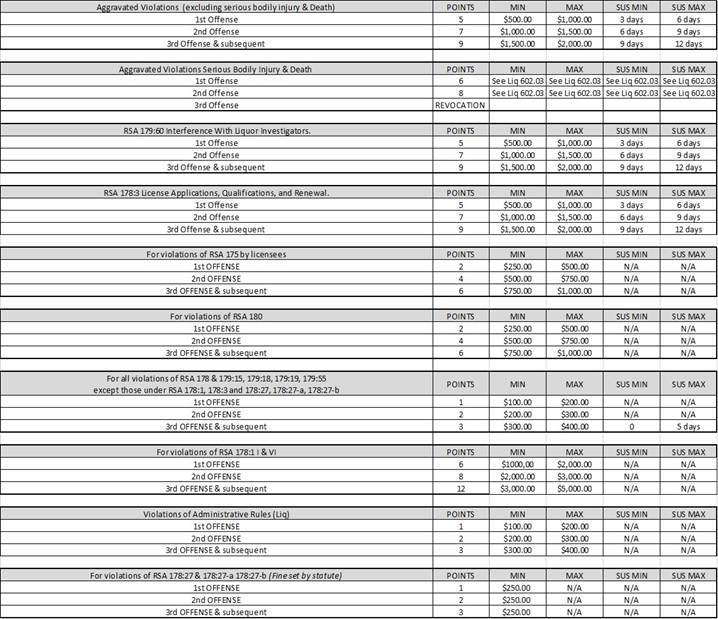
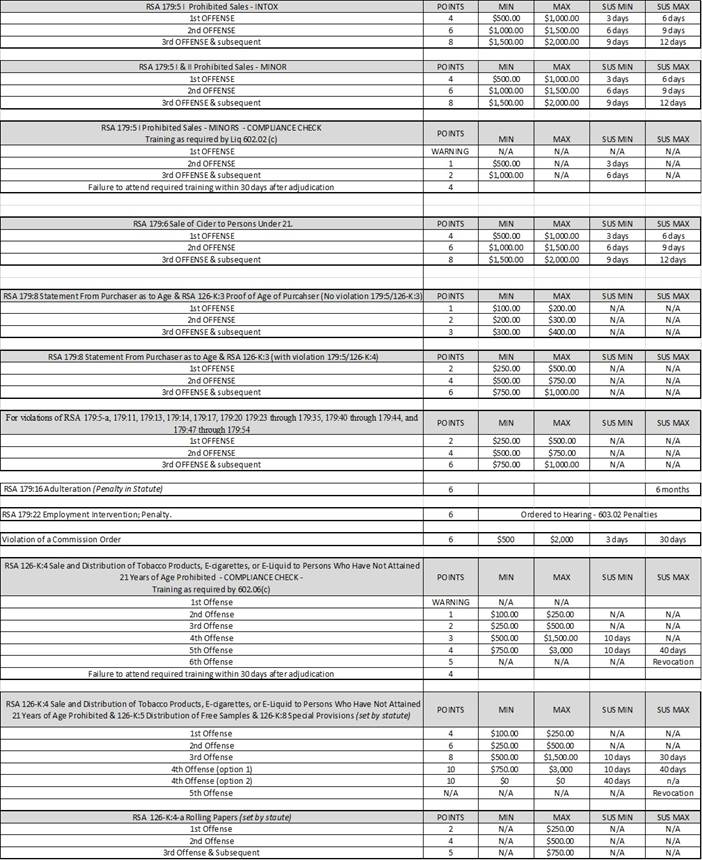
(b) No
portion of points shall be suspended or waived in any manner.
(c)
For any violation, a licensee may request a hearing.
(d)
For all violations, the presiding officer shall have the authority to
impose conditions to maintain proper controls.
(e)
For all violations, the presiding officer shall have the authority to
suspend or revoke the license.
Source. (See Revision Note at chapter heading for Liq 600) #13983, eff
5-24-24
Liq 602.02
Presiding Officer Consideration.
(a)
The presiding officer shall consider any testimony or evidence offered
by the prosecutor, the licensee, and by all witnesses
in determining an appropriate penalty.
(b) The presiding officer,
when hearing testimony or evidence regarding a violation of a statute, order,
or an administrative rule, shall consider any aggravating factor or mitigating
factor which is offered in any defense or prosecution, as required by RSA
179:56 III (a), in determining any administrative action or penalty.
(c)
Aggravating factors shall include but not be limited to:
(1) The
failure to train employees in liquor education classes;
(2) The
failure to have adequately trained managers;
(3) The
failure to take advantage of education classes offered by the
bureau of enforcement;
(4) The
failure to have any training with regard to
RSA Title XIII requirements for an employee;
(5) The
failure to request identification of a person who appears younger than age 21
before sale of alcoholic beverage;
(6) The
failure to monitor the quantity of alcohol served to a patron;
(7) The
failure to detect poor quality identification documents as being false;
(8) The
reckless serving of alcohol to a person under age 16 years;
(9) Serving
a minor who is legally intoxicated;
(10) The
active encouragement of intoxicated patrons to consume more alcohol;
(11) The
service of alcohol to a patron that is so continuous and excessive that it
creates a risk of death by alcohol poisoning;
(12) The
active assistance of a patron into a motor vehicle when the patron is so
intoxicated as to need assistance, when a person knows or should know that the intoxicated
person will operate the motor vehicle;
(13)
The failure to properly manage the premises, such as allowing
overcrowding, unaccompanied minors in lounges,
standees to drink, lack of effort to clear aisles, or areas of ingress or
egress and blocked fire exits;
(14) The
failure to take corrective action on previously cited violations;
(15) A
culpable mental state, as defined by RSA 626:2, II, General Principles, of the
New Hampshire Criminal Code shall be an aggravating factor when
"purposefully" or "knowingly" is proven; and
(16) Any factor which increases the hazard to
public safety due to the sale or consumption of alcohol.
(d) Mitigating factors shall include but not be limited
to:
(1) Service of only one
drink to a person who becomes intoxicated
(2) The completion of
NHLC training by person(s) in charge, managers, security staff, servers, and clerks;
(3) The
licensee admitting to problems detected and taking steps to rectify the situation;
(4) Maintaining an adequate number of trained employees to supervise the
sale and consumption of alcoholic beverages on the premises to assure compliance with the liquor laws and rules;
(5) A
new employee with instruction
from management, but not having attended a liquor education program; and
(6) Established management policies:
a. Ensuring persons of questionable age are
checked as to age before sale or service of alcohol or tobacco; and
b. Ensuring the proper
operation of the establishment.
(e) The presiding officer
shall decide each case after closing the hearing and all decisions shall be
based upon a preponderance of the evidence.
Source. (See Revision Note at chapter heading for Liq 600) #13983, eff
5-24-24
Liq
602.03 Special Penalty For Certain Aggravated Violations.
(a)
For any aggravated violation as defined in Liq 201.01
(f) which results in serious bodily injury or death the presiding officer shall impose the following
penalties:
(1) For the first
offense, subject to the limitations of RSA 179:57, I, a suspension of not less
than 30 days provided that the suspension shall be reduced by 15 days if the
person(s) in charge, managers, security staff, servers, and clerks have
completed NHLC training within 24 months
before the date of violation, fine of $5000, and points as listed in Liq 602.01 (a);
(2) For the
second offense, within 7 years of the first offense, 30 day
suspension, fine of $5,000, and points as listed in Liq
602.01(a); and
(3) For the third offense within 7 years of the second offense,
revocation.
(b)
On the second violation of RSA 179:5 within a 24-month period, excluding
any violations resulting from compliance checks, the presiding officer shall
consider:
(1) The complete
record of all violations at the licensed location that occurred within 7 years;
(2) The
circumstances of the violations of RSA 179:5; and
(3) If the licensee shall be required
to provide security under the requirements of RSA 178:5.
(c) If security for liability is required, the
commission shall immediately suspend the license until such time as security is
provided.
(d)
Security shall consist of insurance or a deposit meeting the
requirements of RSA 178:5, I (a), except if the licensee provides proof that
the licensee cannot obtain either insurance or a bond, the commission shall
accept $300,000 in cash or marketable securities to be held by the state
treasurer in an escrow account with any interest going into the general fund.
(e) The requirement for security of liquor
liability shall be in effect:
(1) So long as the license holder maintains
control of the license; or
(2) At least a calendar year.
(f) Cash or marketable securities held by the
state treasurer in escrow shall be returned only after the statute of
limitations for claims against the required security deposit has expired.
(g)
The security required in Liq 602.03 (d) shall
be in addition to any penalties imposed under Liq
602.01(2).
Source. (See Revision Note at chapter heading for Liq 600) #13983, eff
5-24-24
Liq 602.04 Revocations;
Payment of Fines.
(a)
Revocation shall be a permanent loss of a liquor license.
(b)
No license shall be issued to or renewed for an applicant who has not
paid an outstanding administrative fine issued by the commission.
Source. (See Revision Note at chapter heading for Liq 600) #13983, eff
5-24-24
Liq 602.05 Penalties
For Violating Commission Orders. The presiding officer shall impose a penalty
as provided in Liq 602.01(a), on any licensee who
fails to comply with the requirements of a commission order.
Source. (See Revision Note at chapter heading for Liq 600) #13983, eff
5-24-24
Liq 602.06 Progressive
Discipline.
(a) Except as provided in
(b) and (c) below, the division shall follow a progressive discipline model for
violations of Title XIII, Chapter 126-K, or commission rules or orders.
(b)
Identical violations shall be addressed in the following sequence:
(1) Verbal counseling for the first violation;
(2) Warning for the second violation; and
(3) Administrative notice for subsequent
violations.
(c)
The following shall result in an administrative notice:
(1) Violations of RSA 179:5 other than compliance
checks;
(2) Violations of
RSA 126-K:4 other than compliance checks;
(3) All aggravated violations;
(4) Violations arising during any of the above violations;
(5) Violations of commission orders;
(6) Violations of RSA 178:3;
(7) Violations of RSA 179:60; and
(8) Violations of RSA 179:22.
(d) A
violation discovered in a compliance check shall be addressed as follows:
(1) Warning for the first violation and training required within 30 days of adjudication; and
(2) Administrative notice and training required within 30 days of adjudication.
(e) A violation shall not be a second or higher
violation unless it occurs after the previous violation has been adjudicated.
(f) Except as provided in Liq
602.08, when a single event results in multiple charges of the same violation,
points shall only be applied once for that violation. Fines and suspensions shall be applied for
each of the violations. Points shall remain on the license for a period of 3
years from the date of adjudication.
(g) Except as provided in Liq
602.08, when a licensee accumulates 12 points or over, the licensee shall be
ordered to a hearing to determine if enhanced
penalties or conditions of the license are necessary to maintain proper
controls.
(h) When a licensee accumulates 25 points or
over, the licensee shall be ordered to attend a hearing to determine if revocation is necessary.
Source. (See Revision Note at chapter heading for Liq 600) #13983, eff
5-24-24
Liq
602.07 Non-Renewal, Denial, and
Revocation.
(a) Nothing in this
chapter shall prohibit the division from
recommending non-renewal of a license or denial of an application based
on the specification of RSA 178:3.
(b) Nothing in this chapter shall prohibit
the commission from revoking a license when there is a significant risk to public safety, or the business fails to operate in strict accordance with
all applicable state and federal alcoholic beverage or tobacco control laws.
Source. (See Revision Note at chapter heading for Liq 600) #13983, eff
5-24-24
Liq 602.08 Multiple
Offenses Over Time.
(a) For a first offense, points and penalties
shall be as listed in Liq 602.01.
(b) For the
second offense within 7 years of the adjudication for the first offense, points
and penalties shall be as listed in Liq 602.01.
(c) For the third offense within 7 years of the adjudication of the second offense,
points and penalties shall be as listed in Liq
602.01.
(d) For subsequent
offenses, points and penalties shall be as listed in Liq
602.01.
Source. (See Revision Note at chapter heading for Liq 600) #13983, eff 5-24-24
PART Liq 603 ADMINISTRATIVE PENALTIES AND FINE PROVISIONS FOR
TOBACCO VIOLATIONS
Liq 603.01 Commission
Compliance. The commission shall determine the level of the violation
by reviewing the licensee's record and counting violations that have occurred
within 3 years of the date of the violation being considered. The commission
shall notify the commissioner of revenue administration prior to the effective
date of any suspension or revocation.
Source. (See Revision Note at chapter heading for Liq 600) #13983, eff 5-24-24
Liq 603.02 Administrative
Penalties. The penalties shall be as
provided in Liq 602.01(a).
Source. (See Revision Note at chapter heading for Liq 600) #13983, eff 5-24-24
CHAPTER Liq
700 LICENSEE LICENSING
REVISION
NOTE #1:
Document #5289, effective 1-1-92,
adopted Part Liq 706, which made extensive changes to
the wording and format of the requirements in Part Liq
405. Document #5289 did not, however, repeal Liq 405, due to an agency
oversight. Part Liq
405 remained in effect until repealed, effective 3-21-92, by Document #5363.
REVISION
NOTE #2:
Document #13144, effective 9-25-20,
adopted, repealed, readopted with amendment, or readopted with amendment and
renumbered all of the rules in Chapter Liq 700. Extensive
changes were made in the wording, format, and numbering of rules in the former
Chapter Liq 700.
Document #13144 replaces all prior
filings for rules in the former Chapter Liq 700. The prior filings affecting rules in the
former Chapter Liq 700 include the following
documents:
#4455, eff 7-5-88
#5043, eff 1-11-91
#5180, eff 7-22-91
#5289, eff 1-1-92
#6391, eff
11-28-96
#7551, INTERIM,
eff 9-9-01, EXPIRED: 3-8-02
#7668, eff 3-29-02
#8138, eff
8-13-04, EXPIRED: 8-13-12
#9965, eff 7-29-11
#10323, INTERIM,
eff 4-25-13, EXPIRES: 10-22-13
#10443, eff
10-22-13
#10742, eff
12-10-14
PART Liq
701 CHAPTER DEFINITIONS AND OVERLYING
CONDITIONS
Liq
701.01 Definition of Terms. The following terms shall be construed as set
forth below:
(a)
"Affidavit" means a sworn statement of fact by an individual
under oath or on affirmation before an authorized magistrate or officer;
(b) "Applicant" means any natural or
unnatural person intending to fulfill the statutory and administrative
requirements for the issuance of a license pursuant to RSA 178;
(c)
"Application" means any written form, provided by the
commission, which is a formal request for the issuance of a license;
(d)
"Application fee" means that fee that accompanies Form LIQ-A1,
which covers the processing costs of new applicants;
(e) “Chairman”
means the executive director of the New Hampshire liquor commission;
(f)
"Cold food preparation area" means an area with at least a
preparation counter, refrigeration, and food storage;
(g) “Commission” means the New Hampshire liquor commission;
(h)
“Designation form” means a form provided by the commission to license
applicants which is used to designate an individual to attend the required
management training;
(i) "Director of enforcement" means the
chief of the division of enforcement and licensing;
(j)
"Division" means the division of enforcement and licensing;
(k)
"Form LIQ-A1" means the initial license application form;
(l)
"Hot food preparation area" means an area containing at least
a stove, or an oven, or a microwave, or a steamer, or a steam table;
(m) "Investigator" means a liquor
enforcement officer appointed under the provisions of RSA 179:59, who is
empowered to recommend to the director the issuance of a license;
(n) "License" means any license to sell liquor, wine, beverages, or tobacco products issued by the commission;
(o) “Licensing agent" means an employee of
the commission who is authorized to assist the public with applications for
liquor licenses, to evaluate license applications as to their completeness,
confirm the applicant and proposed business meet all requirements of the
license applied for, and to recommend either the issuance or rejection of such license;
(p)
"License year" means the period of time
which an original license has been issued until it has expired or been renewed;
(q)
“Management training seminar” (“MTS”) means the commission training
program for new licensees required by RSA 178:2;
(r)
“Manager” means an individual who:
(1) Exercises personal control over policies,
operating procedures, and operations of a licensed business; and
(2) Is designated by the holder of or applicant
for a license under this chapter to attend the management training seminar for
the licensee;
(s)
"Original license" means the first license issued to a
business pursuant to RSA 178;
(t) "Renewal" means any
application for a license that has not lapsed or expired more than 90 days
except for a seasonal license;
(u) "Signature” means an original manual
signature or mark. Nothing in these
rules shall be construed so as to prohibit electronic
or other signature forms when the commission has the capability of authorizing
and processing such signatures;
(v)
Supporting documentation"
means complete signed copies of all requested materials in support of an
application and required by Liq 702.04; and
(w) "Wait service" means service by a
licensee or their employee of food, beverages, liquor, or other items to the
seating accommodations of the patrons.
Source. (See Revision Notes #1 and #2 at chapter
heading for Liq 700) #13114,
eff 9-25-20
Liq
701.02 Completing Forms. Whenever a person is required to complete a
form, as described in RSA 178 and this chapter, the following provisions shall
apply:
(a)
Forms shall be filled out completely and truthfully;
(b)
Forms shall be completed in a legible manner;
(c)
Forms shall be completed in non-fading, non-erasable graphic such as ink
or typewritten; and
(d) Nothing in this section shall be
construed so as to prohibit completion or filing of
forms via the internet or other electronic completion or filing of forms when
the division has the capability of authorizing and processing such forms.
Source. (See Revision Notes #1 and #2 at chapter
heading for Liq 700) #13114,
eff 9-25-20
Liq
701.03 Incomplete Form Returned. In the event a person submits a form not in
compliance with Liq 700, such form shall not be
processed. The form shall be returned to
the submitting party with the reasons for such return noted.
Source. (See Revision Notes #1 and #2 at chapter
heading for Liq 700) #13114,
eff 9-25-20
Liq
701.04 Failure to Comply with Statute
or Rule. In the event an applicant
fails to comply with an application rule or statute, such applicant's
application shall not be processed and the applicant
shall be notified within 10 working days of the date of rejection, together
with the reasons for such rejection of the application.
Source. (See Revision Notes #1 and #2 at chapter
heading for Liq 700) #13114,
eff 9-25-20
Liq
701.05 Fees, Form of Payment.
(a) Whenever an applicant makes a payment to the
division for satisfaction of a fee, the provisions of
this section shall apply.
(b)
Payment shall be made in the form of United States currency, a check,
money order, or other negotiable instrument payable upon demand for the total
amount due for the initial or renewal license year for each license applied
for.
(c) Such instrument described in paragraph (a)
above shall be made payable to the "State of New Hampshire-Liquor
Commission," however, a suitable alternative term including but not
limited to "State of NH", "State Liquor Commission" or
"Liquor Commission" shall not be cause for refusal to accept such
instrument, providing it does not lend itself to endorsement of the instrument
by any other party other than the state of New Hampshire, nor for any private
individual or purpose.
(d)
Any payment made to the division by check that was returned for
insufficient funds which has not been made good, including any fees pursuant to
RSA 6:11-a by cash, money order or certified check within 24 hours, excluding
weekends and holidays, of notification of the licensee or one of their
employees, shall result in proceedings for suspension or revocation of the
license not paid for.
(e)
The division shall also accept payments by means of approved credit and
debit cards when the division is
capable of authorizing and processing such payments.
Source. (See Revision Notes #1 and #2 at chapter
heading for Liq 700) #13114,
eff 9-25-20
Liq
701.06 When Submitted. Unless otherwise provided in
these rules, any fee prescribed by a statute or rule shall be submitted for the
full amount due as calculated by Liq 703.06 at the
same time as the application to which it applies.
Source. (See Revision Notes #1 and #2 at chapter
heading for Liq 700) #13114,
eff 9-25-20
Liq
701.07 Checks.
(a)
No check shall be accepted which bears a date subsequent
to the date of the transaction.
(b) Except as provided in this rule, no two-party
check shall be accepted.
(c)
A two-party check shall be accepted if:
(1) One of the parties is the state of New Hampshire;
(2) The applicant is the other party; and
(3) The amount of the check is not greater than
the fee.
(d)
No check shall be accepted that is dated more than 30 days prior to the
receipt.
(e)
Any check as described in Liq 701.07(a), (b),
or (d) shall cause the application to be incomplete.
Source. (See Revision Notes #1 and #2 at chapter
heading for Liq 700) #13114,
eff 9-25-20
Liq
701.08 License Application Fees.
(a)
Each new applicant for a one day, a beer festival, a liquor and wine
festival, an alcohol consultant, or a liquor and wine representative license
shall pay a processing and investigation fee of $25.00.
(b)
Each new applicant for any other type of
license, except a special or supplemental license, shall pay a processing and
investigation fee of $100.00.
Source. (See Revision Notes #1 and #2 at chapter
heading for Liq 700) #13114,
eff 9-25-20
PART Liq
702 APPLICATION PROCESS
REVISION NOTE:
Document
#13754, effective 9-27-23, readopted with amendments Form LIQ-A1 “Initial
License Application” pursuant to the expedited revisions to agency forms
process in RSA 541-A:19-c. Form LIQ-A1
is incorporated by reference in paragraph(a) Liq
702.02 titled “Initial License Application”.
Document #13754 also updated the revision date of the form from “1/2020”
to “07/2023” to reflect the amendments made to the form, and the revision date
of “1/2020” in Liq 702.02 was subsequently updated to
“07/2023” as an editorial change. The
prior filing affecting rule Liq 702.02 was Document
#13114, effective 9-25-20, and the effective date of the rule remained
unchanged.
Liq 702.01 Purpose. The purpose of these rules is to maintain a
uniform and systematic approach to licensing of
businesses as required and described under Liq 700
and RSA 178.
Source. (See Revision Notes #1 and #2 at chapter
heading for Liq 700) #13114,
eff 9-25-20; (see also Revision Note at part heading for
Liq 702)
Liq 702.02 Form LIQ-A1 Initial Application For a License.
(a)
When any natural or unnatural person desires to obtain a license, the
applicant’s or his, her or it’s designee shall complete and submit Form LIQ-A1 “Initial Application,” (revised
7/2023) and shall produce preliminary information necessary to initiate the
application process.
(b)
As part of the application procedure, any new applicant for a new
license issued pursuant to this title, except supplemental, special, or one day
licenses, shall pay an application fee to recover the costs of processing and
investigating each type of license application.
(c)
The applicant shall submit the application fee at the time they complete
and submit Form LIQ-A1.
(d) No application, except a special,
supplemental, or one-day license application, shall be processed without the
application fee accompanying Form LIQ-A1.
(e) Application processing and investigation fees
shall be non-refundable.
(f)
An applicant shall be considered a new applicant if such applicant’s
license has lapsed more than 90 days, unless the applicant was the holder of a
seasonal license in the current or previous calendar year.
(g)
Pursuant to RSA 641:3, applicants shall certify they are authorized to
sign on behalf of the business entity applying for a license, and that the
information provided is true, correct, and complete to the best of their
knowledge and belief.
Source. (See Revision Notes #1 and #2 at chapter
heading for Liq 700) #13114,
eff 9-25-20; (see also Revision Note at part heading for Liq
702)
Liq
702.03 Application Packet. Upon the submission of Form LIQ-A1, the
licensing agent shall provide the applicant with the license type application
as described in Liq 702.07 and the license type
worksheet as described in Liq 702.07(b) and part Liq 705 of these rules.
Source. (See Revision Notes #1 and #2 at chapter
heading for Liq 700) #13114,
eff 9-25-20
Liq
702.04 Required Documentation. As part of the application process,
applicants shall produce and submit copies of the following documents:
(a)
For all applicants located within the state of New Hampshire:
(1) A signed deed, lease, or rental agreement for
the premises:
a. In name of applicant; and
b. Providing that the applicant has the right to
occupy the premises and is in control of the premises;
(2) A copy of a valid certificate, license, or
letter of compliance issued by the state or town in which the business is
located showing compliance with the provisions of RSA 143-A;
(3) A bill of sale or lease for all furniture,
fixtures, and equipment that:
a. Shall be in name of applicant; and
b. Shall state that
applicant owns, leases or rents the furniture and equipment;
(4) A signed and dated bill of sale for any
alcoholic beverages purchased when buying an existing business that specifies:
a. The amount paid; and
b. The complete inventory of stock by brand type;
(5) A copy of the trade name registration with
the New Hampshire secretary of state;
(6) A notarized affidavit showing affiant’s
ownership, management control, or employment by the business applying for a license;
(7) A managerial appointment consisting of a
letter from and signed by the owners, partners, ormembers
or a manager of an limited liability corporation
(“LLC”) or authorized corporate officer, as applicable, naming the manager
together with his or her address, date, and place of birth;
(8) A diagram, sketch, or plan of physical layout
of establishment;
(9) Copy of prior license or trade name and prior
license number;
(10) A
notarized certificate or affidavit from the registered agent of the entity
furnishing all information required by RSA 178:3, V;
(11) A notarized original power of attorney and
original affidavit for any person with power of attorney;
(12) Town or
city approval;
(13) Permit of assembly; and
(14) Health or food service license, if applicable;
(b)
For on-premises licenses:
(1) A signed bill of sale or lease of draft
system or humidor for cigar bar, to the applicant;
(2) A copy of a valid permit of assembly, letter,
or certificate of occupancy issued by the local or state fire authorities;
(3) Food service permit from local or state health
agency;
(4) Menu, if the applicant operates a restaurant;
and
(5) Correspondence from the municipality
indicating that it does not object to the forms of entertainment proposed by
the applicant;
(c) For a corporation:
(1) A certificate of incorporation with all
addendums attached;
(2) A corporate certificate or letter of good
standing from the New Hampshire secretary of state dated or issued within the
last 12 months;
(3) A copy of the articles of incorporation,
by-laws, and an attachment indicating ownership and distribution of stock
within the corporation;
(4) A copy of the certificate of authority from
the New Hampshire secretary of state, if a non-New Hampshire corporation;
(5) Minutes of the election of the current
officers and directors or minutes of each meeting electing officers or
directors to provide a complete and accurate record of the current
status of all officers and directors and true ownership of the
corporation or a sworn affidavit by the corporate
secretary attesting to who the current officers and directors are in lieu of minutes;
(6) Complete list of all current corporate
officers, directors, shareholders including:
a. Full Name;
b. Date of birth (“DOB”); and
c. Legal address; and
(7) Notarized original power of attorney and
original affidavit for any person with power of attorney;
(d) For limited liability corporations (“LLC”):
(1) A copy of the certificate of existence issued
by the New Hampshire secretary of state, or a copy of the certificate of
formation of the limited liability company with the filing date stamp of the
New Hampshire secretary of state, or a copy of the authorization of the New
Hampshire secretary of state for the LLC to do business in New
Hampshire;
(2) A copy of the certificate of good standing
issued within the last 12 months;
(3) A copy of the LLC operating agreement; and
(4) Complete list of all
current members or appointments of LLC managers including:
a. Full name;
b. DOB; and
c. Legal address;
(e) For partnerships:
(1) A notarized affidavit showing the partner’s
ownership, management control, or employment by the business applying for a
license; and
(2) Notarized original power of attorney and
original affidavit for any person with power of attorney;
(f) For a liquor, wine or beverage manufacturer,
brew pub, beverage vendor, nano brewer, or rectifier a copy of the United
States Treasury Tax and Trade Bureau (“TTB”) permit issued to the applicant;
(g)
For a common carrier, a copy of the United States Department of Transportation or
Interstate Commerce Commission license or an affidavit from a New Hampshire
based in-state carrier attesting to being a person who, for a fee, provides
public transportation of goods or persons;
(h) For a wholesaler, a surety bond issued to the wholesaler guaranteeing the
amount pursuant to the provisions of RSA 178:16, II;
(i) For an off-premises special license, a copy of a bill of sale, order of foreclosure, or letter of
administration by the judge of probate;
(j) For an off-premises
with a pharmacy, license or certificate issued by the New
Hampshire pharmacy board;
(k) RESERVED
(l) For a passenger tramway device, proof of licensing by the New Hampshire department of
safety and a copy of the tramway inspection
certificate issued for the device;
(m) For a
college club, proof of accreditation of a
college or university with a letter from the accrediting
agency indicating that the college or university is accredited and in good standing;
(n) For non-profits, proof of non-profit status which shall consist of a copy of the U.S. Internal Revenue Service issued document and New
Hampshire secretary of state document granting non-profit status;
(o) For a dining or rail car:
(1)
Proof of inspection with the New Hampshire department of transportation; and
(2) A copy of the certificate, letter of compliance, or license
issued by the inspecting agency;
(p)
For a state fair:
(1) A written statement indicating official
approval of the chief of the fire department with jurisdiction as to the safety of the location;
(2) A written statement indicating
official approval of the health department with jurisdiction concerning
sanitary conditions;
(3) A written statement indicating
official approval of the police department with jurisdiction as to the
accessibility and public safety of the location and the event; and
(4) For a New Hampshire fair or exposition, a
letter of good standing from the New Hampshire Association of Fairs and Expositions;
(q)
For social and veterans clubs, a roster of club
members and auxiliaries, including addresses;
(r) For a one-day license:
(1) A written
statement indicating official approval of the chief of the fire department with
jurisdiction as to the safety of the location;
(2) A written statement
indicating official approval of the health department with jurisdiction concerning sanitary conditions;
(3) A written statement indicating official
approval of the police department with jurisdiction as to the accessibility and public safety of the location and the event;
(4) A certificate of attendance at a commission
management training seminar within 12 months prior to the
effective date of the license;
(5) A letter of
authorization from a non-profit organization designating an official in charge
of the event;
(6) A notarized affidavit
showing affiant’s ownership, management control, or employment by the business
applying for a license; and
(7) A list of alcohol servers
for the function;
(s) For a vessel, current operating certificate
issued by the New Hampshire department of safety;
(t)
For a wine or beer festival:
(1) A written statement indicating official
approval of the chief of the fire department with jurisdiction as to the safety
of the location;
(2) A written statement indicating official
approval of the health department with jurisdiction concerning sanitary conditions;
(3) A written statement indicating official
approval of the police department with jurisdiction as to the accessibility and
public safety of the location and the event;
(4) A letter of
authorization from a non-profit
organization designating an official in charge of the event;
(5) A notarized affidavit
showing affiant’s ownership, management control, or employment by the business
applying for a license;
(6) A list of alcohol servers
for the function; and
(7) A certificate of attendance at a commission
management training seminar within 12 months prior to the effective date of the
license;
(u) For a vending tobacco license, location and
name of business of each tobacco vending machine;
(v) For
pari-mutuel
and commercial motor vehicle race track license, a
listing of the areas that the applicant intends to utilize for the service and
consumption of alcoholic beverages including a brief description of the area;
and
(w) For an agency store:
(1) A financial statement from a credit company or
bank providing a copy of the applicant's credit standing;
(2) Letters of recommendation from 3 New
Hampshire residents indicating the reliability of the applicant's customer
service record in the community; and
(3) Any photographs of the business or other
representation or other documentation that the applicant wants the commission
to consider in the selection process.
Source. (See Revision Notes #1 and #2 at chapter
heading for Liq 700) #13114,
eff 9-25-20
Liq 702.05 Input From
Municipality.
(a)
As part of the application process, the licensing agent shall send
correspondence to the municipality where the licensee is proposed to be
located, notifying it of the license application.
(b)
The correspondence shall solicit the following information from a
municipality in its review of the license application under Liq
702.08:
(1) That the proposed location of the business is
appropriate for the sale and service of alcohol, tobacco, or both;
(2) The nature of the business
relative to the surrounding neighborhood;
(3) The number of similar
businesses in the neighborhood; and
(4) Objections from the municipality relative to
the appropriateness of a liquor license under RSA 178:3, VII(f).
Source. (See Revision Notes #1 and #2 at chapter
heading for Liq 700) #13114,
eff 9-25-20
Liq
702.06 In-State Premises Inspection.
(a)
The commission shall inform the applicant of the requirements specific
to the license type sought by the applicant.
(1) Once the applicant has obtained all
documentation required by Liq 702.04, completed all
desired renovations at the proposed locations, and installed
all furniture, the applicant shall request an inspection of the site by an
investigator.
(c) The commission shall inspect the premises to
determine compliance with applicable statutes and rules and the physical
requirements of Liq 706.
Source. (See Revision Notes #1 and #2 at chapter
heading for Liq 700) #13114,
eff 9-25-20
Liq
702.07 License Type Application.
(a) Once the applicant has obtained and submitted
copies of all documentation required by Liq 702.04
and an investigator has inspected the premises pursuant to Liq
702.06, the applicant shall complete and submit as appropriate:
(1) Form LTA-1M
“License Type Application-Manufacturers” (revised 1/2020) for manufacturers, including
brew pub, liquor manufacturer, beverage manufacturer, nano brewery with sampler
(no restaurant), nano brewery with restaurant, rectifier, tenant brewer, wine
manufacturer with sampler, and wine manufacturer retail outlet; or
(2) Form LTA-2D “License Type
Application-Distributors – Non-Retail” (revised 1/2020) for distributors,
including beverage vendor, carrier, liquor and wine representative, liquor and
wine vendor, liquor/wine/beverage warehouse, wholesale distributor, and alcohol
consultant; or
(3) Form LTA-3R-OFF “License Type
Application-Retailers-Off-Premises” (revised 1/2020) for retailers
off-premises, including agency store, beer festival, beer specialty,
combination, off-premise specialty, retail tobacco,
retail wine, tobacco sampling, tobacco vending, and wine festival; tobacco
retail license fee; or
(4) Form LTA-3R-ON “License Type
Application-Retailers-On-Premises” (revised 1/2020) for retailers on-premises,
including, ballroom, bed and breakfast / hotel, caterer on-premises, caterer
off-premises, college club, convention center, dining car / rail car,
restaurant, military club, veteran’s
club, social club, one day non-profit organization, state fair, sports
entertainment complex, pari-mutuel / commercial motor vehicle race track,
sports recreation facility, performing arts, vessel, wine / liquor festival,
beer festival and cigar bar.
(b) The applicant shall complete and submit the
“License Type Worksheet” as set forth in Liq 705 of
these rules, in addition to the “License Type Application” set forth in Liq 702.07(a).
(c) If the license application and
corresponding worksheet is completed, and the applicant satisfies all
requirements for the license type, the licensing agent shall submit the
application to the director for review.
(d) The
director shall review the license application and submit to the commission a
written recommendation as to whether the commission should grant or deny the
license.
(e)
If the director recommends that the
commission grant the applicant a license, the director shall issue that applicant a temporary license pending the chairman or deputy commissioner’s
final review and decision.
(f)
If the director believes that he or she
lacks sufficient information to determine whether to recommend the grant or
denial of the license, because he or she is unable to fully assess the actual
control structure of the licensee, the effect that any third-party interests may play on the
licensee’s operations, the effect of the licensed establishment on the
neighborhood, or, based on specific circumstances,
there is reason to believe the applicant may be unable to comply with the
provisions set forth in Title XIII or these rules, the director shall
request additional information, and shall respond to the application by issuing
the applicant a temporary license, which shall allow the applicant to operate
pending the director’s determination regarding a recommendation of grant or denial.
(g) Any
temporary license issued pursuant to Liq 702.07(e) or
(f) shall automatically expire upon the occurrence of any of the following
events:
(1) The director’s recommendation to the commission that it deny the license;
(2) The commission’s grant of the license; or
(3) 90 days following its issuance.
(h) Any
temporary license issued by the director pursuant to Liq
702.07(e) or (f) shall state on the document that it shall expire upon the
occurrence of any of the events set forth in Liq
702.07(g)(1-3).
Source. (See Revision Notes #1 and #2 at chapter
heading for Liq 700) #13114,
eff 9-25-20
Liq
702.08 Additional information. In order to
determine whether or not to approve the request for a
license, the chairman or deputy commissioner may request additional information
pursuant to RSA 178:3, V.
Source. (See Revision Notes #1 and #2 at chapter
heading for Liq 700) #13114,
eff 9-25-20
Liq
702.09 Final Review. The
chairman, or the deputy commissioner pursuant to RSA 176:2-a, shall determine whether or not to approve the request for a license based on
the following:
(a) The operational and business qualifications of
all persons with a right to control the operations and
policies of the proposed licensee;
(b) The existence of any disqualifying felonies as
specified in RSA 178:3, VI;
(c) The information
received from the municipality pursuant to Liq 702.05;
(d) Completeness of the application;
(e) That the applicant is of legal age;
(f)
That the applicant is of good character;
(g) That the application accurately disclosed the
applicant’s interests in other business activities;
(h) That the applicant’s interests in other
business activities would interfere with the lawful operation of the proposed business;
(i) That interests in
other business activities would create unfair competition or unlawful activities;
(j) That the proposed business would be managed in
a manner which would hinder the commission from exercising its regulatory and
financial responsibilities;
(k) That the proposed location of the business is
an appropriate one, considering the nature of the business, the nature of the
surrounding neighborhood, and the number of similar businesses in the
neighborhood; and
(l) The recommendation of the director of the
division of licensing and enforcement.
Source. (See Revision Notes #1 and #2 at chapter heading for Liq
700) #13114, eff 9-25-20
Liq
702.10 Issuance of License.
(a) The licensing agent shall notify the licensee
in writing whether or not the request has been
approved, and
of any condition or conditions which the chairman, or the deputy
commissioner pursuant to RSA 176:2-a, attached to any license approval,
including, but not limited to:
(1) A warehouse
licensee, other than DHL, shall not store bailment products;
(2) A combination licensee shall operate each of the licenses
in comportment with the hours of sales requirements for the license in
operation as established by RSA 179:17; and
(3) Any other condition or conditions that
further the primary duties of the commission as outlined in RSA 176:3.
(b) Any denials shall be accompanied by a written
statement stating the basis for the denial and that the applicant has a right
to a hearing.
Source. (See Revision Notes #1 and #2 at chapter
heading for Liq 700) #13114,
eff 9-25-20
Liq
702.11 Management Training Seminar.
(a)
The commission shall offer the management training seminar (“MTS”)
pursuant to RSA 178:2, II.
(b) All retail licensees or a
manager designee shall attend and receive a certificate of completion
with positive identification in compliance with RSA 179:8.
(c)
The seminar shall cover the following topics:
(1) Information on state law;
(2) Alcohol sales practices;
(3) Criminal and civil liability; and
(4) Management practices intended to reduce access to alcohol by persons under the age of 21 and over service of alcohol to
patrons.
(d)
A schedule of classes shall be provided to all license applicants by the
licensing officer.
(e) Prior to
the effective date of a one-day license, the training program shall be attended
by a management representative of the applicant provided, however, if 2 or more one day licenses are issued to the
same applicant during any 12-month period, the management representative of the
applicant shall be required to attend the training program only once during
that 12-month period.
Source. (See Revision Notes #1 and #2 at chapter
heading for Liq 700) #13114,
eff 9-25-20
Liq 702.12
Training Required, Designee.
(a)
Pursuant to RSA 178:2, for each on or off premise license initially
issued, all retail licensees or a manager designee shall attend the commission
MTS licensee basic training course.
(b)
An applicant may designate a manager by name to attend the training in
his or her stead on a designation Form L-003 provided by the commission, which
shall be filed with the license application.
Source. (See Revision Notes #1 and #2 at chapter
heading for Liq 700) #13114,
eff 9-25-20
Liq 702.13 License Suspension.
(a)
Pursuant to RSA 178:2, V, the chairman may suspend, pursuant to RSA
541-A:30, III, the license of any person who holds a license under the
provisions of this chapter for failure to comply with the requirements of RSA
178:2, IV, which license shall not be reissued until the required training is
complete.
(b) Notice of possible suspension pursuant to
paragraph (a) shall accompany the license application and be signed by the
licensee.
(c) Upon 20 days after the license is issued, if
the licensee has not yet attended the mandatory training, the division shall
issue a warning notice to the licensee directing the licensee to complete the
training by the 45-day deadline.
(d) A warning notice issued pursuant to Liq 702.13(c) constitutes a commission order.
(e)
Once 45 days has
elapsed since the license was issued, the division shall issue a licensee who
still has not attended the training an administrative notice of violation and
schedule a hearing on the violation.
(f) If the chairman suspends a license for failure to attend MTS, the license shall
not be reinstated until the required training is completed.
Source. (See Revision Notes #1 and #2 at chapter
heading for Liq 700) #13114,
eff 9-25-20
PART Liq 703 LICENSING
FORMULA
Liq
703.01 Purpose. The purpose of this part is to provide
applicants with a formula for the calculation of license fees as required
pursuant to RSA 178.
Liq 703.02 Definitions.
(a) "B-Month" means the birth month for
an individual or legal date of organization.
(b) "C-Month" means the effective month
of a new license;
(c) "D-Month" means the difference in
months between B-Month and C-Month.
(d) "Eff Date" means the first day of
the month the license is to take effect.
(e) "License-Months" means the length
of a license issued in measurement by month.
(f) "SPI" means either the birth date
or legal date of incorporation or other organization.
(g)
"Table" means any chart, graph, or reference material included
to more clearly explain a concept or legal requirement.
Source. (See Revision Notes #1 and #2 at chapter
heading for Liq 700) #13114,
eff 9-25-20
Liq 703.03 Reserved
Liq
703.04 Formula for Calculation of
Licensing Months. The formula for
calculation of licensing months for initial licenses shall be as follows:
(a)
If B-Month is less than C-Month, the license fee shall be calculated as
follows:
(1) The D-Month shall equal the C-Month minus
B-Month plus one;
(2) If D-Month is less than 9, the license months
shall equal 12 minus D-Month; and
(3)
If D-Month is greater than or equal to 9, the license months shall equal
24 minus D-Month.
(b)
If B-Month is greater than or equal to C-Month, the license fee shall be
calculated as follows:
(1) The D-Month shall equal the B-Month minus
C-Month minus one;
(2) If D-Month is less than 4, the license months
shall equal 12 plus D-Month; and
(3) If D-Month is greater than or equal to 4, the
license months shall equal D-Month.
(c)
Licenses, except for seasonal, supplemental, state fair, special, beer
festival, or one day licenses shall be issued
for periods of at least 4 months, but shall not exceed
15 months as determined by the formula in Liq
703.04(a) and (b).
Source. (See Revision Notes #1 and #2 at chapter
heading for Liq 700) #13114,
eff 9-25-20
Liq 703.05 Table
A.
(a) The length of the license issued shall be
determined by matching the SPI month in the X axis with the effective month in
the Y axis;
(b) Once the effective month and SPI month have
been determined the number of months for the initial license or lapsed license
shall be in compliance with table A below:
TABLE A
|
SPI MONTH |
||||||||||||
|
Eff. Month |
||||||||||||
|
|
Jan |
Feb |
Mar |
Apr |
May |
June |
July |
Aug |
Sept |
Oct |
Nov |
Dec |
|
Jan |
13 |
14 |
15 |
4 |
5 |
6 |
7 |
8 |
9 |
10 |
11 |
12 |
|
Feb |
12 |
13 |
14 |
15 |
4 |
5 |
6 |
7 |
8 |
9 |
10 |
11 |
|
Mar |
11 |
12 |
13 |
14 |
15 |
4 |
5 |
6 |
7 |
8 |
9 |
10 |
|
Apr |
10 |
11 |
12 |
13 |
14 |
15 |
4 |
5 |
6 |
7 |
8 |
9 |
|
May |
9 |
10 |
11 |
12 |
13 |
14 |
15 |
4 |
5 |
6 |
7 |
8 |
|
June |
8 |
9 |
10 |
11 |
12 |
13 |
14 |
15 |
4 |
5 |
6 |
7 |
|
July |
7 |
8 |
9 |
10 |
11 |
12 |
13 |
14 |
15 |
4 |
5 |
6 |
|
Aug |
6 |
7 |
8 |
9 |
10 |
11 |
12 |
13 |
14 |
15 |
4 |
5 |
|
Sept |
5 |
6 |
7 |
8 |
9 |
10 |
11 |
12 |
13 |
14 |
15 |
4 |
|
Oct |
4 |
5 |
6 |
7 |
8 |
9 |
10 |
11 |
12 |
13 |
14 |
15 |
|
Nov |
15 |
4 |
5 |
6 |
7 |
8 |
9 |
10 |
11 |
12 |
13 |
14 |
|
Dec |
14 |
15 |
4 |
5 |
6 |
7 |
8 |
9 |
10 |
11 |
12 |
13 |
Source. (See Revision Notes #1 and #2 at chapter
heading for Liq 700) #13114,
eff 9-25-20
Liq 703.06 License Fees. The initial or renewal fee for any license
shall be the sum of the license- months divided by 12 multiplied by the annual
cost for each category pursuant to RSA 178:29 except for seasonal, special,
supplemental, beer festival, and state fair licenses.
Source. (See Revision Notes #1 and #2 at chapter
heading for Liq 700) #13114,
eff 9-25-20
Liq 703.07 Refunds Prohibited. The fees paid by any licensee for a license,
regardless of the license term, shall not be refundable except when a refund
request is received by the commission prior to the effective date of the
license.
Source. (See Revision Notes #1 and #2 at chapter
heading for Liq 700) #13114,
eff 9-25-20
PART Liq 704 LICENSE
RENEWALS
Liq 704.01 Notice
of Renewal.
(a) The division shall identify all year round licenses 90 days before their renewal date.
(b) The following shall apply:
(1) The division shall issue a written
application, the applicable License Type Worksheet (LTW), or the renewal of licenses to every licensee;
(2) The application shall be delivered
electronically, or by mail if requested by the applicant, or other appropriate
method to an address designated by the licensee;
(3) The applicant shall answer all questions in
the applicable license type worksheet
designed for the renewal of a license as required pursuant to RSA 178:3
and applicable parts of Liq 700;
(4) All
questions shall be answered truthfully, completely, in a legible manner, and in
a non-erasable graphic;
(5) Any supporting documentation required to
update an application pursuant to Liq 702.04 shall
accompany the application when submitted for renewal;
(6) The renewal applicant's application to the
division office in Concord shall be postmarked at least 30 days before the
expiration date of their license; and
(7) The fees, and form of payment shall comply
with the provisions of Liq 701.05.
Source. (See Revision Notes #1 and #2 at chapter
heading for Liq 700) #13114,
eff 9-25-20
Liq
704.02 Bond Required.
(a)
A wholesale distributor as defined by RSA 175:1, LXVI, shall give to the
state of New Hampshire a surety bond required by RSA 178:16, II.
(b)
The formula for a renewed bond shall be 1.5 times the highest monthly
sum of additional fees paid pursuant to RSA 178:26 during the 12-month period
ending 3 months prior to the license renewal date.
(c)
The amount of the bond required for an original applicant shall be in an
amount determined by an estimate of the chairman based upon the vendor's or
applicant's estimated sales.
(d) The bond amount shall be reviewed every
3 months and shall be based upon the actual number of gallons of beverage sold
monthly multiplied by the amount of tax specified by RSA 178:26 for each gallon
sold multiplied by 1.5 during the period of the original license.
(e)
The length of time a bond is required shall be consistent with the
requirements of RSA 178:16.
Source. (See Revision Notes #1 and #2 at chapter
heading for Liq 700) #13114,
eff 9-25-20
PART Liq 705 LICENSE TYPE
WORKSHEETS
REVISION NOTE:
Document #13346, effective 2-24-22,
readopted with amendments Form LTW-05 “License Type
Worksheet-Sports Recreation Facility” pursuant to the expedited revisions
to agency forms process in RSA 541-A:19-c.
Form LTW-05 is incorporated by reference in Liq
705.33 titled “Sports Recreation Facility License”. Document #13346 also updated the revision
date of the form from “8/2020” to “2/2022” to reflect the amendments made to
the form, and the revision date of “8/2020” in Liq
705.33 was subsequently updated to “2/2022” as an editorial change. The prior filing affecting rule Liq 705.33 was Document #13114, effective 9-25-20, and the
effective date of the rule remained unchanged.
Document
#13423, effective 7-30-22, readopted with amendments Form LTW-03 “License Type
Worksheet-Restaurant” pursuant to the expedited revisions to agency forms
process in RSA 541-A:19-c. Form LTW-03
is incorporated by reference in Liq 705.29 titled
“Restaurant and Related Licenses.”
Document #13423 also updated the revision date of the form from “8/2020”
to “7/22” to reflect the amendments made to the form, and the revision date of
“8/2020” in Liq 705.29 was subsequently updated to
“7/22” as an editorial change. The prior
filing affecting rule Liq 705.29 was Document #13114,
effective 9-25-20, and the effective date of the rule remained unchanged.
Liq
705.01 Information Required on
Worksheets.
(a)
Each applicant for a license shall retain, maintain and keep readily
available all supporting documentation relative to their specific worksheet and, upon
investigation, provide such documentation to any member of the commission.
(b) Each applicant for a license shall provide
the name of the business, the trade name of the business, if any, and the
primary contact for the applicant.
(c)
Each applicant for a license shall provide specific information and
acknowledgements on a “License Type Worksheet” as required by Liq 702.07 (a) and as specified in this Part. The information provided shall be certified
by the applicant under penalty of unsworn falsification pursuant to RSA 641:3.
Source. (See Revision Notes #1 and #2 at chapter
heading for Liq 700) #13114,
eff 9-25-20
Liq 705.02 Liquor
Manufacturer Licenses. Applicants
for a liquor manufacturer license shall complete and submit Form LTW-19,
“License Type Worksheet-Liquor Manufacturer” (revised 8/2020) providing all
required information and acknowledgments.
Source. (See Revision Notes #1 and #2 at chapter
heading for Liq 700) #13114,
eff 9-25-20
Liq
705.03 Rectifier Licenses. Applicants for a rectifier license shall
complete and submit LTW-32, “License Type Worksheet-Rectifier” (revised 8/2020)
providing all required information and acknowledgements.
Source. (See Revision Notes #1 and #2 at chapter
heading for Liq 700) #13114,
eff 9-25-20
Liq
705.04 Liquor and Wine Vendor License. Applicants for a liquor and wine vendor
license shall complete and submit Form LTW-45, “License Type Worksheet-Liquor
and Wine Vendor” (revised 8/2020) providing all required information and
acknowledgments.
Source. (See Revision Notes #1 and #2 at chapter
heading for Liq 700) #13114,
eff 9-25-20
Liq 705.05 Liquor/Wine/Beverage Warehouser
License.
Applicants for a liquor/wine/beverage/warehouse license shall complete and
submit Form LTW-12, “License Type Worksheet-Liquor, Wine and Beverage
Warehouser” (revised 8/2020) providing all required information and
acknowledgments.
Source. (See Revision Notes #1 and #2 at chapter
heading for Liq 700) #13114,
eff 9-25-20
Liq
705.06 Wine Manufacturer's License. Applicants for a wine manufacturer’s license
shall complete and submit Form LTW-30, “License Type Worksheet-Wine
Manufacturer – Off Premises Sampling/Retail Sales” (revised 8/2020) providing
all required information, acknowledgments, and, for
an off-premises sampling retail event, attach a copy of the authorization
letter from the nano-brewery allowing the applicant permission to conduct sales
and sampling.
Source. (See Revision Notes #1 and #2 at chapter
heading for Liq 700) #13114,
eff 9-25-20
Liq 705.07 Liquor
and Wine Representative License.
Applicants for a liquor and wine representative license shall complete
and submit Form LTW-35, “License Type Worksheet-Liquor and Wine Representative”
(revised 8/2020) providing all required information, acknowledgments, and
attach a
warranty deed or lease agreement.
Source. (See Revision Notes #1 and #2 at chapter
heading for Liq 700) #13114,
eff 9-25-20
Liq 705.08 Beverage
Manufacturer Licenses. Applicants
for a beverage manufacturer license shall complete and submit Form LTW-18,
“License Type Worksheet-Beverage Manufacturer” (revised 8/2020) providing all
required information, acknowledgments, and attach a completed form LTW-03 “Restaurant” worksheet, if the applicant will
hold an on-premise license.
Source. (See Revision Notes #1 and #2 at chapter
heading for Liq 700) #13114,
eff 9-25-20
Liq 705.09 Carrier License. Applicants for a carrier license shall
complete and submit Form LTW-16, “License Type Worksheet-Carrier” (revised
1/2020) providing all required information and acknowledgments.
Source. (See Revision Notes #1 and #2 at chapter
heading for Liq 700) #13114,
eff 9-25-20
Liq 705.10 Beverage
Vendor Licenses. Applicants for a
beverage vendor license shall complete and submit Form LTW-31, “License Type
Worksheet-Beverage Vendor” (revised 8/2020) providing all required information
and acknowledgments.
Source. (See Revision Notes #1 and #2 at chapter
heading for Liq 700) #13114,
eff 9-25-20
Liq 705.11 Wholesale
Distributor Licenses. Applicants for
a wholesale distributer license shall complete and submit Form LTW-20, “License
Type Worksheet-Wholesale Distributer” (revised 8/2020) providing all required
information and acknowledgments.
Source. (See Revision Notes #1 and #2 at chapter
heading for Liq 700) #13114,
eff 9-25-20
Liq 705.12 Off-Premises
Special License (Auction).
Applicants for an off-premises special license shall complete and submit
Form LTW-42, “License Type Worksheet-Off-Premise
Specialty (Auction)” (revised 8/2020) providing all required information,
acknowledgments, and attach the following:
(a) If an administrator/executor sale, the letter
of administration signed by the probate judge;
(b) A copy of the foreclosure, court order,
assignment or liquidation order, if applicable;
(c) A letter from a non-profit signed by a
corporate officer designating that person is allowed to represent the
non-profit organization for the event;
(d) An affidavit for the designated person in
charge of the event;
(e) Form L-023d “Special One Day / Auction
Licenses Only – Inventory”; and
(f) Form L-023e “Auction – Affidavit for Alcohol
Sold”.
Source. (See Revision Notes #1 and #2 at chapter
heading for Liq 700) #13114,
eff 9-25-20
Liq 705.13 Combination
License. Applicants for a
combination license shall complete and submit Form LTW-47, “License Type
Worksheet-Combination” (revised 8/2020) providing all required information and acknowledgments.
Source. (See Revision Notes #1 and #2 at chapter
heading for Liq 700) #13114,
eff 9-25-20
Liq 705.14 Retail
Table Wine License. Applicants for a
retail table wine license shall complete and submit Form LTW-46, “License Type
Worksheet-Retail Table Wine” (revised 8/2020) providing all required
information and acknowledgments.
Source. (See Revision Notes #1 and #2 at chapter
heading for Liq 700) #13114,
eff 9-25-20
Liq 705.15 Bed
and Breakfast and Hotel License.
Applicants for a bed and breakfast or a hotel license shall complete and
submit Form LTW-02, “License Type Worksheet-Bed & Breakfast / Hotel”
(revised 8/2020) providing all required information and acknowledgments.
Source. (See Revision Notes #1 and #2 at chapter
heading for Liq 700) #13114,
eff 9-25-20
Liq 705.16 State
Fair License. Applicants for a state
fair license shall complete and submit Form LTW-23, “License Type
Worksheet-State Fair” (revised 8/2020) providing all required information and
acknowledgments.
Source. (See Revision Notes #1 and #2 at chapter
heading for Liq 700) #13114,
eff 9-25-20
Liq 705.17 Ballroom
License. Applicants for a ballroom
license shall complete and submit Form LTW-11, “License Type
Worksheet-Ballroom” (revised 8/2020) providing all required information and acknowledgments.
Source. (See Revision Notes #1 and #2 at chapter
heading for Liq 700) #13114,
eff 9-25-20
Liq 705.18 Caterer
License On-Site and Caterer Off-Site.
Applicants for a caterer on-site & off-site license shall complete
and submit Form LTW-34, “License Type Worksheet-Caterer On-Site / Caterer
Off-Site” (revised 8/2020) providing all required information and acknowledgments.
Source. (See Revision Notes #1 and #2 at chapter
heading for Liq 700) #13114,
eff 9-25-20
Liq
705.19 Reserved
Liq
705.20 College, Military, Veteran’s
and Social Club Licenses. Applicants
for a college, military, veteran’s or social club license shall complete and
submit Form LTW-01, “License Type Worksheet-College,
Military & Veterans / Social Clubs” (revised
8/2020) providing all required information and acknowledgments.
Source. (See Revision Notes #1 and #2 at chapter
heading for Liq 700) #13114,
eff 9-25-20
Liq
705.21 Reserved
Liq
705.22 Reserved
Liq
705.23 Convention Center License. Applicants for a convention center license
shall complete and submit Form LTW-25, “License Type Worksheet-Convention
Center” (revised 8/2020) providing all required information and
acknowledgments.
Source. (See Revision Notes #1 and #2 at chapter
heading for Liq 700) #13114,
eff 9-25-20
Liq. 705.24 Reserved
Liq. 705.25 One Day Non-Profit Organization License. Applicants for a one day
license shall complete and submit Form LTW-41, “License Type Worksheet-One Day Non-Profit Organization” (revised
1/2020) providing all required information and acknowledgments 15 days before
the date on which the license is needed.
Source. (See Revision Notes #1 and #2 at chapter
heading for Liq 700) #13114,
eff 9-25-20
Liq
705.26 Performing Arts Facility
License. Applicants for a performing
arts facility license shall complete and submit Form LTW-08, “License Type
Worksheet-Performing Arts” (revised 8/2020) providing all required information
and acknowledgments.
Source. (See Revision Notes #1 and #2 at chapter
heading for Liq 700) #13114,
eff 9-25-20
Liq.705.27 Pari-Mutuel and Commercial Motor Vehicle Race Track License.
Applicants for a pari-mutel or a commercial
motor vehicle race track license shall complete and
submit Form LTW-24, “License Type Worksheet-Pari-mutuel
/ Commercial Motor Vehicle Race Track”
(revised 8/2020) providing all required information and acknowledgments.
Source. (See Revision Notes #1 and #2 at chapter
heading for Liq 700) #13114,
eff 9-25-20
Liq
705.28 Dining Car or Rail Car License. Applicants for a dining or rail car license
shall complete and submit Form LTW-27, “License Type Worksheet-Dining Car / Rail Car” (revised 8/2020) providing all
required information and acknowledgments.
Source. (See Revision Notes #1 and #2 at chapter
heading for Liq 700) #13114,
eff 9-25-20
Liq
705.29 Restaurant and Related
Licenses. Applicants for a
restaurant license shall complete and submit Form LTW-03, “License Type
Worksheet-Restaurant” (revised 7/2022) providing all required information and
acknowledgments.
Source. (See Revision Notes #1 and #2 at chapter
heading for Liq 700) #13114, eff 9-25-20; (see also Revsion Note at part heading for Liq
705)
Liq
705.30 Vessel License. Applicants for a vessel license shall
complete and submit Form LTW-13, “License Type Worksheet-Vessel” (revised 8/2020) providing all required
information and acknowledgments.
Source. (See Revision Notes #1 and #2 at chapter
heading for Liq 700) #13114,
eff 9-25-20
Liq
705.31 Agency Store License. Applicants for an agency store license shall
complete and submit Form LTW-04, “License Type Worksheet-Agency Store” (revised
8/2020) providing all required information,
acknowledgments, and attach a business plan of
operations detailing how the proposed agency store would operate during the
term of the license.
Source. (See Revision Notes #1 and #2 at chapter heading for Liq
700) #13114, eff 9-25-20
Liq
705.32 Brew Pub License. Applicants for a brew pub license shall
complete and submit Form LTW-15, “License Type Worksheet-Brew Pub” (revised
8/2020) providing all required
information and acknowledgments.
Source. (See Revision Notes #1 and #2 at chapter
heading for Liq 700) #13114,
eff 9-25-20
Liq
705.33 Sports Recreation Facility
License. Applicants for a sports
recreation facility license shall complete and submit Form LTW-05, “License
Type Worksheet-Sports Recreation Facility”
(revised 2/2022) providing all required information, acknowledgments, and
attach a business plan of operations which shall detail the type of
sports/recreation provided by the applicant and the physical facility in which
their operations are carried out.
Source. (See Revision Notes #1 and #2 at chapter
heading for Liq 700) #13114,
eff 9-25-20; (see also Revision Note at part heading for Liq
705)
Liq 705.34 Alcohol Consultants. Applicants for an alcohol consultant license
shall complete and submit Form LTW-44, “License Type Worksheet-Alcohol
Consultant” (revised 8/2020) providing
all required information, acknowledgments, and attach Form
L-075 – “New Hampshire Liquor Commission Direct Shipper Affiliation Form”.
Source. (See Revision Notes #1 and #2 at chapter
heading for Liq 700) #13114,
eff 9-25-20
Liq
705.35 Beer Festival License. Applicants for a beer festival license shall
complete and submit Form LTW-14, “License Type Worksheet-Beer Festival” (revised
8/2020) providing
all required information, acknowledgments, and attach the following:
(a)
Proof of non-profit status from the New Hampshire Secretary of State;
and
(b)
A letter of designation from a non-profit group.
Source. (See Revision Notes #1 and #2 at chapter
heading for Liq 700) #13114,
eff 9-25-20
Liq
705.36 Beer Specialty License. Applicants for a beer specialty license shall
complete and submit Form LTW-07, “License Type Worksheet-Beer Specialty” (revised
8/2020) providing
all required information and acknowledgments.
Source. (See Revision Notes #1 and #2 at chapter
heading for Liq 700) #13114,
eff 9-25-20
Liq
705.37 Cigar Bar License. Applicants for a cigar bar license shall
complete and submit Form LTW-06, “License Type Worksheet-Cigar Bar” (revised
8/2020) providing
all required information and acknowledgments.
Source. (See Revision Notes #1 and #2 at chapter
heading for Liq 700) #13114,
eff 9-25-20
Liq
705.38 Tenant Brewer License. Applicants for a tenant brewer license shall
complete and submit Form LTW-09, “License Type Worksheet-Tenant Brewer” (revised
8/2020) providing
all required information and acknowledgments.
Source. (See Revision Notes #1 and #2 at chapter
heading for Liq 700) #13114,
eff 9-25-20
Liq
705.39 Nano Brewery License. Applicants for a nano brewery license shall
complete and submit either Form LTW-22, “License Type Worksheet-Nano Brewery
with Restaurant Option and Off-Premises Sampling / Retail Sales” (revised
8/2020) or “License Type Worksheet-Nano Brewery Option and Off-Premises
Sampling / Retail Sales (No Restaurant Option)” (revised 8/2020) providing all
required information, acknowledgments, and attach the following:
(a)
For a nano brewery with the restaurant option, a completed form LTW-03
“Restaurant”; and
(b)
For an off-premises sampling retail event, a copy of the authorization
letter from the wine manufacturer allowing the applicant permission to conduct
sampling and sales.
Source. (See Revision Notes #1 and #2 at chapter
heading for Liq 700) #13114,
eff 9-25-20
Liq
705.40 Tobacco Licenses. Applicants for a tobacco retailer, tobacco
sampler or a tobacco vending license shall complete and submit Form LTW-17,
“License Type Worksheet-Retail Tobacco / Tobacco Sampler / Tobacco Vending”
(revised 8/2020) providing all required information and acknowledgments.
Source. (See Revision Notes #1 and #2 at chapter
heading for Liq 700) #13114,
eff 9-25-20
Liq
705.41 Wine or Liquor Festival
License. Applicants for a wine or
liquor festival license shall complete and submit Form LTW-21, “License Type
Worksheet-Wine Festival / Liquor Festival” (revised 8/2020) providing all
required information and acknowledgments.
Source. (See Revision Notes #1 and #2 at chapter
heading for Liq 700) #13114,
eff 9-25-20
Liq
705.42 Sports Entertainment Complex. Applicants for a sports entertainment complex
license shall complete and submit Form LTW-43, “License Type Worksheet-Sports
Entertainment Complex” (revised 8/2020) providing
all required information,
acknowledgments, and attach a copy of
the applicant’s contract for operating under this license if the applicant is
not the owner of the complex.
Source. (See Revision Notes #1 and #2 at chapter
heading for Liq 700) #13114,
eff 9-25-20
Liq
705.43 Wine Manufacturer Retail
Outlet. Applicants for a wine
manufacturer retail outlet license shall complete and submit Form LTW-29,
“License Type Worksheet-Wine Manufacturer Retail Outlet” (revised
8/2020) providing all required information and
acknowledgments.
Source. (See Revision Notes #1 and #2 at chapter
heading for Liq 700) #13114,
eff 9-25-20
Liq
705.44 Reserved
PART
Liq 706
PHYSICAL REQUIREMENTS REQUIRED FOR NEW OR RENEWAL APPLICATIONS FOR
LICENSES
Liq
706.01 Liquor/Rectifier
Manufacturer's Requirements.
(a)
Applicants for a liquor or rectifier manufacturer license shall have a securable premises located within the boundaries of New
Hampshire capable of manufacturing the products to be sold according to any
laws or rules provided pursuant to RSA 143-A.
(b)
Each manufacturer or rectifier shall have an office located on the
premises where receiving reports, shipping papers,
packing slips, shipping reports, and other related records for the business
shall be stored for all transactions of the liquor manufacturer or rectifier.
Source. (See Revision Notes #1 and #2 at chapter
heading for Liq 700) #13114,
eff 9-25-20
Liq 706.02 Liquor/Wine/Beverage
Warehouse Requirements.
(a) Applicants for a liquor/wine/beverage
warehouse license shall have a securable warehouse facility located within the
state of New Hampshire.
(b) Each warehouse shall be equipped with loading
docks or other arrangements to facilitate the loading or unloading of stock.
(c) Each warehouse shall be equipped at their own
expense with a computer inventory control system capable of interfacing with
the commission's computer system.
(d) Each warehouse
shall have an office located on the premises where
receiving reports, shipping papers, packing slips, shipping reports, and other
related records for the business shall be stored for all transactions of the
warehouse.
Source. (See Revision Notes #1 and #2 at chapter
heading for Liq 700) #13114,
eff 9-25-20
Liq
706.03 Wine Manufacturer Requirements.
(a)
Applicants for a wine manufacturer license shall have a
securable premises located within the boundaries of New Hampshire
capable of manufacturing the products to be sold according to any laws or rules
provided pursuant to RSA 143-A.
(b) Each wine manufacturer shall have an office
located on the premises where receiving reports,
shipping papers, packing slips, shipping reports, and other related records for
the business shall be stored for all transactions of the wine manufacturer.
(c) Each wine manufacturer shall have a separate,
securable room for storage.
(d) Each wine manufacturer wishing to conduct a
tasting on their premises shall have a room or rooms to conduct the tasting in,
which may be the same room as in paragraph (c).
Source. (See Revision Notes #1 and #2 at chapter
heading for Liq 700) #13114,
eff 9-25-20
Liq
706.04 Liquor and Wine Representative
Requirements.
(a)
Each applicant for a liquor and wine representative license shall
designate a resident agent who resides in the state of New Hampshire, and that resident agent shall be responsive, on behalf of the
applicant, to all notices, inquiries, and directives from the commission and
shall accept service of process, on behalf of the applicant.
(b) Any notice or communication of any kind by
the commission to the resident agent shall carry full force and effect as though provided directly to the liquor and wine representative at
the time that it is communicated to the resident agent.
Source. (See Revision Notes #1 and #2 at chapter
heading for Liq 700) #13114,
eff 9-25-20
Liq
706.05 Beverage Manufacturer License
Requirements.
(a)
Applicants for a beverage manufacturer license shall have a securable premises located within the boundaries of New
Hampshire capable of manufacturing the products to be sold according to any
laws or rules provided pursuant to RSA 143-A.
(b)
Each beverage manufacturer shall have an office located on the premises where receiving reports, shipping papers, packing slips,
shipping reports, and other related records for the business shall be stored
for all transactions of the beverage manufacturer.
(c)
Applicants for a beverage manufacturer license shall have a securable
warehouse facility located within the state of New Hampshire.
(d)
A beverage manufacturer's hospitality room shall:
(1) Be a separate room on the licensed premises
with seating accommodations as required by RSA 179:27;
(2) Have a valid permit of
assembly issued by local or state fire authorities; and
(3)
Shall have a valid license issued pursuant to RSA 143-A.
Source. (See Revision Notes #1 and #2 at chapter
heading for Liq 700) #13114,
eff 9-25-20
Liq
706.06 Wholesale Distributor License
Requirements.
(a) Applicants for a wholesale distributor
license shall have a securable warehouse facility located within the state of
New Hampshire.
(b)
Each wholesale distributor shall have an office located on the premises where receiving reports, shipping papers, packing slips,
shipping reports and other related records for the business shall be stored for
all transactions of the wholesale distributor.
(c)
Those wholesale distributors that seek to sell case
lots of beverages to the public shall maintain a separate room that may be the
same as in paragraph (b).
(d) This room shall be equipped with a cash
register or other computerized billing system for recording sales of beverages
under the off-premises provisions of the license.
(e)
Any on-premises license issued to a wholesale distributor under the
provisions of RSA 178:16, III in the same building shall be a
separate securable premises from that of the wholesale distributor's
wholesale operation.
(f)
Any on-premises license issued to a wholesale distributor shall meet all
requirements for that license type.
Source. (See Revision Notes #1 and #2 at chapter
heading for Liq 700) #13114,
eff 9-25-20
Liq
706.07 Combination License
Requirements.
(a)
Combination licensees shall have a separate and securable premises with no interior
connections to another business or another person's private property as
required by RSA 179:48, IV.
(b)
Each premises licensed shall have at least one cash register, shelving,
or other accommodation for retail display and refrigeration for perishable
products.
Source. (See Revision Notes #1 and #2 at chapter
heading for Liq 700) #13114,
eff 9-25-20
Liq 706.08 Retail Table Wine License Requirements.
(a) Retail table wine licensees shall have a
retail business other than sale of alcoholic beverage or wine in order to qualify for a license.
(b) Retail table wine licensees shall have a separate and securable premises with no interior
connections to other businesses as required by RSA 179:48, IV.
(c) Each premises licensed shall have at least
one cash register and shelving, or other accommodation for retail display.
(d) On-premises licensees who are licensed under
RSA 178:19, III shall maintain a separate room(s) for storage, shelving, and
display of table wines with at least one cash register.
Source. (See Revision Notes #1 and #2 at chapter
heading for Liq 700) #13114,
eff 9-25-20
Liq
706.09 On-Premises Beverage and Wine
License Requirements.
(a)
On-premises beverage and wine licensees shall only serve beverage and
wine in licensed areas at such times as food is available.
(b)
Bed and breakfasts shall:
(1) Meet the definition of RSA 175:1, VI;
(2) Be licensed pursuant to RSA 143-A, RSA 47:17,
or RSA 147:1;
(3) Have toilet
facilities available meeting the requirements of RSA 143-A;
(4) Have dining areas with seating for guests as
required by RSA 179:27;
(5) Have hot and cold cooking and preparation
areas capable of servicing at least the maximum number of registered guests at
a time;
(6) Have family style or dining areas with wait
service capable of seating the maximum number of registered guests at one time;
(7) Have a posted room rate that includes
breakfast; and
(8) Have a securable area for the storage of
their beverage and wine.
(c) Dining cars meeting the definition of RSA
175:1, XXIX shall have:
(1) Dining areas meeting the provisions of RSA
179:27 and hot and cold food preparation areas capable of servicing at least
the maximum capacity of the dining car licensed pursuant to RSA 143-A, RSA
47:17, or RSA 147:1 as applicable;
(2) Wait service provided for the safety of the
passengers; and
(3) A securable area for the storage of their
beverage and wine.
(d) Vessels meeting the definition of RSA 175:1,
LXV shall have:
(1) Areas capable of servicing at least the
maximum number of passengers on the vessel at a time licensed pursuant to RSA
143-A, RSA 47:17, or RSA 147:1 as applicable including provisions for cold food
consisting of, but not limited to:
a. Cold food storage and preparation area; or
b. Cold storage for prepackaged foods; and
(2) A securable area for the storage of their
beverage and wine.
(e) Restaurants meeting the definition of RSA
175:1, LIX shall have:
(1) Dining areas with seating for 20 patrons
meeting the provisions of RSA 179:27 and food service preparation and cooking
areas capable of servicing the licensed dining areas, pursuant to RSA 143-A,
RSA 47:17, or RSA 147:1 as applicable including both hot and cold food
preparation areas;
(2) Wait service as an option in the cafeteria or
self-service restaurant operations; and
(3) A securable area for the storage of their
beverage and wine.
Source. (See Revision Notes #1 and #2 at chapter
heading for Liq 700) #13114,
eff 9-25-20
Liq
706.10 On-Premises Beverage and
Liquor License Requirements.
(a)
On-premises beverage and liquor licensees
except vessels, shall serve beverage and liquor in dining rooms of full service restaurants as defined by RSA 175:1, XXXIII,
pursuant to the requirements of RSA 178:20, II using:
(1) Standard metal or plastic flatware;
(2) Glassware or drinking containers other than
paper; and
(3) Plates at such times as full course meals as
defined by RSA 175:1, XXXII are being served;
(b)
In addition to Liq 706.10(a), bed and
breakfasts shall:
(1) Meet the definition of RSA 175:1, VI;
(2) Be licensed pursuant to RSA 143-A, RSA 47:17,
or RSA 147:1;
(3) Have toilet
facilities available meeting the requirements of RSA 143-A;
(4) Have dining areas with seating for guests as
required by RSA 179:27;
(5) Have hot and cold food preparation areas
capable of servicing at least the maximum number of registered guests at a time;
(6) Have family style or dining areas with wait
service capable of seating the maximum number of registered guests at one time;
(7) Have a posted room rate that includes
breakfast; and
(8) Have a securable area for the storage of
their beverage and liquor.
(c) In addition to Liq
706.10(a), dining cars meeting the definition of RSA 175:1, XXIX shall have:
(1) Dining areas meeting the provisions of RSA
179:27 and food service preparation areas capable of servicing the maximum
capacity of the dining car at a time licensed pursuant to RSA 143-A, RSA 47:17,
or RSA 147:1 as applicable including both hot and cold food preparation areas;
(2) Wait service provided for the safety of the
passengers; and
(3) A securable area for the storage of their
beverage and liquor.
(d)
Vessels meeting the definition of RSA 175:1, LXV shall have:
(1) Areas capable of servicing at least the
maximum number of passengers on the vessel at a time licensed pursuant to RSA
143-A, RSA 47:17, or RSA 147:1 as applicable including provisions for cold food
consisting of, but not limited to:
a. Cold food preparation and storage area; or
b. Cold storage for prepackaged foods; and
(2) A securable area for the storage of their
beverage and liquor.
(e)
In addition to Liq 706.10(a), full service restaurants meeting the definition of RSA
175:1, LIX and RSA 175:1, XXXIII shall have:
(1) Dining rooms or function rooms meeting the
provisions of RSA 179:27, rest rooms, and both hot and cold food preparation
areas capable of servicing at least 20 patrons at a time licensed pursuant to
RSA 143-A, RSA 47:17, or RSA 147:1 as applicable;
(2) Wait service provided to the table or other
licensed seating area; and
(3) A securable area for the storage of their
beverage and liquor.
(f) In addition to Liq
706.10(a), hotels meeting the definition of RSA 175:1, XXXVII with full service restaurants meeting the definition of RSA
175:1, LIX and RSA 175:1, XXXIII shall have:
(1) Dining rooms or function rooms meeting the
provisions of RSA 179:27, rest rooms, and both hot and cold food preparation
areas capable of servicing at least 20 patrons at a time licensed pursuant to
RSA 143-A, RSA 47:17, or RSA 147:1 as applicable;
(2) Wait service provided to the licensed seating
areas; and
(3) A securable area for the storage of their
beverage and liquor.
Source. (See Revision Notes #1 and #2 at chapter
heading for Liq 700) #13114,
eff 9-25-20
Liq 706.11 On-Premises
Cocktail Lounge Licenses. Except for
one day and performing arts facility licenses, all applicants for a cocktail
lounge license shall:
(a) Have a separate room, or in the case of a
vessel, designated areas with seating for passengers, operated for the purpose
of serving liquor and beverage without food meeting the definition of RSA
175:1, XXIII with rest room facilities;
(b) Except in the case of a vessel, have a fully
equipped service bar as defined by RSA 175:1, LXI with room for display of
stock and the preparation, refrigeration, and service of liquor and beverages
licensed pursuant to RSA 143-A, RSA 47:17, or RSA 147:1 as applicable;
(c) Be independently securable or
shall have a securable area for the storage of beverage and liquor;
(d) In addition to the requirements of Liq 707.11(a) through (c):
(1) The holder of an alpine slide cocktail
lounge license shall have:
a. A public alpine slide facility as defined by
RSA 175:1, IV whose passenger tramway device is currently registered by the New
Hampshire passenger tramway safety board; and
b. Securable premises in a building open to the
public in which the cocktail lounge shall be housed;
(2) The holder of a ballroom cocktail lounge
license shall have:
a. Securable premises in a building open to the
public in which the cocktail lounge shall be housed meeting the definition of
RSA 175:1, V;
b. A securable room or area for the storage of
alcoholic beverages and liquor for those licensees utilizing the provisions of
RSA 178:22, V(c)(2) during the times when the privilege is being exercised; and
c. A separate room for the service of private
groups in addition to the public areas of the ballroom for those ballroom licensees wishing to remain open to the public while serving
private groups under a supplemental license issued pursuant to RSA 178:22,
V(c)(3);
(3) The holder of a bowling facility cocktail
lounge license shall have:
a. Securable premises in a building open to the
public in which the bowling facility as defined by RSA 175:1, XII shall be
housed; and
b. A separate securable room in the same
facility to house the cocktail lounge;
(4) The holder of a caterer's cocktail lounge
license shall have:
a. For an off-premises caterer's license, either
possession of a convention center cocktail lounge license, a full
service restaurant license or a full service
hotel license issued by the commission or premises required by RSA 175:1,
XV(b); or
b. For an on-premises caterer's license,
securable premises in a building with permanent kitchen and dining facilities
as defined by RSA 175:1, XVI, with seating meeting the requirements of RSA
179:27 and the facilities listed below:
1. Kitchen preparation and cooking areas capable
of servicing 100 patrons at a time when the food is prepared and cooked on the
premises, including both hot and cold food preparation areas; and
2. When the food is prepared off the premises by
a subcontractor, kitchens shall have a preparation area, refrigeration, and
warming or holding devices meeting standards required by local or state health
departments pursuant to RSA 143-A, RSA 47:17, or RSA 147:1;
(5) The holder of a college club cocktail lounge
license shall have a securable premises in a building
housing the cocktail lounge facility which is under the control or ownership of
that accredited college or university;
(6) The holder of a military club cocktail lounge
license shall have a securable room which is not open to the public, housing
the cocktail lounge on the premises of a National Guard Armory;
(7) The holder of a private, veterans, or social
club cocktail lounge license shall have:
a. A secured access, by
key, electronic pass, or buzzer system to the premises housing the cocktail
lounge facility open to members and their guests only; and
b. A separate rental hall facility with an
entrance and rest rooms and with either a temporary or permanent service bar
separate from the social or veterans club cocktail lounge for those clubs
desiring a supplemental club license;
(8) The holder of a convention center cocktail
lounge license shall have:
a. Securable premises in a building meeting the
definition of RSA 175:1, XXVI; and
b. Permanent non-moveable partitions separating
the dining room(s) from the cocktail lounge(s) and other convention rooms;
(9) The holder of a golf facility cocktail lounge
license shall have:
a. A golf facility as defined by RSA 175:1,
XXXV; and
b. A securable premises
in a building on the premises of the golf facility;
(10) The holder of a full
service hotel cocktail lounge license shall have permanent non-moveable
partitions separating the dining room(s) from the cocktail lounge(s);
(11) The holder of a one day
license cocktail lounge license shall have:
a. A public building as defined by RSA 175:1,
LV-a that is not the premises of another licensee, but which may be rental
facilities meeting the requirements of Liq 501.13(b)
on licensed social or veterans club premises;
b. A clearly defined area for service for
outdoor areas fenced so as to delineate exactly what is the lounge area, constructed in such a manner to exclude
patrons under age 18 who are not accompanied by a parent or guardian; and
c. A licensed area equipped with at least a
portable service bar as defined by RSA 175:1, LXII at such times as beverage or
liquor are being served or sold;
(12) The holder of a performing arts facility
cocktail lounge license shall have:
a. A performing arts facility as defined by RSA
175:1, LII with audience seating for at least 50 patrons; and
b. Securable premises equipped with at least a
portable service bar as defined by RSA 175:1, LXII, at such times as beverage
or liquor are being served or sold on the premises of the performing arts facility;
(13) The holder of a racetrack facility cocktail
lounge license shall have:
a. Either a pari-mutuel
or commercial motor vehicle racetrack facility as defined in RSA 175:1, LVI;
b. A securable premises in a building on the
premises of the race track facility, or in the case of
a commercial motor vehicle race track facility
licensed pursuant to RSA 178:22, V(n)(2), at least one securable beverage
service facility and a beverage storage area that are secured when unattended;
c. Food service available to patrons; and
d. All service areas for alcoholic beverages
other than the cocktail lounge defined by ropes, barriers or segregated in such
a manner as to be clearly defined, with signs stating they are areas where
alcoholic beverage service is allowed;
(14) The holder of a racquet sports facility
cocktail lounge license shall have:
a. A racquet sports facility as defined in RSA
175:1, LVII; and
b. Securable premises in a building on the
premises of the racquet sports facility;
(15) The holder of a rail car cocktail lounge
license shall have:
a. A securable rail car as defined in RSA 175:1,
LVIII licensed or inspected by the New Hampshire department of transportation
or other applicable agency; and
b. The rail car coupled to the train in such a
manner as not to require passengers under 18 years of age and unaccompanied by
their parent or guardian to be seated or otherwise remain in the cocktail lounge;
(16) The holder of a full
service restaurant cocktail lounge license shall have:
a. Permanent non-movable partitions separating
the dining room(s) from the cocktail lounge(s); and
b. The cocktail lounge connected to the full service dining room by an interior connection or by a
common foyer that is part of the licensed premises;
(17) The holder of a ski area cocktail lounge
license shall have:
a. Either a cross country
ski facility, or a downhill ski facility as defined by RSA 175:1, LXIV; and
b. Securable premises in a building on the
contiguous property of the ski area or immediately adjacent to the property of
the ski area;
(18) The holder of a vessel cocktail lounge
license shall have:
a. A vessel as defined by RSA 175:1, LXV;
b. A service bar whether permanent or temporary
at such times as beverage or liquor is being served or sold on the vessel; and
c. A securable area for the storage of their
beverage and wine; and
(19) The holder of a billiards/pool hall license
shall have:
a. Securable premises in a building open to the
public in which the billiard/pool hall facility as defined by RSA 175:1, XI-b
shall be housed;
b. Securable area(s) in the same building to
house the cocktail lounge that shall be either the same area as a. above or
accessible directly from that area; and
c. At least 12 regulation
sized, non-coin operated, pool, billiard, pocket billiard, and/or snooker
tables, or any combination thereof.
Source. (See Revision Notes #1 and #2 at chapter
heading for Liq 700) #13114,
eff 9-25-20
CHAPTER Liq 800 EMPLOYEE INCENTIVE PROGRAM
Statutory Authority: Chapter 224:91-Laws of 2011, Liquor Commission; Employee Incentive Program
REVISION
NOTE:
Document #13469, effective 10-22-22, adopted Chapter Liq 800 titled “Employee Incentive Program”, relative to
implementing Chapter 224:91 of the Laws of 2011, which was effective
7-1-11. Chapter 224:91 stated that the
Commission “may develop and implement an employee incentive system for monetary
incentives for its store managers and employees to reward superior customer
service, organization and appearance of retail stores, creativity and
attractiveness of displays, workplace safety records, and other relevant and
objective criteria related to customer service and sales.”
Chapter Liq
800 had formerly been titled “Liquor and Wine Import Warehouser Delivery
Program” and contained rules governing importer warehouse licenses. Document #8126, effective 7-23-04, repealed
Chapter Liq 800 due to the repeal and reenactment of
RSA 178:5 by Chapter 231:13 of the Laws of 2003, effective 7-1-03, which
removed the license type from the statutes.
The filings prior to Document #8126 which affected the repealed Liq 800 included the following documents:
#4646, eff 7-6-89
#5043, eff 1-11-91
#6391, eff 11-28-96
PART Liq 801
PURPOSE
Liq 801.01 Chapter 224:91-Laws of
2011, Liquor Commission. Employee
Incentive Program, provides that the:
(a) The purpose of these rules is to implement an employee incentive system for
monetary incentives for its store managers and employees to reward superior customer service,
organization, and appearance of retail stores, creativity and attractiveness of displays, workplace safety records, and other relevant and objective criteria related to customer service and sales.
Source. #13469, eff 10-22-22 (see Revision Note at
chapter heading for Liq 800)
PART Liq 802 PERCENTAGE
Liq 802.01 Percentage.
(a) The commission shall apply the employee incentive program based on
geographic regions, each supervised and supported by a regional store superior.
(b) The commission shall determine the amount of
the incentive based on the percentage of the total retail sales increase over
the prior fiscal year for the same quarter.
(c) The commission shall allocate 10 percent of a geographic area’s qualifying increase in sales over the
same quarter of the prior fiscal year and use this allocation as the fund from
which it shall make incentive payments to eligible employees for that quarter.
(d) The commission shall cap the
allocation of 10 percent of the total retail sales increase at a 5 percent increase over the corresponding
quarter of the prior fiscal year.
(e) The commission shall
determine each employee’s individual incentive payment based on the number of
employees working in the geographic region that quarter and each employee’s
hours worked, with all full-time employees in the region receiving the same
payment based on 40 hours per-week, and part-time employees receiving payments
based on their actual hours worked during the quarter.
Source. #13469, eff 10-22-22 (see Revision Note at
chapter heading for Liq 800)
PART Liq 803
ELIGIBILITY
Liq 803.01 Eligibility.
(a)
Full-time employees shall work no less than 520 hours in a quarter and
not be out on paid or unpaid leave for 30
continuous days during the quarter.
(b)
Part-time employees shall work no less than 273 hours in a quarter and not be
out for 30 continuous days during the quarter.
(c)
Full-time and part-time employees that work in the same geographic
region for the entirety of the quarter shall be
eligible for incentive pay.
(d)
If the employee leaves the commission prior to the conclusion of the quarter, he or
she shall not be eligible to receive incentive pay.
(e)
If an employee changes his or her primary retail store location, either
by choice or at the direction of the commission, the
employee shall receive the incentive payment for the geographic region that
they began the quarter in so long as the employee spent at least 8 weeks of the
quarter at issue in the geographic region obtaining the incentive.
(f)
When an employee moves from one geographic region to another over the course of a
quarter and both geographic regions qualify for incentive pay that quarter, the
employee shall receive the higher of the 2 incentive payments.
(g)
When the commission promotes an employee from part-time to full-time,
the commission shall calculate that employee’s incentive payment for the
quarter in which the promotion occurred based on actual hours worked as a
part-time employee and at 40-hours per-week following the promotion.
(h) The commission shall report quarterly to the fiscal committee of the general court on the
status of the incentive program for that quarter.
Source. #13469, eff 10-22-22 (see Revision Note at
chapter heading for Liq 800)
PART Liq 804
PAYMENT
Liq 804.01 Payment.
(a)
The commission shall use payroll records to compute each employee’s quarterly hours
worked for the incentive program.
(b)
The commission shall complete this calculation following the issuance of
the paycheck representing the last pay date of the quarter.
(c)
Overtime shall not be included in the compilation of time worked.
(d)
The commission shall make payment when the total sales in a geographic
area increases over the prior fiscal year for the same
period by at least one-half percent.
(e)
The commission shall calculate the incentives quarterly by comparison to
the same quarter of the prior fiscal year.
(f)
The commission shall identify the quarters based on the pay periods of
the state of New Hampshire’s payroll schedule for the given year.
Source. #13469, eff 10-22-22 (see Revision Note at
chapter heading for Liq 800)
CHAPTER Liq 900 LICENSEE DISCOUNT, CREDIT AND BILLING PROCEDURES
Statutory
Authority: RSA 176:14, 178:26 I-V, and
179:57
PART
Liq 901 SYSTEM
ESTABLISHED
Liq 901.01 Purpose. The purpose of this chapter is to set forth
the processes by which the commission may authorize licensees to make purchases
from the commission on credit, including the terms and conditions that apply to
such purchases, and to establish discounts for liquor and wine purchases made
by on and off-premises licensees.
Source. #4720, eff 1-1-90; ss by #5043, eff 1-11-91;
ss by #6391, eff 11-28-96, EXPIRED: 11-28-04
New. #13225, eff 6-30-21
PART Liq 902
APPLICATION PROCEDURE
Liq
902.01 Credit Privilege.
(a) A
licensee’s approval from the commission to make credit-based purchases shall be
deemed a privilege.
(b) No
substantive or procedural guarantees shall attach to this privilege beyond
those set forth in these rules.
Source. #4720, eff 1-1-90; ss by #5043, eff 1-11-91;
ss by #6391, eff 11-28-96; ss by #6974, eff 7-1-99, EXPIRED: 7-1-07
New. #9227, eff 8-6-08, EXPIRED: 8-6-16
New. #12210, eff 6-14-17; ss by #13225, eff
6-30-21
Liq 902.02 Application Form.
(a)
Any licensee that has not established a credit basis with the
commission, and seeks to make credit-based purchases from the commission shall
complete and submit on a “Licensee Credit Application” form (revised 2/2021), https://www.nh.gov/liquor/crdtapp200.doc, the
required information.
(b) All requests
for credit shall
be subject to a credit check.
(c) In the event a licensee submits an incomplete
form, such form shall not be processed, and the commission shall notify the
licensee that its application is incomplete.
(d) Licensees with multiple business locations
shall submit a distribution list that sets forth the amount of credit requested for each of the licensees’ business locations.
(e)
Licensees shall provide the commission with a revised distribution list in the event that additional locations are added.
Source. #4720, eff 1-1-90; ss by #5043, eff 1-11-91;
ss by #6391, eff 11-28-96; ss by #6974, eff 7-1-99, EXPIRED: 7-1-07
New. #9227, eff 8-6-08, EXPIRED: 8-6-16
New.
#12210, eff 6-14-17; ss by #13225, eff 6-30-21 (formerly Liq 902.01)
Liq
902.03 Credit Approval.
(a)
The commission shall allow a licensee to access credit if it
determines that the
licensee has an acceptable credit history in an amount equal to or exceeding
the requested limit.
(b) The commission shall deem a credit history
acceptable if it establishes that the licensee will repay credited purchase in a timely fashion, as evidenced by one or more of
the following factors:
(1) A demonstrated history of making timely payments
to the commission;
(2) Credit and trade references
establishing that the licensee is credit worthy; or
(3) Any other information establishing that the licensee will timely repay credited purchases.
(c) A new licensee without a credit history
requesting credit who is unable to meet the standards set forth in Liq 902.02(a), shall be
granted credit up
to $2,500 for a probationary period not to exceed 6 months from the time of the first purchase if such amount and time period is calculated to increase commission
revenue.
(d) A licensee who is granted credit and
maintains an acceptable credit history with the commission may, at any time,
request additional credit.
(e) The commission shall notify each licensee
applying for credit of the
disposition of the application within 30 business days
of the commission’s receipt of a complete
application.
Source. #13225, eff 6-30-21 (formerly Liq 902.02)
Liq
902.04 Completing Forms. Whenever a person is required to complete a
form, as described in RSA 178 and this chapter, the following provisions shall
apply:
(a)
Forms shall be filled out completely and truthfully;
(b)
Forms shall be completed in a legible manner;
(c)
Forms shall be completed in non-fading, non-erasable graphic such as ink
or typewritten; and
(d) Nothing in this section shall be construed to
prohibit completion or filing of forms by electronic means, including internet based forms, scanned documents, or facsimile,
provided that the division has the capability to accept such submissions and
they are not otherwise specifically prohibited by law or rule.
Source. #13225, eff 6-30-21
PART Liq 903 BILLING AND PRICING OF ORDERS
Liq 903.01 Pricing. The prevailing price on the date that goods
are ordered from a warehouse or at time of purchase at a commission liquor store shall be the price of the merchandise.
Source. #4720, eff 1-1-90; ss by #5043, eff 1-11-91;
ss by #6391, eff 11-28-96, EXPIRED: 11-28-04
New. #9227, eff 8-6-08, EXPIRED: 8-6-16
New. #12210, eff 6-14-17; ss by #13225, eff
6-30-21; ss by #14475, eff 1-6-26, EXPIRES: 1-6-36
Liq
903.02 Ownership. Ownership of merchandise shall shift to the licensee at the time the merchandise is signed for by the
transportation agent at the shipping point, or at the time the merchandise is
purchased at a commission liquor store by the licensee or the licensee’s designated agent.
Source.
#4720, eff 1-1-90; ss by #5043, eff 1-11-91; ss by #6391, eff 11-28-96, EXPIRED:
11-28-04
New. #9227, eff 8-6-08,
EXPIRED: 8-6-16
New. #12210, eff 6-14-17; ss by #13225, eff
6-30-21
Liq
903.03 Payment Deadlines for Credit Purchases. Licensees shall pay for merchandise purchased through credit
within 18 calendar days,
computed as follows:
(a) For merchandise delivered from a warehouse, the
18-day timeline shall begin on the day the transportation
agent signs for the merchandise;
(b) For merchandise ordered from a commission liquor store,
the 18-day timeline shall begin on the day the licensee or agent
of the licensee takes the merchandise from the store; and
(c)
A payment shall be late if it is not received by the commission on or
before 18 calendar days of the licensee taking ownership.
Source. #4720, eff 1-1-90; ss by #5043, eff 1-11-91;
ss by #6391, eff 11-28-96, EXPIRED: 11-28-04
New. #9227, eff 8-6-08, EXPIRED: 8-6-16
New. #12210, eff 6-14-17; ss by #13225, eff
6-30-21
PART Liq 904
LATE/NON PAYMENT
Liq 904.01 Operating
Conditions Governing Licensees.
(a) For purposes of this section a
depletion allowance (depletion) shall be the amount the retail
shelf price of a liquor and wine vendor or representative, or liquor or wine
manufacturer licensee’s product at the commission liquor stores is reduced, and a special purchase allowance (SPA) shall be an agreement by such
licensees to reduce the price the commission pays for product in a purchase
order.
(b)
A licensee may offer an SPA to reduce the cost
of product on a purchase order for a specific cost amount and a certain number
of product and the commission shall accept the offer
unless, based on inventory, the product and the terms of the offer, it will not
optimize profitability.
(c)
Upon written request by a licensee, the commission shall accept the
offer of a depletion from the shelf price of the licensee’s product for a
specific amount and period of time unless, based on
inventory, the product and the terms of the offer, it will not optimize
profitability.
(d)
The licensee shall pay the agreed upon depletion to the commission in
accordance with a schedule agreed upon by the commission and the licensee.
(e) The commission shall track the amount of
product sold and the depletion owed by the licensee.
(f)
The commission shall request a depletion from a licensee regarding a
specific product or products if the request is
designed to increase commission revenue.
The licensee shall respond within 7 business days.
(g) Any licensee or licensee’s agent that fails
to pay the depletion in violation of the agreed schedule shall be assessed a
fee equal to 18% per annum of the amount overdue if the assessment increases
commission revenue.
(h)
When any invoice for merchandise is not paid
in full under the terms of Liq 903.03 or there is a
return of any payment submitted by a licensee by a bank or other collection
agent, the
commission shall suspend all credit sales of liquor and wine to the licensee until the account is paid unless, based on
the licensee’s history of payments to the commission and the circumstances of
the specific instance of nonpayment, such a suspension will reduce commission
revenue.
(i) When a licensee is late with payment more
than once in the prior 12 consecutive months, the commission shall suspend
credit privileges for up to 6 months unless, based on the licensee’s history of
payments to the commission and the circumstances of the specific instance of
nonpayment, such a suspension will reduce commission revenue. A licensee
seeking to re-establish credit may reapply after the period of suspension
subject to the rules and conditions of this chapter.
(j) When a licensee has 2
or more checks returned within the prior 12 consecutive months due to
insufficient funds, the commission shall require cash, certified check, debit
card, or credit card payments for a period of up to 12 consecutive months after
receiving payment unless, based on the licensee’s history of payments to the
commission and the circumstances of the specific instance of nonpayment, such a
suspension will reduce commission revenue.
(k) The commission
shall apply a fee to checks or money orders returned for insufficient funds,
pursuant to RSA 6:11-a, unless the licensee provides the commission with a
written statement from the issuing institution establishing that the negotiable
instrument was returned due to an error on the part of the drawee.
(l)
The commission shall refer all accounts that are 60 or more days in
arrears to the commission’s
legal unit or the department of justice for collection, unless a payment plan
under Liq 904.02 is in effect with the commission.
(m) The
licensee shall, in any event, be responsible for the payment of all protest and
bank fees, if any, in addition to the face value of the check.
(n)
The commission shall cancel telecommunication and internet orders
awaiting payment if payment is not received within 14 days of order
placement.
Source. #4720, eff 1-1-90; ss by #5043, eff 1-11-91;
ss by #5180, eff 7-22-91; ss by #6391, eff 11-28-96, EXPIRED: 11-28-04
New. #9227, eff 8-6-08, EXPIRED: 8-6-16
New. #12210, eff 6-14-17; ss by #13225, eff
6-30-21
Liq
904.02 Payment Plan.
(a)
If a licensee fails to meet the payment requirements of this chapter,
the commission may enter into a payment plan with the
licensee as follows:
(1) The commission shall
notify in writing any licensee whose account is 30 days in arrears of its delinquency and the commission shall make
contact with the licensee;
(2) Continued failure to pay shall result in a
payment plan with the commission;
(3) The payment plan shall consist of at least 2
and no more than 12 equal consecutive weekly payments, and shall result in the
full satisfaction of the licensee’s outstanding balance with the commission;
and
(4) One total payment on a specified date not
more than 60 days after the payment deadline established in Liq
903.03 shall be allowed under special circumstances impacting the licensee’s
immediate ability to pay, such as:
a. The sale of a business;
b. Removal of a pending lien;
or
c. A natural or biological disaster impacting the business, such as a flood, fire or epidemic.
Source. #13225, eff 6-30-21
PART Liq 905
BANKRUPTCY
Liq 905.01 Licensee
Bankruptcy. Any applicant for
credit, who has in the past 7 years declared bankruptcy, either personally or
as a principal of a corporation or other business entity, shall be bound by the
following provisions:
(a) If the licensee is other than a natural
person, that entity shall post a bond or irrevocable letter of credit from a
state or federally recognized financial institution in the amount of the credit
requested;
(b) Any licensee who declares bankruptcy shall
forfeit all credit privileges and shall pay for product with cash, certified
check, or debit card while in bankruptcy; and
(c) Upon emerging from bankruptcy, said licensee
may reapply for credit privileges subject to the provisions of this chapter.
Source. #4720, eff 1-1-90; ss by #5043, eff 1-11-91;
ss by #6391, eff 11-28-96, EXPIRED: 11-28-04
New. #9227, eff 8-6-08, EXPIRED: 8-6-16
New. #12210, eff 6-14-17; ss by #13225, eff
6-30-21
PART Liq 906
ERRORS, RETURNS, DISCONTINUED BUSINESS
Liq
906.01 Payment.
(a) Licensees shall pay their account in full
within the 18-day timeline.
(b) In the event there is an alleged error, it
shall be resolved pursuant to Liq 402.01 (h) and Liq 906.02.
Source. #4720, eff 1-1-90; ss by #5043, eff 1-11-91;
ss by #6391, eff 11-28-96, EXPIRED: 11-28-04
New. #9227, eff 8-6-08, EXPIRED: 8-6-16
New. #12210, eff 6-14-17; ss by #13225, eff
6-30-21
Liq
906.02 Returning Merchandise. Any licensee wishing to return merchandise
shall notify the commission’s marketing bureau’s customer service
representative.
(a) Returns of less than $100 may be made to the
licensee’s commission liquor store within 30 days of purchase and shall be
accompanied by the original receipt;
(b) The commission shall accept or reject any
return requests as follows:
(1) In
determining whether to accept a return, the commission shall consider criteria
affecting whether the commission can resell the merchandise, such as the conditions under which the merchandise was stored, the
age of the merchandise, and the merchandise’s overall condition;
(2) If
the commission accepts the return into its inventory, it shall issue a written
acceptance and return merchandise to the commission’s stock account; and
(3) If
a commission liquor store accepts a return, the store shall bring the product into
its inventory.
(c) The licensee shall bear all shipping costs
unless the merchandise was received in defective
condition, the merchandise was shipped by commission
error, or the licensee demonstrates that it is experiencing financial
hardship.
(d) Once the commission has accepted merchandise
back into its inventory, the commission shall issue a credit memo to the
licensee’s account.
Source. #4720, eff 1-1-90; ss by #5043, eff 1-11-91;
ss by #6391, eff 11-28-96, EXPIRED: 11-28-04
New. #9227, eff 8-6-08, EXPIRED: 8-6-16
New. #12210, eff 6-14-17; ss by #13225, eff
6-30-21
Liq
906.03 Discontinued Business. If a licensed business discontinues operation
while merchandise is in transit, the transportation agent shall return the
merchandise to the warehouse of origin.
Source. #4720, eff 1-1-90; ss by #5043, eff 1-11-91;
ss by #6391, eff 11-28-96, EXPIRED: 11-28-04
New. #9227, eff 8-6-08, EXPIRED: 8-6-16
New. #12210, eff 6-14-17; ss by #13225, eff
6-30-21
PART Liq 907
DISCOUNT ON SALES TO LICENSEES
Liq 907.01 On-Premises
Licensees Discounts.
(a) The
commission shall allow discounts for sale of liquor and wine to on-premises
licensees.
(b) The
discount shall be a percentage from the regular retail
price F.O.B. the warehouse as follows:
(1) The discount shall be on case lot orders or
bottles; and
(2) The discount shall be no less than 10%.
Source.
#13225, eff 6-30-21
Liq
907.02 Hours and Procedures. On-premise licensees approved for credit purchases under Liq 902.02 may purchase wine and liquor from the warehouse
or the commission liquor stores as provided in Liq
402.01.
Source.
#13225, eff 6-30-21
Liq
907.03 Credit Cards.
(a) Licensees may purchase by
credit card liquor or wine for resale at the warehouse or the commission liquor
stores.
(b) The process for credit card
purchases shall be as specified in Liq 402.01.
Source.
#13225, eff 6-30-21
Liq
907.04 Off-Premises Licensees
Schedule.
(a) Off-premise
licensees may purchase fortified wines and table wines by the
bottle at the commission liquor stores or the warehouse.
(b) The process for such
purchases at the commission liquor store or the warehouse shall be as provided
in Liq 402.01.
Source.
#13225, eff 6-30-21
Liq
907.05 Off-Premises Licensees
Discounts with Annual Wine Purchases Under $350,000.
(a) The commission shall allow
discounts for sale of fortified and table wines to off-premises licensees with
annual sales under $350,000.
(b) The $350,000 wine purchase
sales shall be calculated by totaling annual sales for all off-premises
licenses held by a licensee under RSA 178:18.
(c) The discount shall be a
percentage from the regular retail price at the warehouse or commission liquor
stores as follows:
(1) The
percentage shall be no less than 15% less than the regular retail price at the
commission liquor stores; and
(2) The percentage shall be no less than 20% less than the regular price
F.O.B. at the warehouse;
(d)
The process for such purchases at the commission liquor store or the
warehouse shall be as provided in Liq 402.01.
Source.
#13225, eff 6-30-21
Liq
907.06 Off-Premises Licensees
Discounts with Combined Annual Wine Purchases over $350,000.
(a) The commission shall allow
discounts for sale of fortified and table wines to off-premises licensees with
combined annual sales over $350,000.
(b) The $350,000 annual wine
purchase sales shall be calculated by totaling annual sales for all
off-premises licenses held by a licensee under RSA 178:18.
(c) The discount shall be no less than 10% less
than the regular price F.O.B at the warehouse.
Source.
#13225, eff 6-30-21
Liq
907.07 Discount Adjustments for Off-Premises
Licensees.
(a) The commission shall adjust
discounts for off-premises licensees in order to
optimize the profitability of the commission and maintain proper controls,
provided that the commission shall not reduce discounts below the minimum
percentages stated in this rule.
Source.
#13225, eff 6-30-21
CHAPTER Liq 1000 RULES
RELATING TO TOBACCO
PART
Liq 1001 Tobacco Sampling
Liq
1001.01 Proof of Age. No sampler, as defined in RSA 126-K:2,IX,
shall provide any tobacco products, e-cigarettes, or liquid nicotine to any
person without confirming that person’s age under the provisions of RSA
126-K:3.
Source. #6668, eff 1-1-98, EXPIRED: 1-1-06
New. #12082, eff 1-6-17
Liq
1001.02 Distribution. No samples of tobacco products, e-cigarettes
or liquid nicotine shall be distributed in any manner other than directly from
a sampler to a consumer of legal age.
Source. #6668, eff 1-1-98, EXPIRED: 1-1-06
New. #12082, eff 1-6-17
PART
Liq 1002
DELIVERY OF TOBACCO PRODUCTS
Liq
1002.01 License Required. An applicant for a Tobacco Sampling License,
Tobacco Vending Machine License or Retail Tobacco License shall follow the
application process as described in Liq 700-705 and
shall provide all information required in Liq 706.01.
Source. #6668, eff 1-1-98, EXPIRED: 1-1-06
New. #12082, eff 1-6-17
PART
Liq 1003
PACKAGING
Liq
1003.01 Manufacturer’s Packaging
Required. Tobacco products,
e-cigarettes and liquid nicotine shall be sold only in the original packaging
as provided by the manufacturer and bearing all federally required warnings,
except:
(a)
Cigars which are not available in retail packaging may be sold by the
piece as is customary in the industry; and
(b)
Retailers, wholesalers, or subjobbers may
repackage tobacco products for resale in packaging equivalent to the
manufacturer’s original packaging bearing all required federal warnings.
Source. #6668, eff 1-1-98, EXPIRED: 1-1-06
New. #12082, eff 1-6-17
PART
Liq 1004
FEDERAL LAW AND RULE APPLICABILITY
Liq
1004.01 Federal Provisions. All New Hampshire tobacco licensees
shall abide by all federal laws, regulations, and rules governing the sale,
packaging, distribution and advertising of tobacco products, e-cigarettes and
liquid nicotine.
Source. #6668, eff 1-1-98, EXPIRED: 1-1-06
New. #12082, eff 1-6-17
CHAPTER Liq
1100 RULES RELATING TO DIRECT SHIPMENT
PART
Liq 1101
CHAPTER DEFINITIONS
Liq
1101.01 Definition of Terms. The following terms shall be construed for
the purposes of this chapter as set forth below:
(a)
“Addressee” means the person named on a direct delivery invoice;
(b) “Adult” means any individual 21
years of age or older;
(c)
“Commission” means the New Hampshire liquor commission;
(d)
“Direct shipper” means a holder of a direct shipper permit issued by the
commission;
(e) ”Direct shipper permit” means a permit issued
by the NH liquor commission to an individual, corporation, partnership, or
limited liability company that holds a valid liquor license in another state,
to ship beverages, wine, or liquor directly to NH consumers or licensees via a
New Hampshire licensed common carrier;
(f)
“Fulfillment house” means a licensed warehouse located outside of New
Hampshire that ships products on behalf of direct shippers into the State of New Hampshire;
(g)
“Importer’ means an entity that engages in the sale of beverages, wine,
or liquor that are sourced or produced outside of the United States;
(h)
“Licensed common carrier” means the holder of a carrier license issued
by the commission;
(i) “Retail price” means the price the consumer
paid to the direct shipper for beverage, wine, or liquor shipped by direct
shippers into NH. The term shall include
all charges except the actual amount paid by the direct shipper to a licensed
common carrier for delivery;
(j)
“Signature” means an original manual signature or mark; and
(k) “Wine manufacturer” means the
holder of a “Tax and Trade Bureau Producer and/or Blender” (TTB) permit who
sells at retail only those wines produced under that permit. For the purposes of RSA 178:27, such a wine
manufacturer shall not sell to a New Hampshire consumer any wines produced for
other entities under contract bottling agreements, custom crush, packaging or
branding contracts.
Source. #6837, Interim, eff 9-1-98, EXPIRED: 12-30-98
New. #6924, eff 1-1-99, EXPIRED: 1-1-07
New. #9441-A, eff 6-9-11; ss by #12968, eff 1-3-20
PART
Liq 1102
OVERLYING CONDITIONS FOR PERMITS
Liq
1102.01 Permits For
Licensees In Their State Of
Domicile. Persons currently licensed in their state of domicile
as a wine manufacturer, beverage manufacturer, importer, wholesaler, or
retailer, or equivalents thereof may apply for a direct shipper permit from the
commission pursuant to these rules.
Source. #12968, eff 1-3-20
Liq 1102.02
Permitees Shipping Through Licensed
Carriers. Direct shippers shall ship
their products through licensed carriers to customers in the State of New
Hampshire consistent with these laws and rules.
Source. #12968, eff 1-3-20
Liq
1102.03 Completing Forms. Whenever a person is required to complete a
form, as described in RSA 178 and this chapter, the following provisions shall
apply:
(a)
Forms shall be filled out completely and truthfully;
(b)
Forms shall be completed in a legible manner;
(c)
Forms shall be completed in non-fading, non-erasable graphic,
such as ink or typewritten. Nothing in
this section shall be construed so as to prohibit
internet or other electronic filing of forms when the commission has the
capability of authorizing and processing such forms;
(d)
All license applications shall be made in the name of the proposed
licensee and shall be signed and sworn to by the
proposed licensee; and
(e) In the case of a partnership, limited
liability company or partnership, or corporate applicant, the application shall
be signed and sworn to by an agent of the business with a valid power of
attorney, or by all partners or by an officer of the proposed licensee, or in
the case of a limited liability company or partnership by each member if a
natural person, or by a duly appointed representative of the membership if any
other person, or by the manager of the limited liability company.
Source. #6837, Interim, eff 9-1-98, EXPIRED: 12-30-98
New. #6924, eff 1-1-99, EXPIRED: 1-1-07
New. #9441-A, eff 6-9-11;
ss by #12968, eff 1-3-20 (formerly Liq 1102.01)
Liq
1102.04 Fees, Form of Payment.
(a)
Payment shall be made in the form of United States currency, a check,
money order, other negotiable instrument payable upon demand, for the total
amount due for each permit sought.
(b)
Such instrument described in paragraph (a) above shall be made payable
to the "State of New Hampshire-Liquor Commission". A suitable alternative term, including but
not limited to, "State of New Hampshire", "State Liquor
Commission", or "Liquor Commission", shall not be cause for
refusal to accept such instrument, providing it does not lend itself to
endorsement of the instrument by any other party other than the state of New
Hampshire, nor for any private individual or purpose.
(c)
Any payment made to the commission by check that is returned as
unpayable for any reason including any penalty assessment pursuant to RSA
6:11-a shall be replaced by cash, money order, or certified check within 5
business days after notification of the licensee or one of their employees, or
proceedings for suspension or revocation of the permit shall be initiated.
(d)
Direct shipper permit holders who ship less than 5 shipments into New
Hampshire during a 12-month permit period may, after the permit period has ended, request a refund in writing from the commission. The commission shall refund 20% of the permit
fee paid multiplied by the difference between 5
minus the number of shipments made during the permit period.
(e) In the event an applicant submits an
incomplete form or fails to comply with an application rule or statute, such
applicant's application shall not be processed and the application form and any
licensing fee pursuant to RSA 178 shall be returned to the applicant with the
reasons for the application not being processed. Notification shall be
made in writing within 30 days.
Source. #6837, Interim, eff 9-1-98, EXPIRED: 12-30-98
New. #6924, eff 1-1-99, EXPIRED: 1-1-07
New. #9441-A, eff 6-9-11; ss by #12968, eff 1-3-20
(formerly Liq 1102.03)
Liq
1102.05 Applicant Information
Required.
(a)
For all new direct shipper
applicants, the following information and documentation shall be required:
(1) A photocopy of the applicant’s home state
license to sell or manufacture alcoholic beverages shall be attached to the
permit application. The attached license
shall entitle the applicant to engage in its business
in its domiciliary state;
(2) A copy of the applicant’s registration from
his or her state or other governing authority of domicile to conduct business
shall be attached to the permit application;
(3) If the applicant is
requesting the $100 wine manufacturer direct shipper permit, the applicant
shall also provide:
a. A copy of the applicant’s TTB
Producer/Blender permit; and
b. A certification on the New Hampshire permit
application that the applicant only sells wine manufactured under that TTB
permit, and
(4) The applicant shall
provide on form D-001 “Direct Shipper Permit Application”, amended 10-31-2019:
a. Business legal name in New
Hampshire;
b. Trade name and business physical address
under which the business shall operate in New Hampshire;
c. Whether the business is a single
proprietorship, partnership, corporation, or limited liability company;
d. Business phone number;
e. Business mailing address;
f. Business website;
g. The names and addresses of the business
owners if a single proprietorship or partnership, or the names and addresses of
the corporate officers or members in the case of a corporation or limited
liability company; and
h. A certification
that the applicant agrees to operate in New Hampshire under the requirements of
RSA 178:27, Liq 1100, and all other applicable New
Hampshire laws and liquor rules.
(b) The applicant shall certify that all
information provided is true and correct, and that the applicant agrees to meet
the New Hampshire operating conditions.
Applications shall be signed by the business owner, a partner, corporate
officer, member of a limited liability corporation, or an agent of the business
with a valid power of attorney.
Source. #6837, Interim, eff 9-1-98, EXPIRED: 12-30-98
New. #6924, eff 1-1-99, EXPIRED: 1-1-07
New.
#9441-B, eff 6-9-11; ss by #12968, eff 1-3-20
(formerly Liq 1102.04)
Liq
1102.06 Permit Renewals. Renewal of permits shall be the
responsibility of the permittee. Failure
of the commission to notify the permittee shall not extend the existing permit
or excuse shipment into New Hampshire without a
permit.
Source. #6837, Interim, eff 9-1-98, EXPIRED: 12-30-98
New. #6924, eff 1-1-99, EXPIRED: 1-1-07
New. #9441-A, eff 6-9-11; ss by #12968, eff 1-3-20
(formerly Liq 1102.05)
Liq
1102.07 Alcohol Consultant Employment
By A Direct Shipper.
(a)
Direct shippers may hire alcohol consultants to perform educational
events and solicit orders on behalf of the direct shipper permittee in New
Hampshire.
(b) Direct shippers shall provide the alcohol consultant a letter of employment as an agent.
(c)
Alcohol consultants shall register with the New Hampshire secretary of
state.
(d)
Alcohol consultants employed by a direct shipper may use the registered
trade name of the direct shipper.
(e)
Direct shippers shall notify the commission immediately when alcohol
consultants cease employment as an agent.
(f)
Direct shippers shall report and pay direct shipper fees to the
commission on all shipments into New Hampshire that alcohol consultants
solicited on behalf of the direct shipper.
(g)
Direct shippers shall report and pay direct shipping fees to the
commission on all products shipped to alcohol consultants.
Source. #10742, eff 12-10-14; ss by #12968, eff
1-3-20 (formerly Liq 1102.06)
PART
Liq 1103
SHIPMENT AND FEE REPORTING
Liq
1103.01 Direct Shipping Reports and
Fees Due. Each direct delivery
shipper permittee shall file the following with the commission offices no later
than the fifteenth calendar day of the month following each month for which
there are shipments into New Hampshire:
(a) A completed “Direct Shipping Worksheet” form
D-006, amended 10-31-2019;
(b) Required direct shipment fee payments
covering all deliveries into New Hampshire for the preceding month; and
(c)
Copies of all invoices delivered to New Hampshire or a report of the
invoices consistent with Liq 1103.02 (c).
Source. #6837, Interim, eff 9-1-98, EXPIRED: 12-30-98
New. #6924, eff 1-1-99, EXPIRED: 1-1-07
New. #9441-A, eff 6-9-11; ss by #12968, eff 1-3-20
Liq
1103.02 Direct Shipping Worksheet.
(a) The commission shall provide to each direct delivery permittee at or
prior to initial permit issuance, a “Direct Shipping Worksheet” form D-006.
(b) The permittee shall include the following on
the “Direct Shipping Worksheet”:
(1) The direct shipper name;
(2) The direct shipper address;
(3) The direct shipper permit number;
(4) The month covered by the form;
(5) The number of invoices
shipped into New Hampshire during the month;
(6) The dollar total of the
above invoices, including shipping, and with shipping subtracted;
(7) The number of products shipped;
(8) The total direct shipment
fee owed;
(9) Fulfillment house used, if
applicable; and
(10) A signature attesting to
the accuracy of the “Direct Shipping Worksheet” under the provisions of RSA
641:3.
(c) The permittee shall attach to the “Direct
Shipping Worksheet”:
(1) The names and addresses of
the individuals to whom the alcoholic beverages were shipped;
(2) Product information as
follows:
a. For domestic, fortified, and table wine, the vintage, brand, specific variety, and
quantity of each product shipped;
b. For liquor, the
manufacturer, brand, specific types, and quantity of each product shipped; and
c. For beverage or beer, the
manufacturer, brand, specific style, and quantity of each product shipped;
(3) The prices charged for each
product;
(4) The licensed common carrier
used to deliver the alcoholic beverages; and
(5) The licensed common carrier
tracking number used to identify each shipment.
Source. #6837, Interim, eff 9-1-98, EXPIRED: 12-30-98
New. #6924, eff 1-1-99, EXPIRED: 1-1-07
New. #9441-A, eff 6-9-11 (para. (a)); #9441-B, eff 6-9-11
(paras. (b) & (c)); ss by #12968, eff 1-3-20
Liq 1103.03 Fulfillment House Requirements. Direct shippers may contract with a
fulfillment house subject to the following requirements:
(a)
The direct shipper shall notify the
commission that it intends to employ a fulfillment house and provide the name
and contact information of the fulfillment house;
(b)
The fulfillment house shall provide, by the 10th
of each month, “Fulfillment House Reports” to the commission that provide the
following information:
(1) The name and physical address of the direct
shippers it has served;
(2) The direct shipper permit number and
expiration date for each of the direct shippers it has served;
(3) The name and physical address of the New
Hampshire consumer; and
(4) The carrier tracking number for the alcohol
shipped, and
(c) Fulfillment houses that fail to report in
accordance with Liq 1103.03 (b) shall be treated as
unauthorized
shippers.
Source. #12968, eff 1-3-20
PART
Liq 1104 LICENSED
COMMON CARRIER REQUIREMENTS FOR DIRECT SHIPMENTS
Liq
1104.01 Record Keeping Requirements.
(a)
Licensed common carriers delivering alcohol from direct shippers or
their fulfillment warehouses shall maintain copies of adult signatures for each
delivery of alcoholic beverages for a period of not less than 6 months from the
date of delivery and make such signatures available to the commission upon
request.
(b) Licensed common carriers
delivering alcohol from direct shippers or fulfillment warehouses shall:
(1) Require an adult signature on a signature
form or other format approved by the commission; and
(2) Refuse delivery when:
a. An adult refuses to
personally accept and sign for the alcohol; or
b. The addressee or the adult
receiving the shipment:
1.
Is under age 21;
2.
Appears legally intoxicated;
3.
Appears under the influence of drugs; or
4.
Meets any criteria of Title XIII that makes
such delivery of alcohol illegal by a New Hampshire licensee.
(a)
Licensed common carriers shall report delivery of packages of alcoholic
beverages from direct shippers to the commission monthly so as to arrive by the 10th
day of the month following delivery. The
licensed common carrier shall retain adult signature records for at least 6
months from the date of delivery.
(b)
Common carrier reports required by (c) above shall contain the following
information:
(1) Name of shipper and address;
(2) Number of packages shipped;
(3) Name and
clarification that an adult received the package;
(4) Weight of package;
(5) Recipient name and
address;
(6) Business name and
address, if applicable; and
(7) Package tracking
number.
Source. #6837, Interim, eff 9-1-98, EXPIRED: 12-30-98
New. #6924, eff 1-1-99, EXPIRED: 1-1-07
New. #9441-A, eff 6-9-11; ss by #12968, eff 1-3-20
Liq
1104.02 Warehouse Requirements for
Direct Delivery Shipments.
(a)
A warehouse license shall not be required for direct-shipped alcohol by
a licensed common carrier provided that alcohol is not
stored any longer than required for transfer from a delivery vehicle to the
next scheduled local delivery vehicle.
(b) When an adult is not available to sign for
the initial delivery attempt, a licensed common carrier may hold the product
for delivery not more than 7 calendar days without the commission’s approval.
(c)
Alcohol that is refused or undeliverable shall, within 7 calendar days
of receipt in New Hampshire:
(1) Be returned to the direct delivery shipper;
or
(2) The commission shall be notified and the
alcohol held for commission pick up and disposal.
Source. #6837, Interim, eff 9-1-98, EXPIRED: 12-30-98
New. #6924, eff 1-1-99, EXPIRED: 1-1-07
New. #9441-A, eff 6-9-11;
ss by #12968, eff 1-3-20 (formerly Liq 1104.03)
Liq
1104.03 Commission Notification.
(a)
The commission shall provide licensed common carriers with lists of
active direct shipper permittees upon request.
(b)
The commission shall once a month provide licensed common carriers a list of unauthorized direct shippers from whom
delivery is prohibited.
(c)
The commission shall notify licensed common carriers, in writing, when a
company is removed from the list of unauthorized shippers subject to RSA
178:14.
(d)
The list of active direct shippers and unauthorized direct shippers
shall also be made available on the commission’s website.
Source. #6837, Interim, eff 9-1-98, EXPIRED: 12-30-98
New. #6924, eff 1-1-99, EXPIRED: 1-1-07
New. #9441-A, eff 6-9-11; ss by #12968, eff 1-3-20
(formerly Liq 1104.04)
Liq
1104.04 Illegal Products. Licensed common carriers shall deliver direct
shipments of alcohol in New Hampshire pursuant to this chapter and Title
XIII. Any other deliveries shall be
deemed violations of RSA 178:1, I, and shall be investigated and prosecuted by
the commission.
Source. #6837, Interim, eff 9-1-98, EXPIRED: 12-30-98
New. #6924, eff 1-1-99, EXPIRED: 1-1-07
New. #9441-A, eff 6-9-11;
ss by #12968, eff 1-3-20 (formerly Liq 1104.05)
Liq
1104.05 Illegal Delivery. The commission shall investigate and
prosecute both the individual and the company involved in any delivery
violating the provisions of RSA 179:1 or RSA 179:5, I.
Source. #6837, Interim, eff 9-1-98, EXPIRED: 12-30-98
New. #6924, eff 1-1-99, EXPIRED: 1-1-07
New. #9441-A, eff 6-9-11; ss by #12968, eff 1-3-20
(formerly Liq 1104.06)
PART
Liq 1105
IDENTIFICATION REQUIREMENTS
Liq
1105.01 Direct Shipper Package Mark. Each shipment of alcohol into New Hampshire
from a direct shipper shall be clearly marked as “Alcoholic Beverages Adult
Signature Required.”
Source. #6837, Interim, eff 9-1-98, EXPIRED: 12-30-98
New. #6924, eff 1-1-99, EXPIRED: 1-1-07
New. #9441-A, eff 6-9-11; ss by #12968, eff 1-3-20
PART Liq 1106 LICENSEE
PURCHASES FROM DIRECT SHIPPERS
Liq
1106.01 Request to Purchase. New Hampshire licensees who wish to obtain
products from direct shippers shall request permission from the commission by
sending a written request to the direct shipping unit of the commission,
including:
(a) Product information as follows:
(1) For domestic, fortified, and table wine, the vintage, brand, specific variety, and
quantity of the product or products which the licensee wishes to purchase;
(2) For liquor, the
manufacturer, brand, specific types, and quantity of the product or products
which the licensee
wishes to purchase; and
(3) For beverage or beer, the
manufacturer, brand, specific style, and quantity of each product shipped;
(b) The name of the
direct shipper from whom the licensee wishes to purchase the product; and
(c)
Whether the licensee wants permission for a single order or to purchase
from this source on an ongoing basis.
Source. #9441-A, eff 6-9-11; ss by #12968, eff 1-3-20
Liq 1106.02 Commission
Determination. The commission shall,
in a public meeting, determine, pursuant to RSA 176:3,
whether to approve the licensee request for purchase from a direct shipper
based on the following:
(a)
Financial impact on commission and state revenue;
(b)
Impact on business relationships with New Hampshire state suppliers; and
(c)
If the commission would profit by listing and selling the products to
the licensee.
Source. #9441-A, eff 6-9-11; ss by #12968, eff 1-3-20
(formerly Liq 1106.03)
Liq
1106.03 Licensee Notification. The direct shipping unit shall notify the
licensee in writing whether or not the request for
purchase was approved, and of any conditions that the commission attaches to
the approval issued. A copy of the
notice shall be sent to the direct shipper(s) named in the request.
Source. #9441-A, eff 6-9-11; ss by #12968, eff 1-3-20
(formerly Liq 1106.04)
APPENDIX
|
RULE |
STATUTE |
|||
|
Liq 101-104 |
RSA 176:1, 2,
and 2-a, RSA 176:14, I and III and RSA 541-A:16,
I(a) |
|||
|
|
|
|||
|
Liq 201 |
RSA 541-A:30-a |
|||
|
Liq 202 |
RSA 176:14, IV |
|||
|
Liq 203 |
RSA 176:14, II |
|||
|
Liq 204 |
RSA 541-A: 1 et
seq |
|||
|
Liq 205-206 |
RSA 179:56; RSA
541-A:30-a |
|||
|
Liq 207 |
RSA 176:14, V |
|||
|
Liq 208 |
RSA 541-A:39;
RSA 178:3, VII, X |
|||
|
Liq 209 |
RSA 179:56,
III(c); RSA 541-A:30, III |
|||
|
|
|
|||
|
Liq 300 |
RSA 176:14, VI;
RSA 176:13, II and RSA 177:7 |
|||
|
Liq 307.01 |
RSA 176:13, II;
and RSA 176:14, VI |
|||
|
|
|
|||
|
Liq 401 -Liq 402 |
RSA 176:11, RSA
176:13; RSA 176:14 |
|||
|
Liq 401 |
RSA 176:14
VIII(c) |
|||
|
Liq 402 |
RSA 178:28 |
|||
|
Liq 402.01 |
RSA 178:28 |
|||
|
Liq 403 |
RSA 179:25 |
|||
|
Liq 404 |
RSA 176:14
VII(c); 178:4; RSA 179:15 |
|||
|
Liq 404.01 |
RSA 179:19, VI |
|||
|
Liq 404.02 |
RSA 178:15; RSA
175:1, XXXVI |
|||
|
Liq 404.03 |
RSA 179:22, II |
|||
|
Liq 404.04 |
RSA 179:18, I |
|||
|
Liq 404.05 |
RSA 178:24 |
|||
|
Liq 404.06 |
RSA 178:4; RSA
179:23, V |
|||
|
Liq 404.07 |
RSA 175:1, LX-a |
|||
|
Liq 405 |
RSA 179:44 |
|||
|
|
|
|||
|
Liq 501.01-501.08 |
RSA 178:22, V(h) |
|||
|
Liq 501.09 |
RSA 179:19, VI |
|||
|
Liq 501.10-501.14 |
RSA 178:22, V(h) |
|||
|
Liq 501.15 |
RSA 178: 25 |
|||
|
Liq 502 |
RSA 178:21,
II(b) and RSA 178:22, V(k) |
|||
|
Liq 503 |
RSA 178:20 and
RSA 178:21, II |
|||
|
Liq 505 |
RSA 178:22, V(l) |
|||
|
Liq 506.01-506.07 |
RSA 178:16 and
RSA 178:26 |
|||
|
Liq 506.08 |
RSA 179:33 |
|||
|
Liq 506.09 |
RSA 179:31 and
RSA 179:33 |
|||
|
Liq 506:10 |
RSA 178:16 and
RSA 178:26 |
|||
|
Liq 506:11
(RESERVED) |
|
|||
|
Liq 506:12-506:13 |
RSA 179:33 |
|||
|
Liq 506:14
(RESERVED) |
|
|||
|
Liq 506.15 |
RSA 178:12 and
RSA 178:12-b |
|||
|
Liq 506.16 |
RSA 178:12, V;
RSA 178:15, VII; RSA 178:12-a, I and VIII; RSA 178:6, VI; RSA 178:7, VI; RSA
178:8, IV; RSA 178:30, V; RSA 178:26; RSA 179:14; RSA 179:35 |
|||
|
Liq 506.17 |
RSA 178:12, V;
RSA 178:13, IV; RSA 178:12-a, I and VIII; RSA 178:12-b, III; RSA 178:6,
VI; RSA 178:7, VI; RSA 12-b, VI; RSA
178:8, IV |
|||
|
Liq 506.18 |
RSA 178:12, V;
RSA 178:15, VII; RSA 178:13, IV; RSA 178:12-a, I and VIII; RSA 178:6, VI; RSA
178:7, VI; RSA 178:8, IV; RSA 178:30, V; RSA 178:26; RSA 179:14; RSA 179:35 |
|||
|
Liq 506.19 |
RSA 176:14, VIII
(b); |
|||
|
Liq 506.20 |
RSA 178:12, V
and X; RSA 178:15, II; RSA 178:16. |
|||
|
Liq 506.21 |
RSA 178:8, IV;
RSA 178:12-a |
|||
|
Liq 506.22 |
RSA 175:22; RSA
176:14; RSA 179:16 |
|||
|
Liq 507 |
RSA 178:22, V(e) |
|||
|
Liq 508 |
RSA 177:9-16 |
|||
|
Liq 509 |
RSA 178:22, V(v) |
|||
|
Liq 510 |
RSA 176:14 and
RSA 178:27-a |
|||
|
Liq 511 |
RSA 178:20-a |
|||
|
Liq 601-Liq 604 |
RSA 179:56, III
(a), RSA 175:1 |
|||
|
Liq 603 |
RSA 179:57, I;
RSA 178:5, II |
|||
|
Liq 605 |
RSA 179:57, III;
RSA 126-K |
|||
|
Liq 601 – Liq 602 |
RSA 541-A:16, I
(b) intro; RSA 178:5; RSA 179:56; RSA 179:57 |
|||
|
Liq 603 |
RSA 126-K |
|||
|
Liq 601 – Liq 602 |
RSA 541-A:16, I
(b) intro; RSA 178:5; RSA 179:56; RSA 179:57 |
|||
|
|
|
|||
|
Liq 702.13(a) |
RSA 178:2, V and
RSA 541-A:30 |
|||
|
Liq 703 |
RSA 178 |
|||
|
Liq 704 |
RSA 178:3 and
RSA 176:14, VII |
|||
|
Liq 704.02(a) |
RSA 178:16, II |
|||
|
Liq 704.02(b) and
(c) |
RSA 178:26 |
|||
|
Liq 704.02(d) |
RSA 178:16 |
|||
|
Liq 705 |
RSA 178:3 |
|||
|
Liq 705.01 |
RSA 641:3 |
|||
|
Liq 705.02(e) and Liq 705.03(e) |
RSA 178:6, III |
|||
|
Liq 705.05(b) |
RSA 348:1 |
|||
|
Liq 705.06(c) |
RSA 178:8, IV |
|||
|
Liq 705.06(o) |
RSA 143-A |
|||
|
Liq 705.07(h) |
RSA 178:9 |
|||
|
Liq 705.07(i) |
RSA 179:21 |
|||
|
Liq 705.08(n) |
RSA 179:26; RSA
179:27 and RSA 179:23, IV and V |
|||
|
Liq 705.10(b) |
RSA 180 |
|||
|
Liq 705.11(d) |
RSA 178:16, II |
|||
|
Liq 705.13(h) |
RSA 178:29 II |
|||
|
Liq 705.13(l) |
RSA 178:18 |
|||
|
Liq 705.15(a) |
RSA 178:20, I
and RSA 178:21, II(c) |
|||
|
Liq 705.15(a)(7) |
RSA 143-A |
|||
|
Liq 705.15(b) |
RSA 178:21,
II(c) |
|||
|
Liq 705.16(a) |
RSA 143-A |
|||
|
Liq 705.17(a) |
RSA 143-A |
|||
|
Liq 705.17(e) |
RSA 179:19 |
|||
|
Liq 705.18(i) |
RSA 143-A |
|||
|
Liq 705.19(d) |
RSA 143-A |
|||
|
Liq 705.19(h) and (i) |
RSA 178:22,
V(e)(2) |
|||
|
Liq 705.20(e), Liq 705.21(f), and Liq
705.22(g) |
RSA 143-A |
|||
Liq 705.23(d), Liq 705.24(a), and Liq
705.26(d) |
RSA 143-A |
|||
|
Liq 705.26(f) |
RSA 178:21, I |
|||
|
Liq 705.27(a)(8)
and Liq 705.27(b)(9) |
RSA 143-A |
|||
|
Liq 705.27(b)(10) |
RSA 178:22,
V(n)(2) |
|||
|
Liq
705.27(b)(11)(b) |
RSA 179:39 |
|||
|
Liq 705.28(a) |
RSA 178:20, II;
RSA 178:21, II; and RSA 178:22, V(p) |
|||
|
Liq 705.28(a)(6) |
RSA 143-A |
|||
|
Liq 705.28(b) |
RSA 178:20, II
and RSA 178:21, II |
|||
|
Liq 705.28(b)(1) |
RSA 143-A |
|||
|
Liq 705.28(b)(3) |
RSA 178:21, II |
|||
|
Liq 705.28(c) |
RSA 178:22, V(p) |
|||
|
Liq 705.29(a) |
RSA 178:20, II |
|||
|
Liq 705.29(a)(3) |
RSA 143-A |
|||
|
Liq 705.29(b) |
RSA 178:21,
II(a) or (b) |
|||
|
Liq 705.30(a) |
RSA 178:20, II
and RSA 178:21, II(e) |
|||
|
Liq 705.30(a)(3)
and (6) |
RSA 143-A |
|||
|
Liq 705.30(b) |
RSA 178:22,
V(s)(1)(A) |
|||
|
Liq 705.31(i) |
RSA 178:18 |
|||
|
Liq 705.32(f) |
RSA 179.33, I
and II |
|||
|
Liq 705.32(j) |
RSA 180 |
|||
|
Liq 705.32(k) |
RSA 178:26, I |
|||
|
Liq 705.32(p) |
RSA 143-A |
|||
|
Liq 705.33(a) |
RSA 143-A |
|||
|
Liq 705.34(h) |
RSA 179:5, I |
|||
|
Liq 705.37(e) |
RSA 143-A |
|||
|
Liq 705.39(h) |
RSA 179:26, I
& II and RSA 179:23, IV or V |
|||
|
Liq 705.43(f) |
RSA 143-A |
|||
|
Liq 706 |
RSA 178:3 |
|||
|
Liq 706.01(a), Liq 706.03(a), and Liq
706.05(a) |
RSA 143-A |
|||
|
Liq 706.05(d)(1) |
RSA 179:27 |
|||
|
Liq 706.05(d)(3) |
RSA 143-A |
|||
|
Liq 706.06(d) |
RSA 178:16, III |
|||
|
Liq 706.07(a) and Liq 706.08(b) |
RSA 179:48, IV |
|||
|
Liq 706.08(d) |
RSA 178:19, III |
|||
|
Liq 706.09(b)(2) |
RSA 143-A; RSA
47:17; and RSA 147:1 |
|||
|
Liq 706.09(b)(4) |
RSA 179:27 |
|||
|
Liq 706.09(c)(1) |
RSA 179:27; RSA
143-A; RSA 47:17; and RSA 147:1 |
|||
|
Liq 706.09(d)(1) |
RSA 143-A; RSA
47:17; and RSA 147:1 |
|||
|
Liq 706.09(e)(1) |
RSA 179:27; RSA
143-A; RSA 47:17; and RSA 147:1 |
|||
|
Liq 706.10(b)(2) |
RSA 143-A; RSA
47:17; and RSA 147:1 |
|||
|
Liq 706.10(b)(4) |
RSA 179:27 |
|||
|
Liq 706.10(c)(1) |
RSA 179:27, RSA
143-A; RSA 47:17; and RSA 147:1 |
|||
|
Liq 706.10(d)(1) |
RSA 143-A; RSA
47:17; and RSA 147:1 |
|||
|
Liq 706.10(e)(1) |
RSA 179:27; RSA
143-A; RSA 47:17; and RSA 147:1 |
|||
|
Liq 706.10(g) |
RSA 179:27; RSA
143-A; RSA 47:17; and RSA 147:1 |
|||
|
Liq 706.11(d)(2)(b) |
RSA 178:22,
V(c)(2) |
|||
|
Liq 706.11(d)(2)(c) |
RSA 178:22,
V(c)(3) |
|||
|
Liq 706.11(d)(4)(b) |
RSA 179:27 |
|||
|
Liq
706.11(d)(4)(b)(2) |
RSA 143-A; RSA
47:17; and RSA 147:1 |
|||
|
Liq
706.11(d)(13)(b) |
RSA 178:22,
V(n)(2) |
|||
|
|
|
|||
|
Liq 801 |
Chapter
224:91-Laws of 2011 |
|||
|
Liq 802 |
Chapter
224-91-Laws of 2011 |
|||
|
Liq 803 |
Chapter
224-91-Laws of 2011 |
|||
|
Liq 804 |
Chapter
224-91-Laws of 2011 |
|||
|
|
|
|||
|
Liq 901 |
RSA 178:28 |
|||
|
Liq
902 |
RSA 176:14 |
|||
|
Liq
903 |
RSA 176:14 |
|||
|
903.01 |
RSA 176:14, VIII(a) |
|||
|
Liq
904 |
RSA 176:14 |
|||
|
Liq
905 |
RSA 176:14 |
|||
|
Liq
906 |
RSA 176:14 |
|||
|
Liq
907 |
RSA 178:28 |
|||
|
|
|
|||
|
Liq 1001.01 |
RSA 126-K:2, IX; RSA 126-K:3 |
|||
|
Liq 1001.02 |
RSA 178:19-c |
|||
|
Liq 1002 |
RSA 78:2, RSA 178:19-a, 178:19-b,
178:19-c |
|||
|
Liq 1003 |
RSA 126-K:8 |
|||
|
Liq 1004 |
RSA 78:34 |
|||
|
|
|
|||
|
Liq 1100 |
RSA 178:27 |
|||
|
Liq 1102 |
RSA 178:27, RSA
178:29 |
|||
|
Liq 1102.06 |
RSA 176:14,
178:27-a |
|||
|
Liq 1102.07 |
RSA 176:14,
178:27-a |
|||
|
Liq 1103 |
RSA 178:27, RSA
179:33, III |
|
|
|
Liq 1104 and 1105 |
RSA 178:27, RSA
179:5, I |
|
|
|
Liq 1106 |
RSA 178:27, RSA
179:33, III |
|
|